Creation Story
Most other names on this shelf were products first.
Hasbro usually designed the figure and printed the file card before Marvel turned either into a G.I. Joe character. Storm Shadow broke that production order. Larry Hama created him for the comic, with no toy brief waiting upstream.
A character invented inside the story does not have to justify a mold. Storm Shadow arrives as a ninja out of the clan Snake Eyes trained with, carrying the same tattoo, standing on Cobra’s side of the war.
He arrives as an assassin and becomes something more within a page: Snake Eyes came out of the same house. Hama built the origin two-parter and Zartan’s exposure in issue #45 on that reveal. Every adaptation that keeps the relationship has to choose what the two men owe each other.
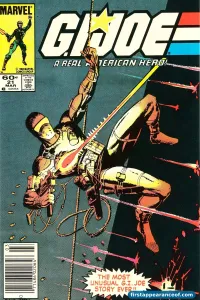
First Appearance: G.I. Joe: A Real American Hero #21
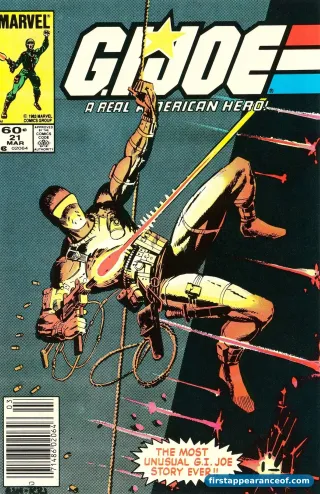
G.I. Joe: A Real American Hero #21 is cover-dated March 1984, with story and breakdowns by Larry Hama and finishes by Steve Leialoha. Its title is Silent Interlude, and it runs a complete story with no dialogue, no captions and no sound effects.
Hama has described the ambition without much ceremony: he wanted to see whether he could do a real, complete story, beginning, middle, end, conflict, characterization, action, solid resolution, without balloons or captions or sound effects. He then did it inside a monthly licensed Copper Age toy comic rather than in a prestige book where nobody would have been surprised.
The story is a rescue. Storm Shadow captures Scarlett; Snake Eyes goes into Trans-Carpathia after her and fights Storm Shadow for the first time since he left the Arashikage clan. As action it works on its own. The last page shows both men carrying the same Arashikage tattoo, an I Ching hexagram named ji ji. Nothing is said about it, because nothing is said about anything. The reader is handed a relationship and left to work out what it means.
That page also set the series’ direction. Issues #26 and #27 doubled back to explain it: the two men served in the same long-range reconnaissance unit in Vietnam, Snake Eyes was invited to train with Storm Shadow’s family after his own were killed, he surpassed Storm Shadow, and the Hard Master named him as successor. Then the Hard Master died, killed by an arrow that was genuinely Storm Shadow’s, and Storm Shadow was condemned by a clan that had no other suspect. He joined Cobra to find the real killer, a motive #21 gives no hint of.
Readers did not like the issue at the time. Hama has said it drew lots of negative mail from people who felt cheated by a comic with no words, one they could finish too quickly. That verdict did not hold. Hasbro reprinted #21 with new cover art for the line’s 25th anniversary, packed with a Snake Eyes and Storm Shadow two-pack; it got a 30th Anniversary Edition in 2014; and Image reprinted it again in 2025 in a Silent Missions line.
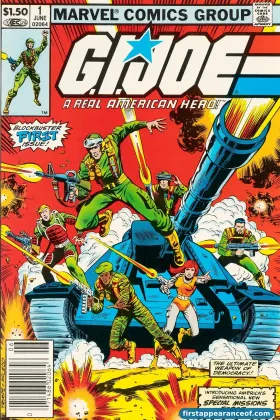
For collectors #21 is the run’s second key issue after the debut, and it carries a scarcity story #1 does not. A newsstand copy is identifiable by the bar-code box on the cover. The scarce version is the 75-cent Canadian price variant, distributed mainly to Canadian newsstands. As of the September 2021 CGC census there were 51 price-variant copies on record against 1,778 regular copies, a census rarity of about 2.8 percent. #1 has no such variant: it is cover-dated June 1982, and Marvel’s cover-price-variant window ran October 1982 to August 1986, so on this series the variants start at #4.
The figure followed in 1984 as a Cobra Ninja. He switched to the Joe side with his second figure in 1988, took a Ninja Force version in 1992 and a Shadow Ninjas repaint in 1994, then returned to Cobra in 2000. The toys roughly followed his route through print.