First Appearance

First Appearance of Snake Eyes

G.I. Joe: A Real American Hero #1 (1982). A soldier with no name, no face and no voice, in a comic that had to make readers care about him anyway.

By Atomm Updated

Cover coming soon
1982Key Issue
1st Appearance
Snake Eyes
G.I. Joe: A Real American Hero#1 Marvel

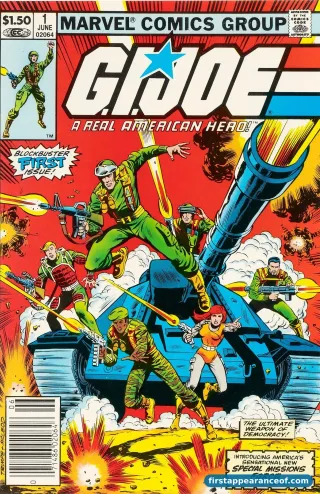
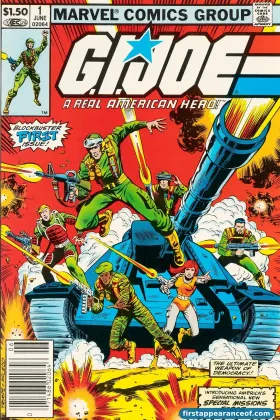
The first appearance (1st app) of Snake Eyes is G.I. Joe: A Real American Hero #1, cover-dated June 1982 and on sale March 2, 1982, written by Larry Hama with pencils by Herb Trimpe and inks by Bob McLeod for Marvel. Hasbro shipped his action figure in 1982 as well, but every source dates that figure to the year alone, with no month, so the comic is the debut carrying a date. #21, Silent Interlude, cover-dated March 1984, is the issue collectors pair with the debut.

Quick Facts

Debut
G.I. Joe: A Real American Hero #1 (June 1982), on sale March 2, 1982
Real name
Classified on every file card
Creators
Larry Hama (writer), Herb Trimpe (pencils), Bob McLeod (inks). Hasbro designed the 1982 figure.
Publisher
Marvel Comics
First ally
Scarlett and Rock 'n Roll, his partners in the debut issue's backup story
Team affiliations
G.I. Joe Team

Firsts Timeline

  1. Toy Debut 1982

    Snake Eyes (Commando), Hasbro 1982

    By Hasbro

    One of the original sixteen straight-arm figures of 1982, molded in black plastic with no painted detail. The file card printed his name and birthplace as classified. Sources date the figure to the year only, so the comic carries the dated debut.

    Read the full breakdown
  2. First Appearance June 1982

    G.I. Joe: A Real American Hero #1

    By Larry Hama, Herb Trimpe

    A 46-page first issue on sale March 2, 1982. Inks by Bob McLeod. Snake Eyes works the backup story, Hot Potato, with Scarlett and Rock 'n Roll.

    Read the full breakdown

Creation Story

Snake Eyes exists because black plastic is cheap.

That is the unglamorous root of one of the most popular characters G.I. Joe ever produced. Hasbro was building sixteen figures for its 1982 relaunch, and this one was designed to save money on paint application: molded in black plastic with no painted detail at all, and given a masked head that needed no detail sculpted into it either. He shared many of his parts with other 1982 figures. Only the head sculpt was his own.

The decision left Hama with a blank. Every other Joe arrived with a biography printed on the back of the card, because Hama wrote the line’s file cards through roughly its first decade and treated each one as a service record. Snake Eyes arrived with a service record that refused to answer. File name classified. Birthplace classified. Service number classified. The omissions became the character.

Hama then wrote the comic as though the blank were the point. He gave Snake Eyes no dialogue, and built the two things every reader remembers around that silence: a face wrecked in a helicopter explosion on an early mission, with vocal cords surgery could not repair, and a past in a Japanese ninja clan he entered through the man who would become his enemy. A mold designed to cut a paint step became the one Joe with something to find out.

The figure and the issue belong to the same year, and the design came before the script.

Toy Debut: Snake Eyes (Commando), Hasbro 1982

Snake Eyes was one of the original sixteen figures in the 1982 G.I. Joe: A Real American Hero line, sold at 3.75-inch scale under the retail name Snake Eyes (Commando). All sixteen shipped with straight arms; the same figure returned in 1983 with the swivel-arm battle grip. His 1982 file card listed him at grade E-5, primary specialty infantry, secondary specialty hand-to-hand combat instructor, with file name and birthplace printed as classified.

Hasbro kept the mold in rotation: a second version in 1985 packaged with his wolf Timber, a third in 1989, a fourth in 1991, then Ninja Force in 1993 and Shadow Ninjas in 1994.

Every source puts the first figure in 1982 and stops there, with no month. He was designed as a figure before he was written as a character; the comic leads the answer because it is the artifact with a date on it. The G.I. Joe hub sets out that rule.

First Appearance: G.I. Joe: A Real American Hero #1

G.I. Joe: A Real American Hero #1 carries a June 1982 cover date and went on sale March 2, 1982. It is a 46-page issue, written by Larry Hama, pencilled by Herb Trimpe and inked by Bob McLeod, and it runs two stories rather than one. The lead is Operation: Lady Doomsday. The backup is Hot Potato, in which Scarlett, Snake Eyes and Rock ‘n Roll are sent to get a tape out of Colonel Sharif’s emirate.

The book is a debut issue several times over. Breaker, Clutch, Flash, Grand Slam, Grunt, Hawk, Rock ‘n Roll, Scarlett, Snake Eyes, Stalker and Short-Fuse all make their first appearances in this issue, and so do Cobra Commander and the Baroness. That density is what a licensed launch looks like when the roster has already been designed in plastic: a whole unit and its enemy arrive in one book, because a whole unit and its enemy were about to arrive on the shelf.

For a collector the practical detail is what #1 is not. There is no Canadian 75-cent price variant of this issue. The Marvel cover-price-variant window opened in October 1982, months after this cover date, so the price variants on this series begin at issue #4 and run to #50. A newsstand printing of #1 exists and gets tracked separately, but in 1982 newsstand distribution was still the ordinary channel rather than the scarce one, so the split does not carry the premium it carries on later issues of the run.

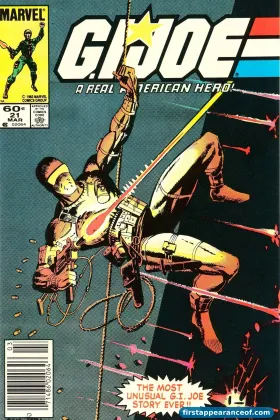
Issue #21 did what #1 did not. Silent Interlude, cover-dated March 1984, is a complete story with no dialogue and no sound effects, and it introduces Storm Shadow as the man Snake Eyes has to get past. Hama described the ambition plainly: a real, complete story with beginning, middle, end, conflict, characterization, action and solid resolution, without balloons or captions or sound effects. The last page reveals that both men carry the same Arashikage tattoo. That single panel gave Snake Eyes a history, and #21 is the issue collectors chase alongside the debut.
Key subsequent appearances

After the debut, these are the issues collectors and historians reach for next.

  1. 1984

    G.I. Joe: A Real American Hero #21

    SILENT INTERLUDE

    First appearance of Storm Shadow, in a full issue told with no dialogue and no sound effects.

    Newsstand variant

    Larry Hama wrote and laid out a complete Snake Eyes rescue with no balloons, no captions and no sound effects, and Steve Leialoha finished it. Snake Eyes goes into Trans-Carpathia after Scarlett and fights Storm Shadow for the first time since he left the Arashikage clan. The last page shows the two men carrying the same clan tattoo, which turns a silent action issue into the hinge of both characters' histories. Readers did not take to it at first. Hama has said the issue drew lots of negative mail from people who felt cheated by a comic they could finish too quickly.

  2. 1984

    G.I. Joe: A Real American Hero #26

    Snake-Eyes: The Origin, Part I. The series stops to explain the man in the mask.

  3. 1984

    G.I. Joe: A Real American Hero #27

    Part II, cover-dated September 1984. Zartan kills the Hard Master with an arrow stolen from Storm Shadow, and the Arashikage clan comes apart.

  4. 1986

    G.I. Joe: A Real American Hero #45

    In Search of Candy. Zartan is exposed as the Hard Master's killer, and Storm Shadow leaves Cobra to fight alongside Snake Eyes.

  5. 1994

    G.I. Joe: A Real American Hero #150

    Snake Eyes beats an armored Cobra Commander, who answers by capturing Storm Shadow and brainwashing him back to Cobra.

  6. 1994

    G.I. Joe: A Real American Hero #155

    The last issue of the Marvel run. Snake Eyes and Scarlett are still on the roster when the team disbands.

In adaptations

Film, TV, animation, and game appearances.

  1. 1983

    G.I. Joe: A Real American Hero (The M.A.S.S. Device)

    Animated

    Sunbow and Marvel Productions ran a five-part miniseries from September 12 to 16, 1983. Snake Eyes appears in his original uniform and, as in print, says nothing. Frank Welker supplied the vocal effects for his wolf, Timber.

  2. 2009

    G.I. Joe: The Rise of Cobra

    Film

    Starring:Ray Park

    An early Stuart Beattie draft gave Snake Eyes a spoken gag. Larry Hama talked him out of it, and the character stayed silent on screen.

  3. 2009

    G.I. Joe: Resolute

    Animated

    This continuity explains the silence differently: Zartan shoots Snake Eyes in the throat to stop him warning their master.

  4. 2013

    G.I. Joe: Retaliation

    Film

    Starring:Ray Park

    Zartan frames Snake Eyes for an assassination. Working the case turns up proof that Storm Shadow was framed too, and the sword brothers end the film on the same side.

  5. 2021

    Snake Eyes: G.I. Joe Origins

    Film

    Starring:Henry Golding

    A solo film set in an alternate continuity. Paramount announced it in May 2018 and cast Golding in August 2019.

Frequently asked questions

The questions readers and collectors ask most.

What is the first appearance of Snake Eyes?

G.I. Joe: A Real American Hero #1, cover-dated June 1982 and on sale March 2, 1982, written by Larry Hama with pencils by Herb Trimpe and inks by Bob McLeod. His Hasbro figure shipped in the same 1982 launch, but sources date that figure to the year rather than to a day, so the comic is the debut with a date on it.

Did the Snake Eyes toy come before the comic?

He was a Hasbro design before he was a Marvel character, and the figure and the comic both arrived in 1982. Neither one can be put ahead of the other on the evidence, because the figure is dated to the year and the comic to March 2. This archive gives the first-appearance line to the comic, the artifact that carries a date.

Why does Snake Eyes not talk?

In the comics his face was disfigured in a helicopter explosion on an early G.I. Joe mission, and surgery could not repair his vocal cords. The mask came first for a duller reason: Hasbro molded the figure in black plastic with no paint, and a covered face needed no detail sculpted into it. G.I. Joe: Resolute gives a different answer, with Zartan shooting him in the throat.

What is Snake Eyes' real name?

There is not one. His file name, birthplace and service number are printed as classified on the 1982 file card and have stayed classified across every continuity since. The 1982 card lists him at grade E-5, infantry, with hand-to-hand combat instructor as his secondary specialty.

Are Snake Eyes and Storm Shadow brothers?

Not by blood. They served together in a long-range reconnaissance unit in Vietnam, and Snake Eyes later trained with Storm Shadow's family, the Arashikage. The comics call them sword brothers. They were also rivals for the favor of Storm Shadow's uncle, the Hard Master, and that rivalry is what the fight in issue #21 is about.