Creation Story
The first wave of Joes were figures being designed before they were characters. Readers met Cobra Commander first.
Larry Hama is credited with creating him, in a 1998 interview where Hama described the character as “being in love with the sound of his own voice” and named the conservative pundit William F. Buckley as the model he had in mind. That brief produces a villain who talks, who performs, who recruits, and who is at his most dangerous in a room rather than on a battlefield. Cobra Commander got a speaking voice before he got a shelf.
Hama was also writing the file cards on the back of the packaging for roughly the first ten years of the line, drawing on his own military service, so the same person defining Cobra Commander on the page was defining every soldier sent to fight him. The comic and the toy aisle were speaking with one voice because they had one author.
The consequence shows up in the origin. Hama eventually gave Cobra Commander a civilian past: a used car lot, a brother who came back from Vietnam wrong, a family destroyed in a car crash, a grudge nursed into a private army. A man who blamed the wrong person and never stopped.
The cartoon rejected all of it. Marvel had a hand in the Sunbow series through Marvel Productions, and the 1987 animated film still went its own way, making him a nobleman of a pre-human civilization called Cobra-La who was disfigured by laboratory spores. Both versions are official, and the split is the honest answer to where Cobra Commander came from.
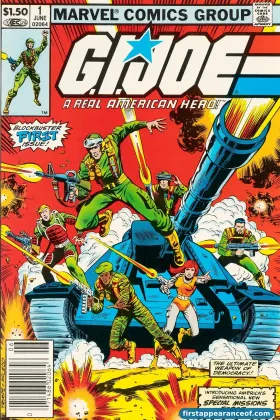
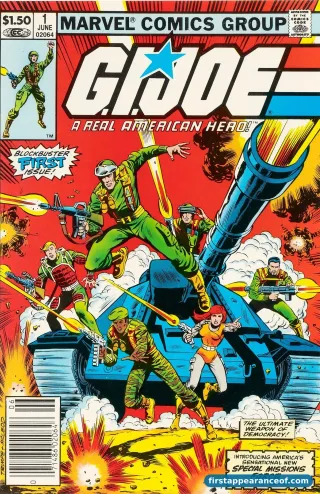
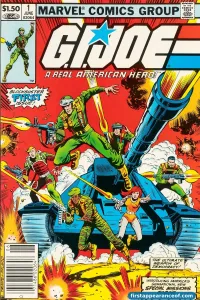
First Appearance: G.I. Joe: A Real American Hero #1
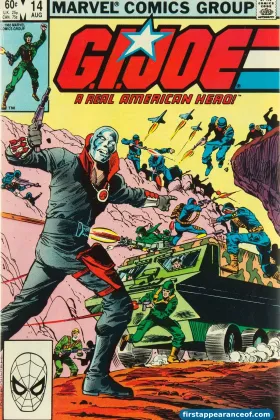
The issue is cover-dated June 1982 and went on sale March 2 of that year, the first of the 155 Marvel issues that make up the original run. Larry Hama wrote both stories in it. The lead, “Operation: Lady Doomsday,” is pencilled by Herb Trimpe and inked by Bob McLeod, with letters by Jim Novak and colors by Glynis Wein. The backup, “Hot Potato,” is drawn by Don Perlin. Trimpe and McLeod did the cover, and Tom DeFalco edited.
The plot is a rescue. Cobra grabs a nuclear physicist, Dr. Burkhart, off a train, and the Joes assault the Cobra fortress to get her back.
The scene that introduces Cobra Commander sets the pattern for the next twelve years. He has Snake Eyes and Scarlett in front of him and a gun in his hand. The real Dr. Burkhart, the hostage, throws herself in front of the shot. The rest of the team comes through the door. He escapes with the Baroness, and the base explodes behind them.
He does not fight at all: he points a weapon, fails to use it on the person he meant to, and leaves through the back. That is the character in one gesture: the leader who is always in the room and never in the wreckage.
Three other first appearances sit in the same issue. The Baroness is there beside him, already his partner rather than his subordinate. Snake Eyes and Scarlett, the two people at the wrong end of his gun, both start here as well. So does the pairing that carries the whole run: the man who ordered a killing years earlier and the soldier who was supposed to be the victim, standing in the same room, neither of them knowing it yet. Hama would not reveal that connection until issue #26 in 1984, and when he did, it turned the debut scene into a near miss nobody noticed at the time.
In 1982 Cobra Commander was not on a card in shops. He was not one of the sixteen figures Hasbro released that year. He was a mail-away: five Flag Points cut from toy packaging plus fifty cents, ordered through Hasbro Direct. A child had to buy other figures, cut up the packaging, and wait for the post to own the villain. The carded version with swivel-arm battle grip came in 1983, and a hooded mail-away followed in 1984.
For most of the G.I. Joe roster, the figure and its file card reached a child before the comic did. Cobra Commander is the case that runs the other way: Joepedia dates the mail-in offer to later in 1982, after the comic was already on sale.
This is the anchor of the run and the start of a Bronze Age licensed series: 155 issues, and it outlasted the toy line it was built to sell.