Creation Story
Cobra runs on true believers. Destro is the man who invoices them.
That distinction is written into the character at the source. Larry Hama’s file card for the 1983 figure makes him the head of M.A.R.S., the Military Armament Research Syndicate, a state-of-the-art weapons manufacturer that has been in his family for centuries. War is the business. He hires mercenaries to start conflicts in unstable regions, then sells to whoever can pay, and the card is explicit that he will sell to both sides of the same war because the first Destro did. He is a supplier with a customer, and the customer happens to be a terrorist organization.
The mask follows the same logic. An ancestor was caught by Cromwell’s men selling weapons to both sides during the Wars of the Three Kingdoms, and neither side would execute him because both still wanted his guns, so they sentenced him to wear a steel mask instead. Twenty-odd generations later his descendants still wear it, in beryllium steel, having converted a punishment for profiteering into an inheritance. The mask says: we did this, we would do it again, and you needed us.
Unlike Cobra Commander, Destro carries no creator credit on record. Hama wrote the 1983 file card and both debut issues. The comic keeps his name and face off the page, introducing him as the specialist Cobra Commander hires when his own people cannot finish the job.
First Appearance, Face Unseen: G.I. Joe: A Real American Hero #11
“The Pipeline Ploy” is cover-dated May 1983, the eleventh issue of Marvel’s Hasbro-licensed series. Larry Hama wrote it, Mike Vosburg pencilled it, Jon D’Agostino inked it, Rick Parker lettered it and Christie Scheele colored it. It is a busy issue that also introduces Gung-Ho, Doc, Snow Job, Airborne and Wild Bill, which is part of why the Destro material reads as a background thread on a first pass.
The plot runs along the Alaskan pipeline. Cobra Commander sends a specialist in to take over the battle there, and the Joes spend the issue chasing him for an antidote he has already taken.
He is never shown properly. His face stays off-panel, he is not named, and the story treats him as a capability rather than a person: the one Cobra can call when Cobra Commander’s own people are losing. That is a deliberate choice and it holds up, because the character’s whole premise is that he is external, hired by Cobra rather than enlisted in it.
For a collector this is the earliest printed appearance of Destro in any form, and it is the reason a Destro first-appearance checklist has two entries instead of one. The issue before it is not a third. #10 is “A Nice Little Town Like Ours..!”, cover-dated April 1983, and it carries the first Dr. Venom and the first flashbacks to Snake Eyes’ ninja training. Destro is not in it.
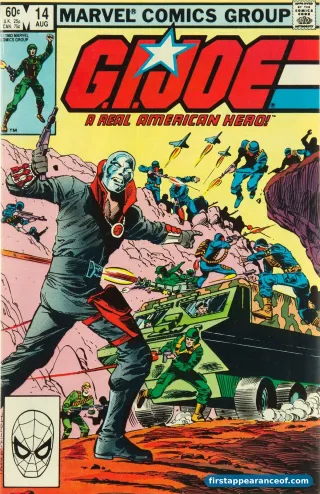
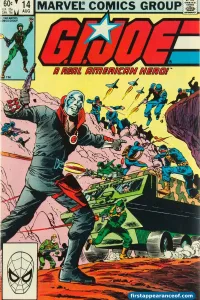
First Full Appearance: G.I. Joe: A Real American Hero #14
“Destro Attacks!” is cover-dated August 1983, three issues and three months after the cameo. Hama wrote it, Vosburg pencilled it, D’Agostino inked it, Joe Rosen lettered it and Christie Scheele colored it. Sellers list this issue as the first appearance of Destro, and for the market that label is the one that matters.
The issue is where he becomes a character. He learns the Baroness is flying Cobra Commander into Springfield, assembles a Cobra airborne unit on his own initiative, parachutes in two miles outside the town, runs five miles, and shoots anyone in his squad who falls behind. Then he intercepts the Joes.
The story finally names and shows him, then reveals what he wants: Cobra Commander removed, Destro in charge, and the Baroness beside him. The hired contractor has been a competitor all along.
Cobra Commander works this out fast. He hires Major Bludd to kill Destro, a night operation in Washington sets it up, and the Baroness realizes what is happening while driving Bludd’s HISS tank and swerves and overturns it. She appears to die in the crash. The plot to kill Destro costs Cobra Commander the Baroness instead.
The Springfield ambush also sets the alliance-of-convenience shape that the rest of the run keeps re-testing. Destro will save Cobra Commander’s son from an assassination he had every reason to allow, take command when the Commander is captured, walk out of Cobra entirely, and come back with a private army called the Iron Grenadiers. All of it is legible from this issue, where the man in the mask decides he is worth more than his client.
G.I. Joe #11 vs G.I. Joe #14
The compact reference for the split:
| G.I. Joe #11 | G.I. Joe #14 | |
|---|---|---|
| Cover date | May 1983 | August 1983 |
| Story | ”The Pipeline Ploy" | "Destro Attacks!” |
| Appearance type | First appearance, face not shown | First full appearance |
| Named in the issue? | No, “the specialist” | Yes, with his own agenda |
| Role | Contractor sent to salvage a failing Cobra operation | Rival planning to replace Cobra Commander |
| Also in the issue | First Gung-Ho, Doc, Snow Job, Airborne, Wild Bill | Springfield ambush, the airborne drop, the naming reveal |
| How listings describe it | ”The mysterious new enemy Destro" | "First appearance of Destro” |
A reader chasing absolute chronology wants #11, the earliest printed page Destro exists on. The market settled on #14 because that is where Destro gets a face, a name and an agenda. Buyers who want the argument closed acquire both, the same practical answer collectors reached for Wolverine.
One question this split does not settle is the toy. Destro was released as an action figure in 1983, in the second series of Hasbro’s 3.75-inch line, the same year as both comics, and no published date for it is finer than the year. For much of the G.I. Joe roster the figure and its file card came first, with a dated debut of their own. Destro is the case where the evidence runs out. The two comics are dated to the month. The figure, silver vacuum-metalized head and all, is dated to the year, and that is the only Bronze Age date it has.