First Appearance

First Appearance of Flint

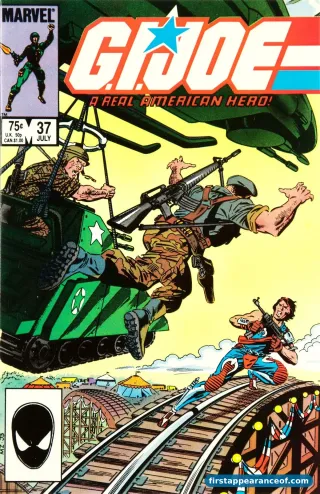
G.I. Joe: A Real American Hero #37 (1985). A warrant officer who plans the mission, flies the helicopter, and does most of the talking until Lady Jaye stops him.

By Atomm Updated

Cover coming soon
1985Key Issue
1st Comics Appearance
Flint
G.I. Joe: A Real American Hero#37 Marvel

Flint's first appearance (1st app) is the animated miniseries G.I. Joe: The Revenge of Cobra, which ran across five weekdays from September 10 to 14, 1984, written by Ron Friedman for Sunbow and Marvel Productions. He was created for the cartoon. His first comics appearance is G.I. Joe: A Real American Hero #37 (July 1985), "Twin Brothers!", written by Larry Hama with pencils by Frank Springer, the issue that also introduces Footloose and the Cobra twins Tomax and Xamot.

Quick Facts

Debut
G.I. Joe: The Revenge of Cobra (September 1984); first comic G.I. Joe #37 (July 1985)
Real name
Dashiell R. Faireborn
Creators
Ron Friedman (wrote the miniseries he was created for), Larry Hama and Frank Springer (comics debut)
Publisher
Marvel Comics for the first comics appearance
First enemy
Tomax and Xamot, who capture him in his comics debut
First ally
Footloose, taken in the same ambush
Team affiliations
G.I. Joe Team

Firsts Timeline

  1. Animated Debut September 1984

    G.I. Joe: The Revenge of Cobra

    By Ron Friedman

    Flint's first appearance anywhere. The second Sunbow and Marvel Productions miniseries ran across five weekdays, September 10 to 14, 1984, written by Ron Friedman. Flint was created for the cartoon.

    Read the full breakdown
  2. First Comics Appearance July 1985

    G.I. Joe: A Real American Hero #37

    By Larry Hama, Frank Springer

    "Twin Brothers!" also carries the first appearances of Footloose and of the Crimson Guard twins Tomax and Xamot, who capture Flint and Footloose using a travelling circus as cover.

    Read the full breakdown

Creation Story

The G.I. Joe machine ran on three production lines at once, and they did not stay in step. Hasbro made the figures, Sunbow made the cartoon, and Larry Hama wrote a war comic at Marvel that was under no obligation to introduce anybody in the order the other two did. Flint reached a television set first.

He was made for the cartoon, in 1984, and the sequence is why his file reads the way it does. Neither the comic nor the toy line invented him, so his details arrive already fixed by a television script: Dashiell R. Faireborn, from Wichita, Kansas, chief warrant officer, listed for infantry, helicopter piloting and tactical planning. His 1985 figure printed the rank as E-6, staff sergeant, which is an error on the card rather than a second version of the character.

The other thing that carries over from the cartoon is Lady Jaye, or more precisely the friction with her. The two resisted the attraction for years before admitting to it, and in the Devil’s Due run of 2001 to 2008 they marry once G.I. Joe disbands. A relationship the franchise kept coming back to for two decades began in a weekday serial made to sell plastic.

Animated Debut: G.I. Joe: The Revenge of Cobra

The Revenge of Cobra was the second G.I. Joe miniseries from Sunbow Productions and Marvel Productions, and it ran across five weekdays, September 10 to 14, 1984. Ron Friedman wrote it, as he had written the first miniseries the year before.

Flint began in this broadcast. Bill Ratner voiced him here and across the Sunbow run that followed; the comic and figure came later.

The broadcast gives Flint five air dates in September 1984, ten months before the comic most first-appearance lists name.

First Comics Appearance: G.I. Joe: A Real American Hero #37

G.I. Joe: A Real American Hero #37 is cover-dated July 1985. Larry Hama wrote it, Frank Springer pencilled it and Andy Mushynsky inked it. The story is “Twin Brothers!” Tomax and Xamot own the title and most of the collector attention.

That issue carries four first appearances. Flint and Footloose join the team in it. So do Tomax and Xamot, the identical Cobra twins, who set the plot going by using a travelling circus as cover to ambush and capture the two new Joes. Lady Jaye is already on the roster by this point, driving HISS tanks in a testing zone and cutting Flint’s bragging off at the knees.
In adaptations

Film, TV, animation, and game appearances.

  1. 1984

    G.I. Joe: The Revenge of Cobra

    Animated

    Starring:Bill Ratner

    This is where Flint originates, ahead of both the comic and the figure. Bill Ratner voiced him across the Sunbow run.

  2. 2013

    G.I. Joe: Retaliation

    Film

    Starring:D.J. Cotrona

    Cotrona plays Flint alongside Dwayne Johnson's Roadblock, 29 years after the character was written for a weekday cartoon.

Frequently asked questions

The questions readers and collectors ask most.

Which issue is Flint's first appearance?

In comics, G.I. Joe: A Real American Hero #37, cover-dated July 1985, by Larry Hama and Frank Springer. His first appearance in any medium came earlier: the Sunbow miniseries G.I. Joe: The Revenge of Cobra, which aired September 10 to 14, 1984.

Was Flint created for the comic or the cartoon?

The cartoon. He was originally created as a character for the Sunbow animated series in 1984, and his first televised appearance is The Revenge of Cobra. The comic and the action figure, released as part of series 4, both followed in 1985.

What is Flint's real name?

Dashiell R. Faireborn, born in Wichita, Kansas. He is a chief warrant officer whose listed specialties are infantry, helicopter piloting and tactical planning.

What is Flint and Lady Jaye's relationship?

A long stand-off that eventually gave way. The two resisted the attraction for years before admitting it, and in the Devil's Due run, published between 2001 and 2008, they marry after G.I. Joe disbands. She is already on the team when Flint arrives in issue #37.

Which G.I. Joe issue should collectors chase for Flint?

In comics there is only one: issue #37, which also carries the first appearances of Footloose, Tomax and Xamot. The Cobra twins are what most listings lead with, so Flint tends to travel as part of that book rather than as its headline.