Creation Story
Larry Hama said he could never get a handle on Duke, and he explained why in the flattest possible terms. Army convention gives the commanding officer the good-cop role and the first sergeant the bad-cop role. Duke, as first sergeant, never fit the bad-cop mould, so the character came to the writer with a job title and no friction to write against.
That is an unusual admission from the man who built everyone else in the line. Hama wrote the file cards for G.I. Joe’s first decade out of his own service, and the cards are where most Joes got their personalities: a specialty, a hometown, a service record, a reason to be in the room. Duke’s card is as thorough as any of them: Conrad S. Hauser out of St. Louis, airborne infantryman, artillery and small-arms armorer. The wider biography that grew up around him adds the languages, the Fort Benning and Special Language School training, and the years working with South Vietnamese tribesmen.
Then the cartoon took him. Sunbow’s series made Duke the field leader and second-in-command under Hawk, which is the version that stuck to the character in public memory and the version the live-action films inherited. In Hama’s book he is a competent officer inside a large ensemble, added to the roster after the war with Cobra was already running.
Duke became famous for a rank he mostly holds outside Hama’s comic.
Toy Debut: Duke (Hasbro mail-away figure)
Duke was one of the first mail-away figures Hasbro made for the G.I. Joe line, in 1983. He was not on a peg. His debut has no issue cover or store shelf attached to it; buyers ordered the figure through the mail. He was carded the following year as part of the line’s third series.
The mailer carried Duke’s first text: his name, hometown and airborne specialty. Hama wrote the line’s file cards through this period from his own military background, so the figure arrived with a service record. Unlike the tightly packed 1982 launch, Duke’s order is clean: the figure is his first appearance anywhere, and issue #22 is his first comics appearance.
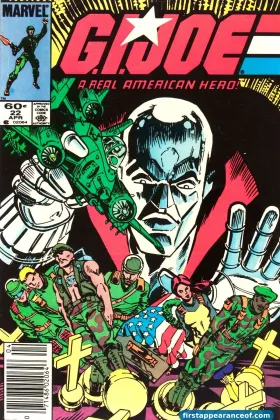
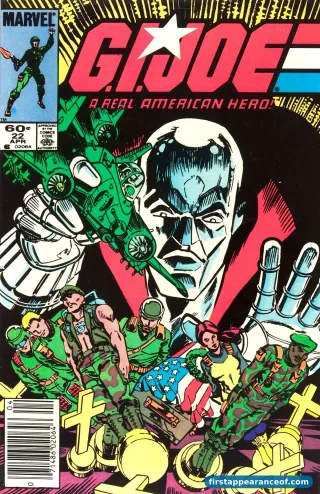
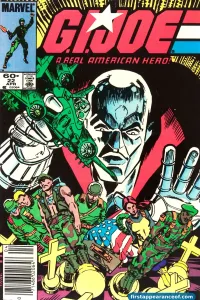
First Comics Appearance: G.I. Joe: A Real American Hero #22
G.I. Joe: A Real American Hero #22 is cover-dated April 1984. Larry Hama wrote it, Mike Vosburg pencilled it, Jon D’Agostino inked it, Klaus Janson pencilled the cover, and Dennis O’Neil edited. It carries the first appearances of Duke and Roadblock, both arriving in the same scene.
The scene is a funeral. General Flagg is being buried at Arlington National Cemetery, and Duke and Roadblock are working security. Cobra attacks the service with a Rattler. The two of them shoot the plane down before anyone at the graveside is hurt.
Duke’s first scene is a security detail at General Flagg’s graveside, with no command role attached to him yet. The unit that buried Flagg is the unit Duke is about to help command. He is added to the team as field commander after this, and the assignments follow: surveillance on the Baroness and Major Bludd in Switzerland, holding a mountain prison with Cobra Commander inside it, the assault on the Cobra-run town of Springfield, an assault team on Cobra Island that had to withdraw when the island was recognised as a sovereign state, and the Cobra civil war with Duke as Hawk’s second.
It is also where the comic starts diverging from the cartoon for good. Trucial Abysmia is the arc that settles it: bad intelligence, a captured squad, and four Joes dead, Doc and Heavy Metal and Thunder and Crankcase. Compare what happened on the animation side, where a 1987 film script that killed Duke was rewritten into a coma once Hasbro saw the reaction to Optimus Prime’s death.
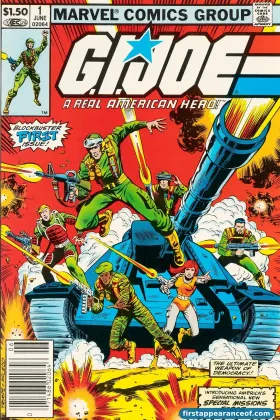
It is a double first appearance, and it belongs to two characters the screen has treated very differently from the page. Duke’s key issue is #22, in a run that launched at #1 without him.
Toy Debut vs Comics Debut: Which Is Duke's First?
The 1983 figure gave Duke a name, a hometown and a rank before he had a single panel. G.I. Joe: A Real American Hero #22 gave him a scene, a place in continuity and Roadblock beside him.
| Toy debut | Comics debut | |
|---|---|---|
| Date | 1983 | April 1984 cover date |
| Form | Mail-away figure with a printed file card | 22nd issue of the Marvel ongoing |
| Attribution | File cards written by Larry Hama through the line’s first decade | Larry Hama script, Mike Vosburg pencils |
| On a collectible cover? | Not applicable; the artifact is a figure, not an issue | Yes, on the issue Klaus Janson pencilled |
| What it establishes | The name, hometown, rank and service record | The character in continuity, and Roadblock alongside him |
The two Dukes drifted apart afterwards. His figure and cartoon made him the face of G.I. Joe; in the comic he arrived at #22, in the first year of the Copper Age, after the book had launched without him. Scarlett is the mirror image: founding roster, first issue, and a figure nobody can date ahead of it.