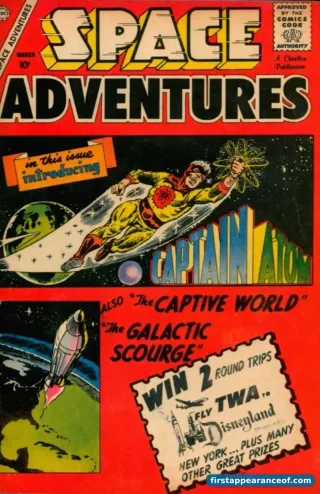
Space Adventures #33 (1960), the Charlton Comics issue that introduces Captain Atom.

1st Appearance

First Appearance of Captain Atom

Space Adventures #33

March 1960 · DC · Silver Age

Less a man with powers than a walking nuclear reaction that learned to wear a costume.

Key Issue

Created by Joe Gill · Steve Ditko

By Atomm Updated

The first appearance (1st app) of Captain Atom is Space Adventures #33 (March 1960), a Charlton Comics story by writer Joe Gill and artist Steve Ditko. He is Captain Allen Adam, a U.S. Air Force officer atomized in a rocket explosion who reforms with control over atomic energy. DC acquired the Charlton heroes in 1983 and relaunched him in 1987 as Nathaniel Adam, a metal-skinned soldier powered by the Quantum Field. Captain Atom was also the model for Doctor Manhattan in Watchmen.

Quick Facts

Debut
Space Adventures #33 (March 1960)
Real name
Allen Adam (Charlton); Nathaniel Christopher Adam (DC)
Creators
Joe Gill (writer), Steve Ditko (artist)
Publisher
Charlton Comics, later DC Comics
Team affiliations
The Charlton Action Heroes; Justice League International

Firsts Timeline

  1. Space Adventures #33 cover
    First Appearance March 1960

    Space Adventures #33

    By Joe Gill, Steve Ditko

    Captain Atom debuts in a Charlton Comics story by writer Joe Gill and artist Steve Ditko. Captain Allen Adam, a U.S. Air Force officer, is atomized in a rocket explosion and reforms able to control atomic energy.

    Read the full breakdown
  2. First in DC Continuity March 1987

    Captain Atom #1

    By Cary Bates, Greg Weisman, Pat Broderick

    After DC bought the Charlton heroes in 1983, this 1987 series was his first sustained run in DC continuity. Writers Cary Bates and Greg Weisman with artist Pat Broderick recast him as Nathaniel Adam, a soldier sheathed in alien metal and powered by the Quantum Field.

    Read the full breakdown

Creation Story

Captain Atom is one of the few comic heroes outshined by his own copy. The glowing blue god most people can picture is Doctor Manhattan, the centerpiece of Watchmen, and Doctor Manhattan exists because Captain Atom did first. That is the strange shape of his career: the most powerful character in a small 1960s superhero line, now best known through the character built to take him apart.

The original is a pure product of the atomic age. Writer Joe Gill and artist Steve Ditko made him for Charlton in 1960, and the premise is right there in the name. Captain Allen Adam, an Air Force officer, is caught in an experimental rocket when it explodes high in the atmosphere. He is vaporized down to his atoms and then, impossibly, pulls himself back together, now able to channel nuclear energy. Where most heroes are people who gain a power, Captain Atom is closer to a man who becomes one: a walking reactor in a red-and-yellow suit, built when the bomb was the thing everyone was afraid of.

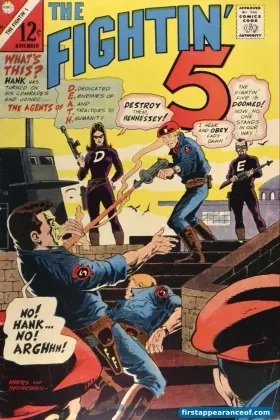
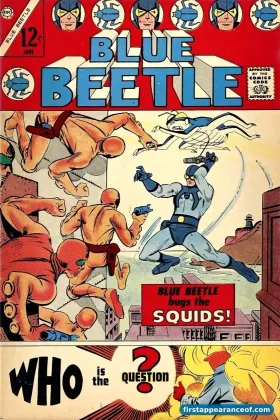
Charlton ran a small superhero line in the 1960s, later called the Action Heroes, that never sold like Marvel’s or DC’s. Captain Atom was its heaviest hitter, alongside the Question, Blue Beetle, Nightshade, and Peacemaker. Ditko drew the feature, which is part of why these obscure books are collected at all. When Charlton’s comics line collapsed, DC bought the characters in 1983 and began folding them into its universe.

The buyout is also how Captain Atom became the most influential character almost nobody outside comics can name. DC handed the new acquisitions to Alan Moore, whose pitch would have left them dead or unusable, so the publisher had him build original stand-ins instead. The result was Watchmen. Doctor Manhattan is the figure Moore shaped from Captain Atom, the detached, near-omnipotent man of energy who drifts away from his own humanity. The deconstruction landed so hard that it now reads back onto the source: the modern Captain Atom is written as the question Doctor Manhattan asked first.

First Appearance: Space Adventures #33

The first appearance (1st app) of Captain Atom is Space Adventures #33, cover-dated March 1960, a Charlton Comics story by Joe Gill and Steve Ditko. The few pages do exactly what a debut needs: they establish Captain Allen Adam, the rocket accident that atomizes him, and the reconstruction that leaves him able to wield atomic energy. It is a tidy origin for the era, and a sharper concept than the small line around it usually managed.

As a collector book, Space Adventures #33 is an early Ditko key, and its interest tracks two things rather than scarcity. The first is the Ditko pedigree, the same draw that lifts the other Charlton Silver Age debuts. The second is the Watchmen lineage: once a reader knows Captain Atom is the seed of Doctor Manhattan, the obscure 1960 book becomes the origin point of one of the most acclaimed characters in the medium. For a first-appearance archive, it is a clean case of a debut whose value lives in what it later inspired.

First in DC Continuity: Captain Atom #1

Captain Atom’s first sustained run in DC’s own universe is Captain Atom #1, cover-dated March 1987, written by Cary Bates and Greg Weisman with art by Pat Broderick. DC had acquired the Charlton heroes in 1983, and this series is where the company rebuilt him from the ground up. The rocket pilot became Nathaniel Adam, an Air Force officer used in a secret military experiment that bonds an alien metal to his body in an atomic blast. The metal gives him a metallic skin and access to the Quantum Field, the energy source behind his powers.

The DC version is darker and more militarized than the Charlton original, a soldier whose power comes from a weapons program rather than a lone accident. That framing is part of why DC’s 1991 event Armageddon 2001 was built to unmask him as the future tyrant Monarch. The twist leaked before publication, the ending was rewritten to blame Hawk instead, and Captain Atom kept the odd distinction of being the villain a famous story intended but never delivered. The thread running through all of it, the soldier-weapon who might stop being a person, is the same idea Doctor Manhattan made famous, now written back into the character who started it.

For collectors

The collector story is clean. Space Adventures #33 (1960) is the single issue that matters, the first appearance, and an early Steve Ditko book on top of that. Everything after is a story key rather than a separate value play: the 1987 DC #1 marks the modern reinvention but is not scarce, and the Armageddon 2001 and WildStorm crossovers are continuity beats, not debuts. What moves the original is reputation, not print run. An overlooked atomic-age hero from a defunct publisher became a tracked Silver Age key once collectors followed the line from Ditko’s Captain Atom to Moore’s Doctor Manhattan.
Key subsequent appearances

After the debut, these are the issues collectors and historians reach for next.

  1. 1991

    Armageddon 2001

    The Monarch Twist

    DC's 1991 event built to the reveal that a beloved hero would become the tyrant Monarch, and Captain Atom was the intended answer. When the twist leaked before publication, DC changed the ending at the last minute and pinned Monarch on Hawk instead.

    The switch is one of the more infamous editorial scrambles of the era. Armageddon 2001 ran through DC's 1991 annuals toward a two-issue payoff, and Captain Atom, a government-made weapon in a hero's suit, was the natural candidate for the hero-turned-dictator. The leak forced a rewrite that many readers found unconvincing, since the story had been seeded for Captain Atom rather than for Hawk. It is a useful reminder that a character's published history and a character's intended history are not always the same book.

  2. 2005

    Captain Atom: Armageddon

    Crossover

    A WildStorm-set limited series that dropped Captain Atom into a different comics universe, testing how a being of near-limitless energy reads against a grittier line. It leaned directly on the idea, inherited from Doctor Manhattan, that a man who becomes a walking power source slowly stops thinking like a man.

In adaptations

Film, TV, animation, and game appearances.

  1. 2004

    Justice League Unlimited

    Animated

    Starring:Chris Cox

    The Nathaniel Adam version appears across the 2004 to 2006 series as a by-the-book military member of the expanded League, voiced first by George Eads and then by Chris Cox.

  2. 2009

    Superman/Batman: Public Enemies

    Film

    Starring:Xander Berkeley

    Xander Berkeley voices Captain Atom in this animated film, part of the roster pulled into the Luthor-administration storyline.

  3. 2010

    Young Justice

    Animated

    Starring:Michael T. Weiss

    Michael T. Weiss voices Captain Atom as a League leader and public face across the 2010 to 2022 series, one of the franchise's most prominent uses of the character.

Frequently asked questions

The questions readers and collectors ask most.

What is Captain Atom's first appearance?

Captain Atom's first appearance is Space Adventures #33 (March 1960), a Charlton Comics story by writer Joe Gill and artist Steve Ditko. He debuts as Captain Allen Adam, an Air Force officer atomized in a rocket explosion.

Is Captain Atom a Marvel or DC character?

Neither, originally. Captain Atom was created at Charlton Comics in 1960. DC Comics bought Charlton's superheroes in 1983 and relaunched him in 1987, which is why he reads as a DC character today.

Did Captain Atom inspire Doctor Manhattan?

Yes. Alan Moore first pitched Watchmen using the Charlton heroes DC had just acquired, but DC declined to let him use them, so Moore built original analogues instead. Doctor Manhattan is the godlike figure shaped from Captain Atom, which is why both are detached, near-omnipotent beings made of energy.

Is Captain Atom the same as Captain Marvel or Shazam?

No. Despite the shared 'Captain,' Captain Atom is the Charlton-and-DC atomic hero created by Gill and Ditko in 1960. Captain Marvel, now usually called Shazam, is a separate and older character who transforms by speaking a magic word.

Did Captain Atom become the villain Monarch?

Not in the published story. DC's 1991 event Armageddon 2001 was built to reveal Captain Atom as the future tyrant Monarch, but after the twist leaked the ending was rewritten to make Hawk the villain instead. Captain Atom was the intended Monarch, not the final one.