Creation Story
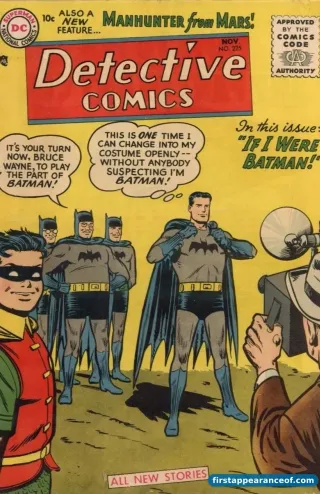
Martian Manhunter arrived quietly. There was no cover banner, no solo title, no fanfare. J’onn J’onzz first appears in a backup story called “The Manhunter from Mars,” tucked behind the lead Batman feature in Detective Comics #225 (November 1955). Writer Joseph Samachson and artist Joe Certa built him as a science-fiction detective hook rather than a costumed hero, which is why he spent his early years in plain clothes solving crimes as police detective John Jones.
The origin is a small tragedy. Dr. Saul Erdel switches on an experimental “robot brain” beam and accidentally pulls a living Martian across space to Earth. The contact kills Erdel, and J’onn is left stranded on a planet he never meant to visit, with no way home. Rather than reveal himself, he uses his shapeshifting to take a human face and a human job. The Manhunter from Mars is, at the start, a refugee hiding in a borrowed life. That note of displacement has stuck to the character for seventy years and is the thing every good version of him comes back to.
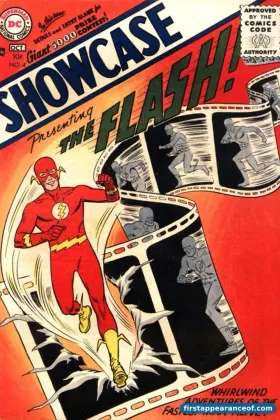
The timing matters more than the page count suggests. J’onn debuted in late 1955, about eleven months before Showcase #4 (October 1956) introduced the Barry Allen Flash and conventionally opened the Silver Age. He sits right on the seam. By the era boundaries this archive uses he is a late Golden Age debut, but plenty of historians call him the first Silver Age superhero, because he is the science-fiction-powered hero who showed up just before the wave that defined the next decade. Either way, he is one of the few characters who can fairly be claimed by both ages at once.
First Appearance: Detective Comics #225
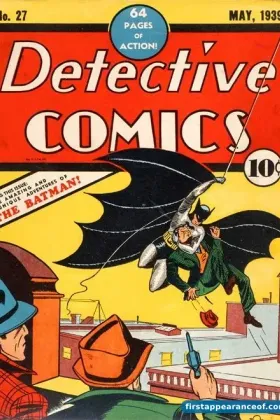
Detective Comics #225 is a Golden Age collector key that hides in plain sight, because the issue is remembered for its lead Batman story and its cover gives no hint that a new franchise character is being born in the back. The Martian Manhunter feature has no cover presence at all. That is part of what makes the book interesting: the first appearance of a future Justice League founder is a quiet interior debut, the kind collectors prize precisely because nobody flagged it at the time.
The story itself is brisk pulp. Samachson and Certa introduce the powers economically. By the end of those few pages J’onn is already established as more capable than any human detective, able to read minds, change shape, and move unseen, while choosing to work small cases under a false identity. The restraint is the point. A being who could level a city is, in his first outing, quietly catching a criminal in a fictional American town. High-grade copies of #225 are scarce, as with most mid-1950s DC books, and the issue has climbed in value as the character’s profile rose through animation and live action.
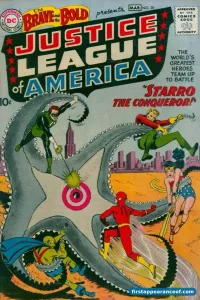
First Justice League Appearance: The Brave and the Bold #28
Five years after his backup-feature debut, J’onn J’onzz got the promotion that moved him from the back pages to DC’s top tier. The Brave and the Bold #28 (March 1960), by writer Gardner Fox and artist Mike Sekowsky, is the first appearance of the Justice League of America, and the Manhunter from Mars is one of the seven charter members. The team forms to stop Starro the Conqueror, a giant alien starfish, in one of the most-referenced debut issues in DC history.
The lineup is the headline. Superman, Batman, Wonder Woman, the Flash, Green Lantern, Aquaman, and Martian Manhunter found the League together. For J’onn it was a step up in class. A character who had been running backup stories now stood shoulder to shoulder with DC’s biggest names, and he never really left that company again. Across decades of relaunches he has been the League’s emotional center, the member who stays when others rotate out, which is why his removal from the founding roster in the 2011 New 52 reboot read to many longtime readers as a mistake worth correcting. His founding status has since been restored. The Brave and the Bold #28 carries the full weight of being the first Justice League book, and J’onn’s presence on that roster is the reason his 1955 debut issue is treated as a key rather than a curiosity.
For collectors
The Martian Manhunter’s value story is unusual because his two most important books are valued for different reasons. Detective Comics #225 is the personal first appearance, scarce in grade and quietly significant. The Brave and the Bold #28 is a shared key, valued for the entire Justice League rather than for J’onn alone, which means his founding role rides along on one of the most sought-after Silver Age team books. The character’s profile has tracked his screen presence: every wave of animation and live-action attention, from the Bruce Timm cartoons to Supergirl to the Snyder cut, has nudged interest in #225 upward. If you are tracing him through the first-appearance archive, the path runs from his 1955 debut to the 1960 League founding to the 1998 Ostrander and Mandrake solo run, which is where the character finally got the long-form treatment his debut never offered.