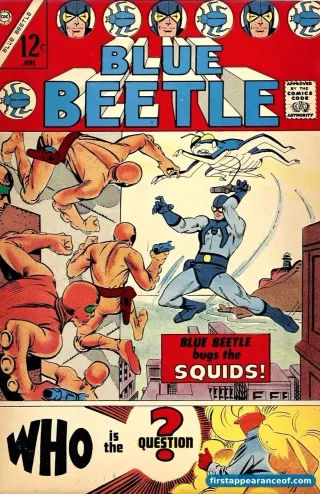
Blue Beetle #1 (1967), the Charlton Comics issue whose backup feature introduces the Question.

1st Appearance

First Appearance of The Question

Blue Beetle #1

June 1967 · DC · Silver Age

A crusading TV reporter who fights crime from behind a blank, featureless mask, and the Charlton hero who became the blueprint for Watchmen's Rorschach.

Key Issue

Created by Steve Ditko

By Atomm Updated

The first appearance (1st app) of the Question is Blue Beetle #1 (June 1967), a Charlton Comics backup feature created, written, and drawn by Steve Ditko. He is Vic Sage, an aggressive investigative television journalist who fights crime as a faceless vigilante. Charlton folded its superhero line later that year, and DC acquired the character in 1983. DC gave him his first solo title in 1987, the Dennis O'Neil and Denys Cowan run. Ditko's faceless objectivist also inspired Rorschach in Watchmen.

Quick Facts

Debut
Blue Beetle #1 (June 1967)
Real name
Vic Sage (Charles Victor Szasz)
Creators
Steve Ditko (writer-artist)
Publisher
Charlton Comics, later DC Comics
Team affiliations
The Charlton Action Heroes; the Justice League in Justice League Unlimited

Firsts Timeline

  1. Blue Beetle #1 cover
    First Appearance June 1967

    Blue Beetle #1

    By Steve Ditko

    The Question debuts in a short backup feature behind Ted Kord's Blue Beetle, created, written, and drawn by Steve Ditko. Vic Sage, an investigative TV journalist, becomes a faceless vigilante using a mask of artificial skin.

    Read the full breakdown
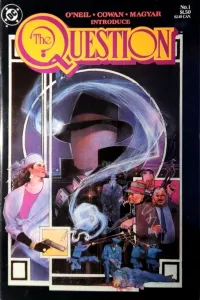
  2. The Question #1 cover
    First Solo Title February 1987

    The Question #1

    By Dennis O'Neil, Denys Cowan

    Charlton never gave the character his own book. His first solo title is DC's 1987 ongoing by Dennis O'Neil and Denys Cowan, which is also his first sustained run in DC continuity. It reinvented Vic Sage as a Zen-driven crime fighter in the corrupt Hub City.

    Read the full breakdown

Creation Story

Steve Ditko built the Question around one hard idea, then hid it behind a blank mask: a man so certain of right and wrong that he could act without a face, without doubt, and without apology. The public half was Vic Sage, a television reporter who went after the stories other journalists ducked. The masked half was the same conviction with the manners stripped off.

The facelessness was literal. Sage’s mask was a sheet of artificial skin called Pseudoderm, fixed in place by a gas from his belt buckle that also recolored his hair and clothes, so the reporter and the vigilante never read as the same man. The certainty underneath was Ditko’s own. He was channeling the Ayn Rand objectivism that ran through his work, and its most uncompromising form was Mr. A, the figure he made for the indie magazine Witzend around the same time. The Question was that idea filed down to clear the Comics Code, the absolutist softened just enough to run in a newsstand book.

Charlton ran a small superhero line in the mid-1960s, later called the Action Heroes, that never sold the way Marvel’s or DC’s books did. The Question was one of them, alongside Blue Beetle, Captain Atom, Nightshade, Judomaster, and Peacemaker. The line was short-lived, discontinued before 1967 was out, and the Question never got his own Charlton title. But the blank-faced reporter was durable enough to outlive the company that made him, and the objectivism Ditko packed into him became the very thing the O’Neil run would later invert.

The Charlton heroes left one more mark, on a book far more famous than anything they ever starred in. Alan Moore pitched Watchmen using the heroes DC had just acquired, but his story would have left several of them dead, so DC blocked the pitch and had him build original stand-ins instead. The result was Watchmen. Rorschach is the figure Moore shaped from the Question, which is why that character’s faceless mask and absolute, unbending morality read as the Question pushed to his breaking point.

First Appearance: Blue Beetle #1

The first appearance (1st app) of the Question is Blue Beetle #1, cover-dated June 1967, in a backup feature behind Ted Kord’s Blue Beetle in Charlton’s Silver Age superhero line. Steve Ditko created, wrote, and drew it, and the short strip does the work a debut needs: it establishes Vic Sage, the crusading-journalist identity, the faceless mask, and the hard-edged moral certainty that separates the Question from every other costumed hero on the rack.

As a collector book, Blue Beetle #1 carries a double significance, since the same issue launches Ted Kord’s version of Blue Beetle. For decades it was a cheap, overlooked Charlton comic that happened to contain two first appearances. Interest in it has grown for reasons that have nothing to do with print run: the Ditko pedigree, the direct line from the Question to Rorschach, and the screen exposure the Question eventually found. The value tracks that reputation rather than any scarcity built into the printing, the usual pattern for a character who spent years in obscurity. For a first-appearance archive, it shows how a backup feature from a defunct publisher becomes a sought-after key.

First Solo Title: The Question #1

The Question never headlined a book at Charlton, so his first solo title did not arrive until DC put him in one. The Question #1 reached stands in February 1987, written by Dennis O’Neil with art by Denys Cowan, and it is both his first starring series and his first sustained run in DC continuity. DC had bought the Charlton Action Heroes in 1983 and worked them into its universe through the mid-1980s, with the Question turning up briefly in Crisis on Infinite Earths before getting his own title.

The O’Neil and Cowan run is the version most modern stories draw on, and it reinvented the character hard. They opened with a near-death experience that sent Sage away to learn martial arts and Eastern philosophy, trading Ditko’s pure objectivism for a searching, Zen-tinged uncertainty. The setting was Hub City, a portrait of urban rot so complete it works as its own character, and the run leaned into moral ambiguity the Code-era Charlton strip could never have touched. It lasted 36 issues and two annuals, with inks by Rick Magyar and frequent covers by Cowan and Bill Sienkiewicz, and critics rank it among DC’s strongest sustained runs. Years later, during the 2006 to 2007 weekly series 52, a dying Sage trained the former Gotham detective Renee Montoya to take over the identity, passing the faceless mask to a new bearer who still carries it.

For collectors

The collector story is clean for a character with this much influence. Blue Beetle #1 (1967) is the single issue that matters, the first appearance, and it carries the bonus of launching Ted Kord’s Blue Beetle in the same book. Everything after it is a story key rather than a separate value play: the 1987 DC ongoing marks the reinvention and is not scarce, and the later Montoya stories are continuity milestones, not debut issues. What moves the original is reputation, not print run. A blank-faced backup feature that most readers skipped in 1967 became a wanted Silver Age key once collectors understood the line that runs from Ditko’s Question to Moore’s Rorschach. If you are tracing the Question, the path begins at that 1967 backup.
Key subsequent appearances

After the debut, these are the issues collectors and historians reach for next.

  1. 1985

    Crisis on Infinite Earths

    DCU Arrival

    After DC bought the Charlton heroes in 1983, the Question turned up briefly in the line-wide event, part of how DC folded its newly acquired Charlton heroes into the mainstream universe through the mid-1980s. It is the bridge between the obscure Charlton backup and the DC solo star who followed, not a single spotlight issue.

  2. 1987

    The Question #1 (1987)

    DC Reinvention

    Dennis O'Neil and Denys Cowan's ongoing recast Vic Sage as a Zen-influenced detective in Hub City. The run lasted 36 issues and two annuals and is the version most later stories build on.

    O'Neil and Cowan opened with a near-death experience that sent Sage away to learn martial arts and Eastern philosophy, then return to Hub City a changed man. The Hub City of the run is a portrait of urban decay so total it reads as its own character, and the book leaned into moral ambiguity in a way the Code-era Charlton strip never could. Inker Rick Magyar, colorist Tatjana Wood, and frequent covers by Cowan and Bill Sienkiewicz gave it a look unlike anything else on DC's stands. Critics rank it among DC's strongest sustained runs, and it is why a faceless backup feature from a defunct publisher became a character writers keep returning to.

  3. 2006

    52

    Mantle Passes

    Across DC's 2006 to 2007 weekly series, a dying Vic Sage trains former Gotham detective Renee Montoya to take over as the Question, the line's most prominent handoff of the identity to a new bearer.

In adaptations

Film, TV, animation, and game appearances.

  1. 2004

    Justice League Unlimited

    Animated

    Starring:Jeffrey Combs

    Jeffrey Combs voiced the Question across the 2004 to 2006 series as a twitchy conspiracy theorist whose distrust of the government agency Cadmus drives a major arc. He debuted in Fearful Symmetry (September 2004), the episode Question Authority (2005) is his showcase, and the performance is what gave the obscure character mainstream recognition.

  2. 2018

    Scooby-Doo! & Batman: The Brave and the Bold

    Animated

    Starring:Jeffrey Combs

    Combs returned to the role for this animated film, with the Question appearing as a member of the Mystery Analysts of Gotham. A nod to how strongly his Justice League Unlimited take stuck to the character.

  3. 2024

    Justice League: Crisis on Infinite Earths

    Animated

    Starring:David Kaye

    David Kaye voiced the Question in this animated adaptation of the Crisis event, where the character's fatalism gets a literal stage as realities collapse around the heroes.

Frequently asked questions

The questions readers and collectors ask most.

What is the Question's first appearance?

The Question's first appearance is Blue Beetle #1 (June 1967), a Charlton Comics backup feature created, written, and drawn by Steve Ditko. His real name is Vic Sage, an investigative television journalist.

Is the Question a Marvel or DC character?

Neither, originally. The Question was created at Charlton Comics in 1967. DC Comics bought Charlton's superheroes in 1983 and folded the Question into the DC Universe, which is why he reads as a DC character today.

Who created the Question?

Steve Ditko created the Question, writing and drawing his Charlton debut in 1967. Ditko built him as a Comics-Code-acceptable version of Mr. A, the uncompromising objectivist character he was making for the indie magazine Witzend, so the Question carries the same Ayn Rand influence.

Did the Question inspire Rorschach in Watchmen?

Yes. Alan Moore first pitched Watchmen using the Charlton heroes DC had just acquired, but the company blocked it after learning he meant to kill several of them. Moore built original analogues instead, and Rorschach is the one shaped from the Question, which is why both are faceless, absolutist investigators.

Who is the female Question, Renee Montoya?

Renee Montoya is the second Question. During DC's 2006 to 2007 weekly series 52, a dying Vic Sage trains the former Gotham detective to take up the identity, and she has carried it in DC continuity since.