Creation Story
Peacemaker is built on a contradiction his own motto refuses to hide: a man who loves peace so much that he is willing to fight for it. Joe Gill and Pat Boyette handed that paradox to Christopher Smith, a diplomat tied to international disarmament talks who answered the world’s trouble spots with a costume, high-tech gear, and a willingness to use force in the name of stopping it. It was a sharper idea than the second-string backup strip that carried it.
Charlton ran a small superhero line in the mid-1960s, later called the Action Heroes, that never sold the way Marvel’s or DC’s books did. Peacemaker was one of a handful of these characters, alongside Blue Beetle, Captain Atom, the Question, and Nightshade. He was promoted out of the backup slot fast, with Charlton giving him his own title within a year. The original run was short, but the character was durable enough to outlive the company that made him.
Those same Charlton heroes carried a second kind of significance. When DC handed the newly acquired characters to Alan Moore, his pitch reworked them so heavily that the publisher had him build original stand-ins instead, and the result was Watchmen. The Comedian is the figure Moore shaped from Peacemaker, which is why the cynical, flag-draped killer of that book rhymes so closely with the man who fights for peace.
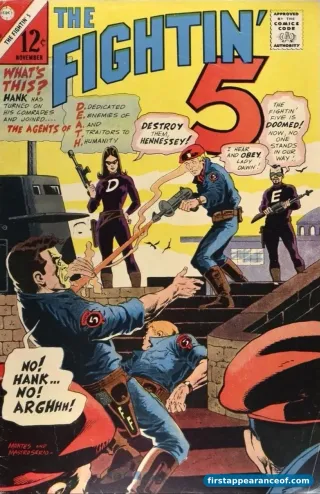
First Appearance: Fightin' Five #40
The first appearance (1st app) of Peacemaker is Fightin’ Five #40, cover-dated November 1966, in a backup story behind Charlton’s war-adventure title The Fightin’ Five. Joe Gill wrote it and Pat Boyette drew it, and the few pages do the work a debut needs to: they establish Christopher Smith, the diplomat identity, the costume, and the motto that explains why a peace envoy is throwing punches.
As a collector book, Fightin’ Five #40 is the one Peacemaker issue that matters, and its status is recent. For decades it was a cheap, overlooked Charlton war comic that happened to contain a first appearance. The 2021 film and the television series that followed changed that, turning a forgotten debut into a sought-after Silver Age key. The value tracks the adaptations rather than any scarcity built into the printing, which is the usual pattern for a character who spent fifty years in obscurity before a screen role found him. For a first-appearance archive, it is a clean example of how a single casting decision can reprice a debut.
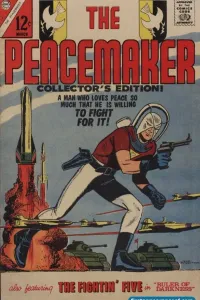
First Solo Title: The Peacemaker #1
Charlton moved Peacemaker into his own book quickly. The Peacemaker #1 arrived in 1967, again written by Joe Gill with art by Pat Boyette, and the series ran five issues across that year before folding. Getting promoted from a backup feature to a solo title inside a year was the most Charlton ever invested in him.
Five issues is a short life, and the title’s cancellation is part of why the character sat unused for so long. But the solo book is where the original concept got its fullest expression before DC inherited it. Collectors treat the early Charlton issues as a small, self-contained set, with the debut in Fightin’ Five #40 carrying the weight and the solo issues filling out the run.
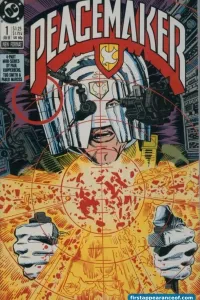
First in DC Continuity: Peacemaker #1
In 1983, DC Comics bought the rights to Charlton’s Action Heroes and began working them into its own universe, a process that ran through the company-wide Crisis on Infinite Earths event in the mid-1980s. Peacemaker’s first dedicated DC title came in 1988: a four-issue miniseries, also called Peacemaker #1 at its start, written by Paul Kupperberg with art by Tod Smith. It is the version most modern stories build on.
The DC take darkened the character. Where Gill and Boyette’s diplomat was a straightforward man of action, the 1988 miniseries gave him a troubled psychology and a haunting by his father, reframing the peace-through-force premise as something closer to unstable. That reading carried forward into later DC stories, including his ties to the black-ops team Task Force X, and it is the foundation James Gunn drew on for the screen version. The obscure Charlton hero and the volatile DC antihero are the same Christopher Smith, separated by a change of owner and a darker tone.
For collectors
The collector story is unusually clean for a character with this much history. Fightin’ Five #40 is the single issue that matters, the first appearance, and everything after it is a story key rather than a value play. The Charlton solo issues from 1967 form a tidy supporting set. The 1988 DC miniseries marks the modern reinvention but is not scarce. What moves the debut is screen exposure, not print run: a book that sat ignored for half a century became a wanted Silver Age key only after John Cena put on the helmet. If you are tracing Peacemaker, the path begins and ends at that 1966 backup story.