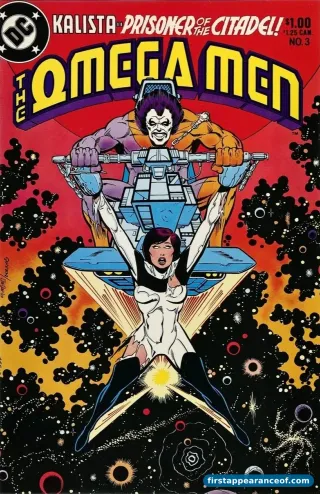
Omega Men #3 (1983). Lobo's first appearance, in his original purple-and-orange uniform.

1st Appearance

First Appearance of Lobo

Omega Men #3

June 1983 · DC · Copper Age

DC's biggest 1990s parody breakout. The 1983 cosmic-thug who became Keith Giffen and Simon Bisley's anti-hero answer to Wolverine, weaponized excess and all.

Key Issue

Created by Roger Slifer · Keith Giffen

By Atomm Updated

The first appearance (1st app) of Lobo is Omega Men #3 (June 1983), created by Roger Slifer (writer) and Keith Giffen (artist). The original Lobo is a B-tier serious cosmic antagonist in purple and orange. The modern parody-character version (the bastich-talking Easy-Rider-coded anti-hero) was introduced by Keith Giffen and Alan Grant in L.E.G.I.O.N. '89 #3 (April 1989). His first solo title is Lobo #1 (November 1990), a four-issue limited series by Giffen, Grant, and Simon Bisley that became one of DC's biggest 1990s breakout hits.

Quick Facts

Debut
Omega Men #3 (June 1983)
Real name
Lobo (his actual given name; means 'he who devours your entrails and thoroughly enjoys it' in Khundian)
Creators
Roger Slifer (writer, co-creator); Keith Giffen (artist, co-creator). Alan Grant and Simon Bisley defined the modern parody version.
Publisher
DC Comics
First enemy
Antagonist himself, mostly. The Heroes-vs-Lobo formula is occasionally inverted with Lobo as protagonist.
First ally
His pet space-dolphin, the Dawg. Various recurring associates from the L.E.G.I.O.N. and Justice League runs.
Team affiliations
L.E.G.I.O.N., Justice League (briefly), Section 8 (occasional)

Firsts Timeline

  1. Omega Men #3 cover
    First Appearance June 1983

    Omega Men #3

    By Roger Slifer, Keith Giffen

    Roger Slifer writes; Keith Giffen pencils. Lobo debuts as a serious cosmic-villain archetype with a purple-and-orange uniform, distinct from his later parody-character framework. Considered a B-tier antagonist for the first six years of his publishing life. Slifer is the writing co-creator; Giffen is the visual co-creator.

    Read the full breakdown
  2. First Modern Lobo (Parody Reframing) April 1989

    L.E.G.I.O.N. '89 #3

    By Keith Giffen, Alan Grant, Barry Kitson

    Lobo's modern parody-character reframing begins in the L.E.G.I.O.N. ongoing. Keith Giffen and Alan Grant write; Barry Kitson pencils. The Easy Rider-coded biker aesthetic, the bastich vocabulary, and the over-the-top violence-as-comedy register are introduced. The character would become DC's biggest 1990s breakout.

    Read the full breakdown
  3. First Self-Titled Series November 1990 Newsstand variant

    Lobo #1 (1990)

    By Keith Giffen, Alan Grant, Simon Bisley

    First Lobo self-titled limited series. Four-issue mini-series. Keith Giffen and Alan Grant write; Simon Bisley pencils. The Bisley art is iconic and helped establish Lobo as DC's anti-hero answer to Wolverine. Sold heavily; the series is widely regarded as the definitive Lobo work.

    Read the full breakdown

Creation Story

Lobo’s history splits into two distinct phases: the 1983 original and the 1989 reframing. The same character, two different frameworks.

Omega Men #3 (June 1983) introduces the original Lobo. Roger Slifer writes; Keith Giffen pencils. The character debuts in a purple-and-orange uniform as a serious B-tier cosmic-villain archetype, hired as muscle for an antagonist faction. Nothing in the original story positioned him as more than a recurring menace. He made few notable appearances across the next six years and was treated as filler-rogue material when he appeared at all.

The L.E.G.I.O.N. reframing

Keith Giffen and Alan Grant, working on L.E.G.I.O.N. ‘89, recognized that the character’s commercial potential was in parody, not in serious cosmic threat. L.E.G.I.O.N. ‘89 #3 (April 1989) introduces the version of Lobo that defines the modern character: Easy Rider biker aesthetic, the made-up profanity vocabulary (“bastich” as the signature euphemism), the over-the-top violence-as-absurdist-comedy register, and the celibate-bounty-hunter persona that became his canonical identity. Barry Kitson pencilled the issue. The reframing was sharp, immediate, and culturally calibrated: the 1989 Lobo reads as commentary on the era’s grim-and-gritty anti-hero excess, simultaneously embodying it and parodying it.

The Bisley era

Lobo #1 (November 1990) launched a four-issue limited series. Keith Giffen plotted; Alan Grant scripted; Simon Bisley pencilled and provided cover art. The Bisley art is one of the defining 1990s comic-art statements: painted-pencil style, over-emphatic anatomy, controlled chaos in panel composition. The book sold heavily and established Lobo as DC’s commercial answer to Wolverine.

The Bisley work is widely regarded as the canonical visual interpretation of the character. Every subsequent Lobo artist has either imitated Bisley’s framework or deliberately reacted against it. The series’s success drove a 1993 ongoing (Lobo #1, December 1993, Alan Grant and Val Semeiks) that ran 64 issues through 1999.

Adaptations

Lobo had no live-action visibility for thirty years. Emmett J. Scanlan’s Lobo in Krypton (Syfy, 2018) was the character’s first significant live-action portrayal, recurring across the show’s second season. Jason Momoa’s Lobo in Supergirl: Woman of Tomorrow (2025, Craig Gillespie, James Gunn’s DCU) is widely regarded as ideal casting; Momoa’s announcement spiked Omega Men #3 collector demand sharply.

Collector context

Omega Men #3 is the Lobo Copper Age key. High-grade CGC 9.8 copies have crossed $400 at auction, with sharper movement around the 2025 Momoa casting announcement.

Secondary keys: L.E.G.I.O.N. ‘89 #3 (1989, modern parody version begins). Lobo #1 (1990, Bisley limited series first issue). Lobo #1 (1993, first ongoing). The 1990 Bisley issue carries particular collector weight given the iconic Bisley art.
Key subsequent appearances

After the debut, these are the issues collectors and historians reach for next.

  1. 1983

    Omega Men #3

    First appearance (serious B-tier version).

  2. 1989

    L.E.G.I.O.N. '89 #3

    Modern parody-character reframing begins.

  3. 1990

    Lobo #1 (1990)

    First solo title. Bisley art establishes the iconic visual.

    Newsstand variant
  4. 1993

    Lobo #1 (1993)

    Ongoing Launch

    Alan Grant writes; Val Semeiks pencils. First Lobo ongoing series. Ran 64 issues through 1999.

    Newsstand variant

In adaptations

Film, TV, animation, and game appearances.

  1. 2018

    Krypton

    TV

    Starring:Emmett J. Scanlan

    Syfy series. Scanlan plays Lobo across season two as a recurring character. The most prominent live-action Lobo to date.

  2. 2025

    Supergirl: Woman of Tomorrow

    Film

    Starring:Jason Momoa

    Craig Gillespie directs. Momoa plays Lobo in James Gunn's DC Universe. The casting was widely received as ideal.

Frequently asked questions

The questions readers and collectors ask most.

What is Lobo's first appearance?

Lobo's first appearance is Omega Men #3 (June 1983), created by Roger Slifer (writer) and Keith Giffen (artist). The original Lobo is a serious B-tier cosmic antagonist in a purple and orange uniform; the modern parody version (the bastich-talking Easy-Rider-coded anti-hero) didn't arrive until Keith Giffen and Alan Grant reframed the character in L.E.G.I.O.N. '89 #3 (April 1989).

Is Omega Men #3 valuable?

Yes. Omega Men #3 is a Copper Age DC key with strong adaptation-driven collector demand. High-grade copies (CGC 9.8) have crossed $400 at auction. The book's value spiked sharply with Jason Momoa's casting as Lobo for the 2025 Supergirl: Woman of Tomorrow film and James Gunn's DCU.

Why is original Lobo different from modern Lobo?

Roger Slifer and Keith Giffen designed the 1983 character as a serious cosmic-thug antagonist. He had a purple and orange uniform, a relatively conventional villain framework, and made few notable appearances across the next six years. Keith Giffen and Alan Grant, working on L.E.G.I.O.N. '89, recognized that the character's potential was in parody and inverted his framework: Easy Rider biker aesthetic, the made-up profanity vocabulary ('bastich,' 'fraggin'), the over-the-top violence-as-absurdist-comedy register. The L.E.G.I.O.N. and subsequent Lobo solo titles became one of DC's biggest 1990s commercial successes. The earlier serious version is treated as a footnote in modern continuity.

Is the Bisley art iconic?

Yes. Simon Bisley's art on the 1990 Lobo limited series is one of the defining 1990s comic-art statements. The painted-pencil style, the over-emphatic anatomy, the stylized motion lines, and the controlled chaos of his pages established the visual register that every subsequent Lobo artist has either imitated or deliberately reacted against. Bisley's Lobo is widely regarded as the canonical visual interpretation of the character.

What does 'bastich' mean?

Lobo's signature made-up profanity, used as a substitute for typical English curse words to allow the character to read as obscene without triggering Comics Code or modern DC content concerns. The term and Lobo's other vocabulary inventions ('fraggin,' 'feetal's gizz') were Alan Grant's writing device. The made-up profanity gave the character a distinct verbal register that defines his reading experience.