Creation Story
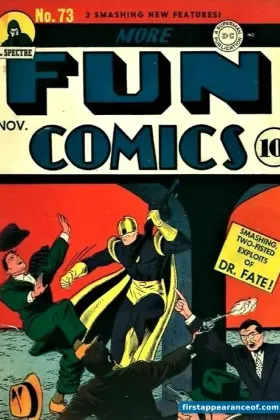
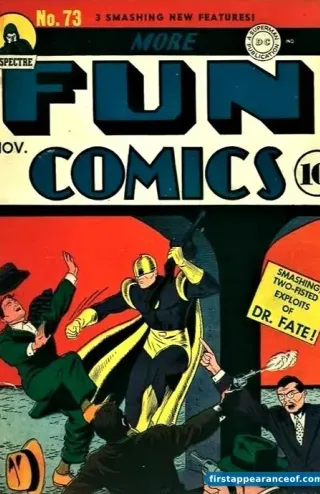
Green Arrow began life as a Batman in a Robin Hood costume. Writer Mort Weisinger and artist George Papp introduced Oliver Queen in More Fun Comics #73 (November 1941), and the template is not subtle: a wealthy hero, a kid sidekick, a cave-like base, themed equipment, and a pair of branded vehicles called the Arrowcar and the Arrowplane to mirror the Batmobile and Batplane. Where Batman had a utility belt, Green Arrow had a quiver of trick arrows, the gimmick that would define him for decades.
The debut is also notable for how little setup it offers. Weisinger and Papp drop Green Arrow into the action already established, as though readers had been following him for years, and let the archery and the gadgets carry the introduction. There is no origin story in #73. For most of the Golden and Silver Ages, Oliver Queen stayed a fairly generic well-off crimefighter, more a collection of arrow tricks than a personality. The character who matters now was a much later invention, which is the unusual thing about Green Arrow: his first appearance is a valuable key, but it is not where the version people love actually starts.
First Appearance: More Fun Comics #73
More Fun Comics #73 is one of the most loaded single issues in Golden Age collecting, because it contains three first appearances at once. Green Arrow and his sidekick Speedy (Roy Harper) debut in “Case of the Namesake Murders,” and in a separate story in the same book, Aquaman appears for the first time. Two enduring DC heroes and a major sidekick, all introduced in one 1941 anthology issue.
That triple debut is the engine of the book’s value. A collector buying More Fun Comics #73 is buying the first Green Arrow, the first Aquaman, and the first Speedy in a single purchase, which is why high-grade copies command Golden Age key prices and why the issue routinely sets records when a strong copy reaches auction. Aquaman tends to get top billing in sale listings because of his higher modern profile, but for Green Arrow collectors this is the foundation stone, the book where the Emerald Archer starts.
The two reinventions
The Green Arrow people picture today was built in two deliberate overhauls, decades after his debut. The first came in Green Lantern #76 (March 1970), where writer Dennis O’Neil and artist Neal Adams paired Oliver Queen with Green Lantern for the run fans call “Hard Travelin’ Heroes.” O’Neil rewrote Queen as a hot-tempered populist who lost his fortune and started caring loudly about poverty, racism, and corruption, while needling the by-the-book Green Lantern at every turn. It turned a forgettable archer into a character with a point of view.
The second overhaul was Green Arrow: The Longbow Hunters (1987), written and drawn by Mike Grell. Grell aged Oliver Queen to 43, moved him from Star City to Seattle alongside his longtime partner Dinah Lance, the Black Canary, and stripped the stories down to grounded, adult-toned crime drama. The series sold well enough to earn Green Arrow his first ongoing solo title. Between O’Neil’s politics and Grell’s grit, the modern Green Arrow was assembled, and the Arrow television series later leaned hardest on Grell’s grounded, survivalist take.
For collectors
The collector story here is unusually clean: there is one book that matters above all others, and it is More Fun Comics #73. Everything else is a distant second. The two reinvention books are meaningful keys in their own right, Green Lantern #76 for the O’Neil and Adams run and The Longbow Hunters #1 for Grell’s mature take, and both carry their own demand, but neither approaches the Golden Age triple-debut weight of #73. If you are tracing the Emerald Archer through this first-appearance archive, the path is simple: the 1941 debut is the financial anchor, and the 1970 and 1987 books are where the character people actually love was made.