Creation Story
Mister Miracle exists because Jack Kirby wanted out. He had created a long roster of Marvel characters without gaining copyright or creative custody of any of them, and the arrangement had soured. Carmine Infantino saw Kirby’s designs during a Passover visit and wanted to bring them to DC. In 1970 Kirby made the jump, and he brought a whole mythology with him.
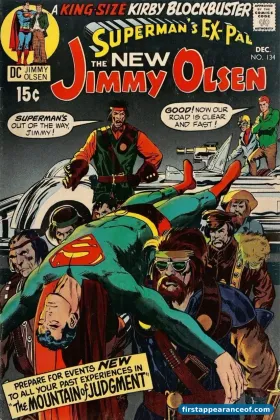
That mythology was the Fourth World, an interconnected saga Kirby wrote and drew across four titles at once. It surfaced first inside Superman’s Pal, Jimmy Olsen #133 (cover-dated October 1970), though Kirby’s original idea, as 50yearoldcomics reads it, appears to have been to launch the saga through the first issues of Forever People, New Gods, and Mister Miracle rather than through Jimmy Olsen at all.
The premise came from a colleague’s resume. Jim Steranko, Kirby’s fellow comics writer-artist, had briefly worked as an escapologist before breaking into comics, and Kirby built his super escape artist on that model. The character arrived right after his creator pulled off an escape of his own.
Mark Evanier unofficially co-plotted sequences in the fifth issue, and he has written that Kirby may never have been creatively happier than when he was writing and drawing this book.
First Appearance: Mister Miracle #1
Mister Miracle #1 is cover-dated March-April 1971 (commonly catalogued as April 1971). Fifteen cents bought a 22-page story called “Murder Missile Trap!”, written, drawn, and edited by Jack Kirby, with Vince Colletta inking the story and the cover.
The story opens on Scott Free, an unassuming young man who turns up at the home of Thaddeus Brown, an aging circus escape artist performing as Mister Miracle, and befriends Brown’s assistant, a dwarf named Oberon. Inter-Gang operatives attack during a practice session, and Scott stays to help protect the old showman. Inter-Gang, the human crime network under Darkseid’s control, had been running through the Fourth World books since Jimmy Olsen #133 and had just resurfaced in Forever People #1, so the new series plugged into the saga’s shared plot immediately.
Brown and Oberon are preparing a stunt called The Big Trap. While Brown practices it, a sniper working for the crime boss Steel Hand shoots him. Before he dies, Brown learns that the quiet young man carries a box with a strange power in it, a Mother Box. Scott puts on the costume, takes the Mister Miracle name, and defeats Steel Hand, striking at Inter-Gang’s operations in the process. First enemy: Steel Hand. First allies: the dying showman and the assistant who stays on as Scott’s partner.
What the issue withholds is Scott himself. He is plainly no ordinary orphan, but who he is and where he comes from stay secret. Kirby held the reveal for a year. New Gods #7, “The Pact” (1972), tells the story: Highfather and Darkseid traded infant sons to stop a war, Orion went to New Genesis, and Scott grew up on Apokolips.
That same-issue handoff makes the book unusual as a key. There is no cameo to argue over and no competing debut in an earlier issue. The original Mister Miracle debuts, dies, and passes the name inside one 22-page story, so a single comic carries the first appearances of Scott Free, Thaddeus Brown, and Oberon, plus the moment the mantle changed hands. Kirby added a third bearer, Shilo Norman, in Mister Miracle #15 (1973), which means every man who has carried the name traces his first appearance back to this one series.
The book also closed out the Fourth World rollout. Superman’s Pal, Jimmy Olsen #133 opened the saga on August 25, 1970. Forever People #1 followed on December 1, New Gods #1 on December 22, and Mister Miracle #1 on January 14, 1971, the three new titles dated per DC’s on-sale records as reported by 50yearoldcomics. The entire four-title launch landed in under five months at the front edge of the Bronze Age, and Mister Miracle was the last of the four to arrive, a little more than three weeks behind New Gods.
In a market post dated June 30, 2025, GoCollect ranked Mister Miracle #1 ninth on its Hottest Bronze Age comics list for the preceding ten days and recorded a CGC 9.0 copy selling for a one-year high of $248 on June 17, days after the animated series announcement.