Creation Story
Darkseid is the engine of Jack Kirby’s Fourth World, the sprawling space mythology Kirby launched at DC in 1970 after leaving Marvel. The idea was a new pantheon: two worlds, the gleaming New Genesis and the nightmare planet Apokolips, locked in a cold war between gods. Darkseid is Apokolips made flesh, its tyrant ruler, and Kirby built him as the immovable dark center the whole saga orbits. Kirby modeled his stone face partly on the actor Jack Palance, and gave him a goal more frightening than conquest: the Anti-Life Equation, a formula that would let him switch off the free will of every living thing.
What makes the character’s debut unusual is where Kirby chose to plant him. Rather than open with a New Gods title, Kirby took over the existing Superman’s Pal Jimmy Olsen book and used it as a beachhead, seeding his new mythology into an established Superman comic. That is why Darkseid’s first appearance is buried at the back of a Jimmy Olsen issue instead of on the cover of his own series. The villain who would become DC’s ultimate cosmic threat slipped in through a side door, in a single panel, before Kirby gave him the full stage a few months later.
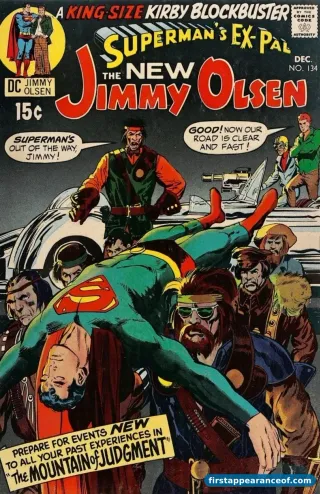
First Appearance (Cameo): Superman's Pal Jimmy Olsen #134
Superman’s Pal Jimmy Olsen #134 (December 1970) is Darkseid’s first appearance, and it is a genuine cameo. He shows up in a single panel near the end of the issue, the figure on the receiving end of a secretly transmitted account of the story’s events. There is no confrontation, no dialogue scene, no sense yet of who he is. Kirby is planting a flag.
For collectors that single panel is enough to make #134 a key. It is the chronological first appearance of Darkseid, full stop, and it carries the added weight of being an early Kirby Fourth World book. High-grade copies are the scarcer of his two debut issues, which is the usual pattern for cameo firsts: the book was not flagged as important when it shipped, so fewer pristine copies survive. The issue is also a Jimmy Olsen book rather than a marquee title, which kept it under the radar for years before Darkseid’s rising profile pulled it into the spotlight.
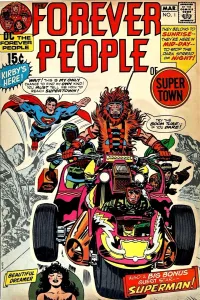
First Full Appearance: Forever People #1
Forever People #1 (cover-dated February to March 1971) is where Darkseid actually arrives. He appears across several pages, speaks, and moves with intent and menace, which is everything the Jimmy Olsen cameo withheld. This is the book most readers and many collectors point to when they call something Darkseid’s “real” first appearance.
Forever People #1 also earns its keep as a multiple debut. The same issue is the first appearance of the Forever People themselves, the New Genesis youth team at the center of the title, and of Infinity Man. That stacking of firsts is what pushes the book up the collector ladder: a buyer is getting Darkseid’s first full appearance plus two other Fourth World debuts in one issue. Between the two debut books, this is the one that delivers the character rather than a glimpse of him.
Jimmy Olsen #134 vs Forever People #1
The two books answer two different questions, which is why both are keys and why collectors rarely agree on a single answer.
| Jimmy Olsen #134 | Forever People #1 | |
|---|---|---|
| Cover date | December 1970 | February to March 1971 |
| Type of appearance | Single-panel cameo | Full appearance, several pages |
| Does he speak or act? | No | Yes |
| Other firsts in the issue | None for the Fourth World | First Forever People, first Infinity Man |
| Collector case | The absolute chronological first | The first real appearance, plus stacked debuts |
If you want the earliest book that contains Darkseid at all, it is Jimmy Olsen #134. If you want the issue where Darkseid is actually a character, it is Forever People #1. Neither is wrong, and the price histories of the two books move together because the market treats them as a matched pair rather than as a contest with one winner.
For collectors
Darkseid is one of the cleaner cameo-versus-full cases in the Bronze Age, because the gap between the two books is only a few months and both are Kirby. The practical split is simple. Jimmy Olsen #134 is the technical first and the scarcer high-grade book; Forever People #1 is the first full appearance and the better story-value purchase thanks to its stacked debuts. A third book, New Gods #1 (1971), is worth knowing too: it is the Fourth World flagship and the first appearance of Orion, Darkseid’s own son raised by the enemy. If you are following the character through this first-appearance archive, the order is cameo in Jimmy Olsen #134, full in Forever People #1, then the mythology opening up in New Gods #1.