Creation Story
Blue Beetle has outlived the company that created him. That survival is the reason “first appearance of Blue Beetle” has three correct answers: each time the character changed owners, the new publisher eventually put a new man in the suit. Fox Comics built him in 1939 and went bankrupt. Charlton picked him up, rebuilt him twice, then shut down its superhero line. DC bought the Charlton heroes in 1983 and has run the mantle since.
The 1939 original was a Fox anthology hero named Dan Garret, and his creation is a house-pseudonym case. The debut ran with art credited to “Charles Nicholas,” a Fox house name; comics historians identify the artist as Charles Nicholas Wojtkoski, though Charles Nicholas Cuidera, who produced later Blue Beetle stories, claimed the creation as his own. The script is murkier still: the Grand Comics Database tentatively credits Will Eisner as the scripter (per Wikipedia), and nothing firmer has settled it. Eisner’s confirmed Blue Beetle credit comes in Winter 1940, when he wrote the first issue of the character’s own Fox title with Wojtkoski on art.
The Charlton handoff was unglamorous. Fox went out of business and sold printing plates to Charlton in the mid-1950s, and Charlton’s first Blue Beetle series was a four-issue 1955 run numbered #18 through #21, because the publisher renumbered it from its horror anthology The Thing! The rebuild that matters came in June 1964, when writer Joe Gill and artists Bill Fraccio and Tony Tallarico recast Dan Garrett as an archaeology professor whose powers came from an ancient mystical Egyptian scarab: super strength, x-ray vision, flight, and energy blasts.
Two years later Steve Ditko replaced the archaeologist with a new man entirely, Ted Kord, and Charlton’s Action Heroes line was gone by the end of 1968. DC acquired the Charlton superheroes in 1983, folded Ted into its universe, and in 2006 introduced a third bearer, Jaime Reyes. The scarab is the thread through all of it, and it skips a generation: Garrett drew his powers from it, Ted Kord never could, and Jaime Reyes’s powers come from it directly.
First Appearance (Dan Garret): Mystery Men Comics #1
The first appearance (1st app) of Blue Beetle is Mystery Men Comics #1, cover-dated August 1939, in Fox’s Mystery Men Comics anthology. Dan Garret arrived as a police officer turned masked vigilante, and the earliest stories kept him closer to a mystery man than a superhuman. The signature gear accreted later in the run: a bulletproof blue costume made of lightweight yet durable cellulose, and temporary superhuman strength and stamina from a compound called “Vitamin 2X.”
One spelling note saves a lot of confusion. Fox spelled the surname Garret, with one t. Charlton’s 1964 rebuild added the second t, which is how the Golden Age cop and the Silver Age archaeology professor end up sharing a name spelled two ways.
The character got his own Fox title fast, in Winter 1940, and the Fox run lasted until August 1950, ending at issue #60.
As a collector book, Mystery Men Comics #1 is defined by scarcity. CGC’s census held a total of 39 copies as of July 28, 2023, per CGC’s feature on the book.
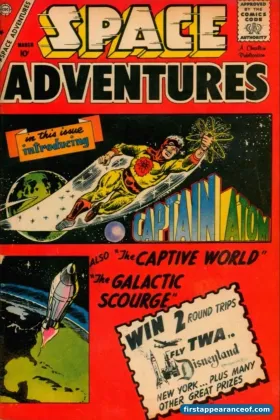
First Appearance of Ted Kord: Captain Atom #83
Ted Kord first appeared in Captain Atom #83, cover-dated November 1966, in the back of someone else’s book. The Blue Beetle feature ran as a backup behind the Captain Atom lead, plotted and drawn by Steve Ditko with Gary Friedrich scripting from Ditko’s conception and plot, and it continued through Captain Atom #86 (June 1967). Collectors treat #83 as the Ted Kord key.
The mantle passed on-panel. In the retelling DC published in Secret Origins vol. 2 #2, Ted was Dan Garrett’s student, and the two investigated an android army built by Ted’s uncle, Jarvis Kord. Garrett fought Jarvis, both were killed in the battle, and the dying Garrett passed the responsibility of the identity to Ted. What Garrett could not pass along was the scarab’s power.
Ditko preferred a power-free character, and he built one. Ted Kord has no superpowers: a genius-level intellect with an IQ of 192, a bug-shaped personal aircraft called the Bug, and a pistol that fires a blinding flash of light. That is the whole kit. The second Blue Beetle is an inventor in a costume, with nothing mystical about him.
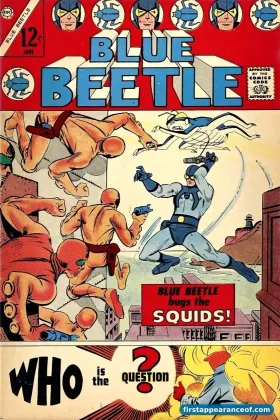
Charlton gave Ted his own title in June 1967. Blue Beetle ran five issues through November 1968. The series ended when Charlton discontinued its entire Silver Age Action Heroes line; a sixth issue later appeared in the Charlton Portfolio.
DC bought the Charlton superheroes in 1983. That purchase is how a hero with a Charlton first appearance ends up a DC character. Ted’s first DC appearance came in Crisis on Infinite Earths #1 (April 1985), per the DCU Guide’s chronology, and a DC solo followed: 24 issues from June 1986 to May 1988, written by Len Wein with art by Paris Cullins. The version most readers remember came next, in the late-1980s Justice League International, where Ted became half of the “Blue and Gold” team with his best friend Booster Gold. DC ended the Kord era in Countdown to Infinite Crisis (2005): Maxwell Lord murders Ted, and the vacancy sets up Jaime Reyes.
Ted’s widest cultural footprint is in a book he is not in. Alan Moore wrote a proposal built around the Charlton characters, titled Who Killed the Peacemaker, and submitted it unsolicited to DC managing editor Dick Giordano. Giordano was receptive but opposed using the Charlton characters for the story, and persuaded Moore to continue the project with new characters that resembled the Charlton heroes. The project became Watchmen, and Moore used the Dan Garret and Ted Kord incarnations of the Blue Beetle as inspiration for the two Nite Owls.
First Appearance of Jaime Reyes: Infinite Crisis #3
Jaime Reyes first appeared in Infinite Crisis #3, cover-dated February 2006, inside DC’s line-wide event. The character was created by Keith Giffen, John Rogers, and Cully Hamner. Jaime enters the event as the teenager who finds the scarab; the costume does not appear until issue #5.
The collector question on Jaime is really three questions, and the answers do not collapse into one issue. Infinite Crisis #3 (February 2006) is his first appearance. Infinite Crisis #5 (April 2006) is his first appearance as Blue Beetle. Blue Beetle #1, launched in 2006, is his first solo issue. Dealer listings regularly blur the first two, stamping #3 as a costume first it is not: the suit debuts in #5. Collectors track all three, and the three-way split is the whole answer.
Unlike Ted, Jaime draws his powers from the scarab itself. The solo series that launched in 2006 was initially written by Keith Giffen and John Rogers, with Cully Hamner on art.
Dan Garret vs Ted Kord vs Jaime Reyes
The comparison collectors need is the three debuts side by side, because each one is the correct 1st app answer to a different question.
| Dan Garret | Ted Kord | Jaime Reyes | |
|---|---|---|---|
| Debut issue | Mystery Men Comics #1 | Captain Atom #83 | Infinite Crisis #3 |
| Cover date | August 1939 | November 1966 | February 2006 |
| Publisher | Fox Comics | Charlton Comics | DC Comics |
| Appearance context | Anthology feature | Backup story behind the Captain Atom lead | Event debut; in costume from Infinite Crisis #5 (April 2006) |
| Creators | ”Charles Nicholas” (Fox house pseudonym; historians identify Charles Nicholas Wojtkoski) | Steve Ditko (plot, art), Gary Friedrich (script) | Keith Giffen, John Rogers, Cully Hamner |
| The scarab | Powers from the scarab after Charlton’s 1964 revision | Carried the mantle without the scarab’s powers | Powers derive from the scarab |
| Collector status | 39 copies in the CGC census as of July 28, 2023, per CGC’s feature | ”First appearance of Ted Kord as The Blue Beetle,” per GoCollect | Collectors track IC #3 (first appearance), IC #5 (first as Blue Beetle), and Blue Beetle #1 (first solo, 2006) |
Asked literally, the first appearance of Blue Beetle is Dan Garret’s, in a 1939 Fox anthology. Asked about the Beetle of Justice League International and the Watchmen analogues, it is Ted Kord’s Captain Atom #83. Asked by someone who met the character through the 2023 film, it is Jaime Reyes’s, and his answer itself splits: on the page in Infinite Crisis #3, in the costume in Infinite Crisis #5.