What the Marvel Multiverse Is
Marvel backed into its multiverse. DC built one on purpose: The Flash #123 (September 1961), by Gardner Fox and Carmine Infantino, introduced Earth-Two in a single story and gave the rival publisher a working parallel-Earth cosmology two decades before Marvel named its own main universe. Marvel, per Popverse, initially didn’t really follow DC down that road; its alternate worlds were often referred to as alternate timelines instead of officially parallel Earths.
The Marvel multiverse is the company’s full stack of alternate realities, filed by Wikipedia as “a collection of alternate realities with a similar nature and a universal hierarchy.” The word itself is older than Marvel. Popverse traces it to philosopher William James in 1895 and credits novelist Michael Moorcock with giving it its current meaning in 1963, when he adopted it for his parallel-Earth novella The Sundered Worlds.
Asking when it first appeared turns up a ladder. Strange Tales #103 (1962) sent the Human Torch to a parallel dimension, which even its chroniclers distinguish from an alternate universe: a separate plane connected to Earth by a portal, not another Earth. Popverse reads Avengers Annual #2 (1968) as the first almost-parallel-world story, the contemporary Avengers against an almost-but-not-quite version of the originals. The load-bearing rung is The Avengers #85, cover-dated February 1971, by Roy Thomas and John Buscema: the first issue to introduce a recurring parallel Earth, the world of the Squadron Supreme, later designated Earth-712 in Marvel’s multiverse numbering. Wikipedia’s multiverse article lists it as the concept’s first appearance, the closest thing to an official answer the question has. Even that rung wobbles, because the Avengers’ mistaken arrival in the Squadron’s universe traces to the previous issue, The Avengers #84 (January 1971).
The ladder keeps climbing through the Bronze Age. A Fantastic Four backup story in #118 (cover-dated January 1972) sends the Thing and Lockjaw to an alternate universe where only Ben and Reed flew the rocket, a world the team dubbed Earth-A only on a later return. Screen Rant calls Fantastic Four #161 (1975) the earliest case of Marvel heroes fighting alternate selves explicitly said to come from an alternate timeline, and credits What If #1 (cover-dated February 1977, on sale in November 1976) with formally introducing the multiverse. No single rung settles it. The ladder is the answer.
How the Multiverse Works
For its first decade the framework ran without a map, and for longer than that the main universe ran without a name. The name came from Britain. “Rough Justice,” a Captain Britain story credited to Alan Moore and Alan Davis in the Marvel UK anthology The Daredevils #7 (July 1983), is the first print use of Earth-616, the designation for the universe where most Marvel stories take place. Who coined it is disputed. Moore commonly gets the credit. Davis said in 2007 that the term had been established earlier by Dave Thorpe, the strip’s previous writer, with the number a variation on the number of the beast, picked because Thorpe disliked the modern superhero genre. Thorpe’s own 2019 account differs on the target: the number is 666 minus 50, he confirmed, but the infernal reference was intended for the “Crooked World” of the Jaspers’ Warp storyline. The address stuck either way, carried into US Marvel through the Excalibur title and then into the Official Handbooks, whose writers kept it for the simplicity of the term.
The map came another two decades after the name. During the 2000s Marvel began consistently numbering its prominent alternate universes in the Official Handbook of the Marvel Universe, starting with one-shot handbooks published in 2004 and 2005; Official Handbook of the Marvel Universe: Alternate Universes, published September 2005, was the one-shot dedicated to them, and the Appendix to the Official Handbook of the Marvel Universe A to Z (2008) followed with a comprehensive numbered list. Marvel even reached backward, assigning numerical designations to several What If stories to make them contiguous with the numbered multiverse.
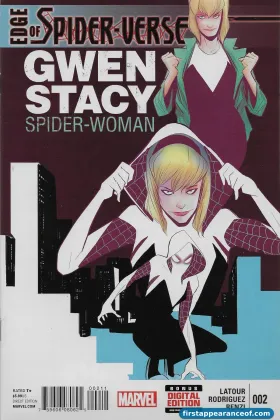
The numbering is why alternate Marvel worlds read like postal codes, and why one mask can carry more than one first appearance, one per Earth. Earth-616 is the main line. Earth-1610 housed the Ultimate books, Earth-65 is Spider-Gwen’s world, and the numbering runs on through Earth-928 and Earth-2149.
Who Navigates It
Uatu the Watcher watches it rather than travels it. What If ran on his premise from 1977 to 1984: a narrator who observes both Earth and alternate realities and presents the roads Marvel history didn’t take. The 1983 Captain Britain run added the first standing cross-Earth institution; per Popverse, it introduced the first superhero team made up entirely of members from different Earths, the Captain Britain Corps.
The heaviest traffic belongs to the Spider-line. Spider-Verse (2014-15) pulled in nearly every variant of Spider-Man and the Spider-People that had appeared across more than fifty years of comics and other media, and its lead-in produced Spider-Gwen, the Gwen Stacy of Earth-65 who became her world’s Spider-Woman, debuting in Edge of Spider-Verse #2 (2014).
Major Storylines
The first recurring parallel-Earth story runs across The Avengers #85 and #86 (February and March 1971): four Avengers on a parallel Earth, trading blows with the Squadron Supreme, that world’s resident heroes. What If made such visits a format. From 1977 the Watcher’s series presented alternate versions of familiar Marvel stories, opening with “What If Spider-Man had Joined the Fantastic Four?”, an alternate take on events from The Amazing Spider-Man #1 (1963).
Spider-Verse ran the premise at event scale. The main arc in The Amazing Spider-Man (vol. 3) #9-15 (November 2014 to February 2015), written by Dan Slott with art by Olivier Coipel and Giuseppe Camuncoli, put Spider-People from across the multiverse under attack by Morlun and his family, the Inheritors; Edge of Spider-Verse (2014), a five-issue run of one-shots, set the table.
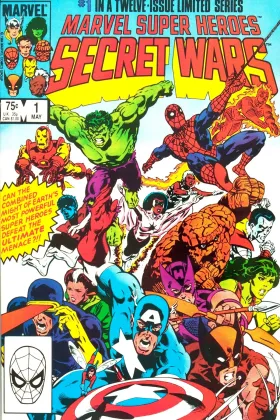
Then Marvel destroyed the whole structure on purpose. Secret Wars (2015), written by Jonathan Hickman and drawn by Esad Ribić, opens after a chain of incursions (collisions between universes) has wrecked the multiverse; issue #1 arrived May 6, 2015, and the surviving pieces are welded into Battleworld under God Emperor Doom. The endgame runs through the Beyonders: Molecule Man transfers their power to Mister Fantastic, Battleworld is destroyed, and Reed Richards departs to restore the multiverse one reality at a time. Marvel stretched the series from eight issues to nine, and it closed with its January 2016 finale; the event is framed as the death of one multiverse and the birth of the next.
On Screen
As of September 2026 the multiverse is the through-line of Marvel’s film slate, and the number showed up on screen years before anyone used it to name the film universe. Earth-616 appears on Erik Selvig’s blackboard in Thor: The Dark World (2013), and Avengers: Endgame (2019) includes a storage area labeled 616. The first person to say it out loud is lying: in Spider-Man: Far From Home (2019), Quentin Beck tells Peter, “There are multiple realities, Peter. This is Earth Dimension 616, I’m from Earth 833,” and the film later exposes him as a fraud.
Spider-Man: No Way Home (December 17, 2021) put the concept at the center of the year’s highest-grossing film. Doctor Strange’s corrupted spell summons people from other universes who know Spider-Man’s identity, and Tobey Maguire and Andrew Garfield return as alternate Spider-Men. It never names Earth-616. The naming waited for Doctor Strange in the Multiverse of Madness (May 2022), which sends Strange and America Chavez, whose power is travel through the multiverse, across incursion-prone worlds; there, Earth-838’s Illuminati are the ones who name the main film universe Earth-616. On paper the accounting is split: the MCU’s main universe is designated Earth-199999 in external media and Earth-616 in internal media.
Deadpool & Wolverine (July 26, 2024) runs the machinery in the open: the Time Variance Authority, an organization outside of time that monitors the Sacred Timeline and the wider multiverse, and a lead who crosses from his own Earth-10005 to Earth-616 hoping to join that reality’s Avengers. Animation made its own case, with Spider-Man: Into the Spider-Verse (2018) and Across the Spider-Verse (2023) built on the same many-Spiders premise the comics event ran first.
The next act is scheduled, not shipped. As of September 2026, Avengers: Doomsday, directed by the Russo brothers with Robert Downey Jr. cast as Doctor Doom, is set for release on December 18, 2026 after two earlier date moves, and Avengers: Secret Wars is scheduled for December 17, 2027 to conclude Phase Six.