Creation Story
Doctor Doom is Death wearing armor. Jack Kirby said so himself in a 1987 interview: “Dr. Doom was the classic conception of Death, of approaching Death.” He saw the character as the Man in the Iron Mask, who symbolized the same thing. “It was the reason for the armor and the hood.” The mask had its own job. “Death is something without mercy and human flesh contains that element of mercy,” Kirby said. “Therefore, I had to erase it, and I did it with a mask.”
Stan Lee had the name. The Fantastic Four was a success by then. Lee later wrote that he and Kirby wanted a “soul-stirring…super sensational new villain” for it, and that he settled on “Doctor Doom” as “eloquent in its simplicity” and “magnificent in its implied menace.”
Kirby pencilled the debut and Joe Sinnott inked it, cover and interior, without credit. The issue is signed by Lee and Kirby alone. It was Sinnott’s first Marvel superhero comic, and he was gone almost immediately: he had committed to a 65-page Treasure Chest job, finished only a panel or two of issue #6 before handing it back to Lee, and did not return to the title until #44 (November 1965).
The rush to publish left a hole. Doom arrived with a name, a mask, and one short flashback, but no full origin. Lee and Kirby took two years to supply one.
Lee kept a soft spot for him. In town for Rhode Island Comic-Con, as reported by Screen Rant in November 2016, he argued that everybody has Doom misunderstood: “Everybody thinks he’s a criminal, but all he wants is to rule the world.” His defense rested on a technicality: “it’s not a crime to want to rule the world.” Screen Rant’s account has Lee naming Doom as his favorite supervillain.
First Appearance and First Cover: Fantastic Four #5
Fantastic Four #5 is cover-dated July 1962 and went on sale April 10, 1962. Cover price: 12 cents. The story is “Prisoners of Doctor Doom!”, written by Stan Lee and pencilled by Jack Kirby, with Joe Sinnott’s inks uncredited at the time.
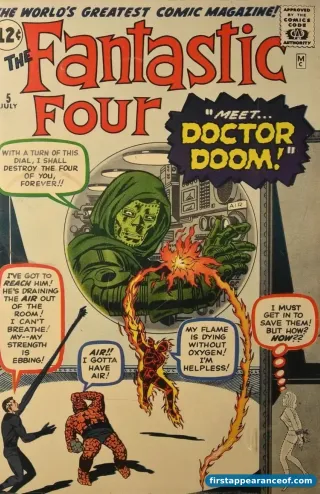
The cover sells the villain. A blurb announces “MEET… DOCTOR DOOM!” Doom looks in through a round window, green hood and metal mask, a gauntleted hand on a dial. His balloon reads, “WITH A TURN OF THIS DIAL, I SHALL DESTROY THE FOUR OF YOU, FOREVER!!” Below him Mister Fantastic, the Thing, and the Human Torch are trapped in an airless room. At the right edge the Invisible Girl, drawn in outline, asks herself how she can get in to save them. Doom’s place at that window makes the issue his first cover as well as his first appearance.
Among Silver Age Marvel books this is the Doom key. Key-issue listings bill it as both his first appearance and his origin, the second on the strength of one short flashback. Near-mint copies sold for six figures in 2022.
Inside, the mask does not fool Mister Fantastic. Reed Richards recognizes Doom’s voice. He went to college with Victor von Doom and had believed him dead. He tells the others about a student fascinated by black magic and sorcery, whose “forbidden experiments” to contact the netherworld got out of his control. The accident scarred Doom’s face and got him expelled. That flashback is all the origin the issue offers, and the sorcery is already in it. Doom was never a scientist who picked up magic later.
Doom declares the four his prisoners and keeps the Invisible Girl as a hostage so the others will follow orders. The orders involve a time machine he has built. He sends Reed, the Human Torch, and the Thing into the past to bring back Blackbeard’s treasure, a chest of gems that once belonged to Merlin. Somewhere in all this, the Human Torch is reading a Hulk comic.
The issue’s twist comes on that trip. The Thing goes in disguise, dressed as a pirate and wearing a black beard, and when the fighting stops the pirates are calling him Blackbeard. The legend the team was sent to rob is Ben Grimm, the Thing himself. The chest Doom opens holds nothing but chains.
The issue carries a second, quieter first appearance: Doom keeps a robot double of himself and sends it to do his fighting. The Thing attacks Doom and discovers he has been dealing with a machine. The comic has no name for it yet. Later stories call them Doombots, and the habit of letting a robot take the punch starts here.
Doom works alone in the debut, with only the robot for company. That changes one issue later, when he returns in Fantastic Four #6 and briefly allies with Namor. He did not stay only a Fantastic Four villain for long. He turned up in The Amazing Spider-Man #5 (October 1963), stole the Silver Surfer’s power across Fantastic Four #57 to #60, shared Super-Villain Team-Up #14 with Magneto, and went to Camelot with Iron Man in 1981. In the 1984 Secret Wars he took the power of the Beyonder, and in the 2015 series, as God Emperor of Battleworld, he ripped the skeleton out of Thanos.
First Full Origin: Fantastic Four Annual #2
Fantastic Four Annual #2 is cover-dated only 1964 and went on sale that July. It cost 25 cents. “The Fantastic Origin of Dr. Doom!” runs 12 pages: Lee script, Kirby pencils, Chic Stone inks. The same annual reprints Fantastic Four #5 and adds a second new story, in which the Latverian embassy appears.
Victor is born to a Romani family in Latveria, and the fictional European kingdom makes its own first appearance in these pages. The 1964 text places it in the heart of the Bavarian Alps. His father, Werner von Doom, is a healer. The Baron summons Werner to cure his sick wife and blames him when she dies. Werner dies fleeing with the boy. Orphaned, Victor learns what his father had hidden from him: his mother, killed when he was an infant, was a sorceress, and her chest of magical effects is now his. The story never names her, and Mephisto is nowhere in it.
He grows up mixing science and sorcery and is recruited to State University in America, where he meets Reed Richards. Reed spots errors in Victor’s equations and says so. Victor ignores him. The machine, built to contact the Nether World, explodes. It scars his face and gets him expelled.
He leaves for Tibet and joins an order of monks, learns their secrets, and becomes their master. The monks forge his armor. When the mask is ready a monk warns that it has not cooled, and Doom puts it on anyway. Twenty years later he is absolute monarch of Latveria.
The crown stayed with the character, and it has a legal use. As a head of state, Doom has diplomatic immunity, which shields him from prosecution for crimes committed outside Latveria.
Other writers kept adding to the origin. Continuity after the 1964 origin names his mother Cynthia von Doom. In Astonishing Tales #8 (October 1971), a backup story by Gerry Conway and Gene Colan titled ”…Though Some Call It Magic!” establishes that Doom fights the forces of Hell every year to free his mother’s soul, damned for her black magic. In Doctor Strange and Doctor Doom: Triumph and Torment (1989), Roger Stern and Mike Mignola send Doom and Doctor Strange into Mephisto’s realm after her. Ed Brubaker and Pablo Raimondi retold the whole origin in Books of Doom (2005 to 2006), which stretches Lee and Kirby’s 12 pages to 120.