First Appearance

First Appearance of Sinestro

Green Lantern #7 (1961). The fallen Green Lantern of Korugar, Hal Jordan's mirror image, who turned a yellow ring of fear into an army that rivals the Corps itself.

By Atomm Updated

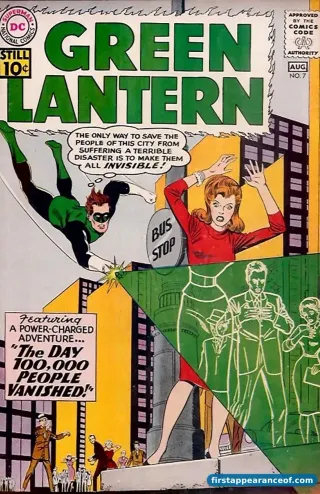
Green Lantern #7 (1961), the issue that introduces Sinestro, the renegade former Green Lantern who becomes Hal Jordan's defining enemy.

First Appearance

  1. First Appearance August 1961

    Green Lantern #7

    By John Broome, Gil Kane

    Sinestro debuts in 'The Day 100,000 People Vanished,' written by John Broome and drawn by Gil Kane. He is introduced already fallen: a former Green Lantern stripped of his ring by the Guardians and exiled to the antimatter world of Qward.

    Read the full breakdown

Quick Facts

Debut
Green Lantern #7 (August 1961)
Real name
Thaal Sinestro, of Korugar
Creators
John Broome (writer), Gil Kane (artist)
Publisher
DC Comics
First enemy
Green Lantern (Hal Jordan), the hero he was created to oppose
First ally
The Weaponers of Qward, who forge his yellow ring
Team affiliations
Green Lantern Corps (former), the Sinestro Corps (founder)

The first appearance (1st app) of Sinestro is Green Lantern #7 (August 1961), created by writer John Broome and artist Gil Kane. He is Thaal Sinestro of the planet Korugar, introduced not as a common villain but as a disgraced former Green Lantern, stripped of his ring and banished by the Guardians for ruling his sector by fear. He returns wielding a yellow power ring forged in the antimatter world of Qward. Decades later he founds the Sinestro Corps, the fear-powered answer to the Green Lantern Corps.

Creation Story

Sinestro was designed as a reflection. Writer John Broome and artist Gil Kane introduced him in Green Lantern #7 (August 1961), early in Hal Jordan’s Silver Age run, and they built him as the hero’s inverse: a Green Lantern who had everything Jordan had and threw it away. Where Jordan was the new recruit learning the job, Sinestro was the veteran who had already failed it, a former Lantern of his own sector who decided the ring was better used to rule than to protect. Kane drew him with a sharp, aristocratic bearing, a look he said he modeled on the actor David Niven.

Making the archenemy a fallen colleague rather than an outside monster is what has kept Sinestro durable. The Green Lantern Corps is a police force of thousands, so the most damaging villain is the one who came from inside it and knows exactly how it thinks. That premise sat mostly dormant for decades, then became the engine of the modern DC Green Lantern books, where Sinestro is less a foil than a dark argument about whether fear or willpower is the better tool.

First Appearance: Green Lantern #7

Green Lantern #7, cover-dated August 1961, introduces Sinestro in the story “The Day 100,000 People Vanished.” Broome writes and Kane draws, with Joe Giella on inks. The issue does not ease him in as a minor threat: he arrives already exiled to the antimatter world of Qward, already stripped of his Green Lantern ring by the Guardians of the Universe, and already committed to using a new yellow ring against the Corps he once served. The backstory is delivered up front, which is unusual for a Silver Age debut and gives the character immediate weight.

As a collector book, #7 is the key first appearance of the most important Green Lantern villain, from the foundational period of the Silver Age Green Lantern title. It belongs in the same conversation as the other early Hal Jordan keys, and it is the issue that anchors Sinestro in any first-appearance archive. Everything the character becomes in the modern era traces back to this single 1961 issue.

The yellow ring and the Sinestro Corps

The yellow ring is the heart of the concept. Classic Green Lantern rings had a built-in weakness to the color yellow, and Broome turned that flaw into a villain by having the Weaponers of Qward forge Sinestro a ring tuned to exactly that gap. For decades that was the whole idea: a fallen Lantern with the one weapon a Green Lantern could not block. The modern relaunch reframed it. In Green Lantern: Rebirth (2004), Geoff Johns recast yellow as the light of fear, the emotional opposite of the Corps’ green light of will, which made Sinestro’s choice of color a thesis rather than a loophole.

That groundwork set up his defining story. The Sinestro Corps War (2007) gave him an army, an order of yellow-ring wielders recruited to spread fear across the universe, and turned a single recurring foe into a galaxy-scale threat. The story was successful enough that Sinestro never went back to being a B-tier villain. He later headlined his own ongoing series, Sinestro #1 (2014), which pushed him toward antihero territory as he tried to save the last survivors of Korugar.

For collectors

The collector path is straightforward: Green Lantern #7 is the key, the first appearance of Hal Jordan’s defining enemy in the run that built the Silver Age Green Lantern. It carries the demand you would expect from a major villain’s debut in a foundational title. The books that follow are story keys rather than scarcity books. Green Lantern: Rebirth is where the modern character starts, the Sinestro Corps Special kicks off his signature war, and the 2014 solo series is the first time he carried a title alone. Each matters to the character; none competes with the 1961 debut.
Key subsequent appearances

After the debut, these are the issues collectors and historians reach for next.

  1. 2004

    Green Lantern: Rebirth #1

    Johns Relaunch

    Geoff Johns and Ethan Van Sciver's six-issue series restored Hal Jordan and re-established Sinestro as the central modern Green Lantern villain. It planted the seeds of the emotional-spectrum mythology that the next decade of stories grew from.

  2. 2007

    Green Lantern: Sinestro Corps Special #1

    Sinestro Corps War

    The opening chapter of the Sinestro Corps War, written by Geoff Johns with art by Ethan Van Sciver. Sinestro fields an army of fear-powered yellow rings against the Green Lantern Corps, the storyline that promoted him from recurring foe to franchise-defining threat.

  3. 2014

    Sinestro #1

    First Solo Series

    Cullen Bunn and Dale Eaglesham launch Sinestro's first ongoing solo title as part of DC's New 52. The premise turns him into a reluctant protagonist, hunting for the surviving people of the Korugar he once doomed.

In adaptations

Film, TV, animation, and game appearances.

  1. 2004

    Justice League Unlimited

    Animated

    Starring:Ted Levine

    Levine voices Sinestro as a recurring Green Lantern Corps antagonist in the DC animated universe.

  2. 2011

    Green Lantern

    Film

    Starring:Mark Strong

    Strong plays Sinestro as Hal Jordan's respected mentor rather than his enemy. A mid-credits scene shows him slipping on a yellow ring, foreshadowing the villain turn the character is known for.

  3. 2011

    Green Lantern: The Animated Series

    Animated

    Starring:Ron Perlman

    Perlman's gravel gives Sinestro real menace across the animated series.

Frequently asked questions

The questions readers and collectors ask most.

What is Sinestro's first appearance?

Sinestro's first appearance is Green Lantern #7 (August 1961), in the story 'The Day 100,000 People Vanished' by writer John Broome and artist Gil Kane. He arrives already disgraced, a former Green Lantern who has turned on the Corps that trained him.

Was Sinestro a Green Lantern?

Yes. Before he became Hal Jordan's enemy, Thaal Sinestro was the celebrated Green Lantern of Korugar, his home sector. The Guardians of the Universe stripped him of his ring and banished him after learning he had used his power to rule Korugar through fear. His villainy is the story of a Lantern who fell.

Why is Sinestro's ring yellow?

Because yellow was the classic weakness of the Green Lantern ring. The Weaponers of Qward, in the antimatter universe, forged Sinestro a ring tuned to that exact blind spot. In modern continuity the color is reframed as the light of fear, the opposite end of the emotional spectrum from the Corps' green light of will.

What is the Sinestro Corps?

It is the army Sinestro builds in modern stories, an order of yellow-ring wielders who weaponize fear the way the Green Lantern Corps weaponizes willpower. Introduced in full during the 2007 Sinestro Corps War, it turned a single villain into a galaxy-scale threat and remains his signature creation.

Related characters