What Kryptonite is
Kryptonite is the rule that makes Superman a character instead of a problem. He is invulnerable, faster than anything, and strong enough to move worlds, so a story needs a lever that can actually threaten him, and kryptonite is that lever: a radioactive fragment of his destroyed homeworld Krypton that drains his power and, in enough quantity, can kill him. It is the rare weakness so famous that the word has left comics entirely and become ordinary English for “the one thing that undoes an otherwise unstoppable person.”
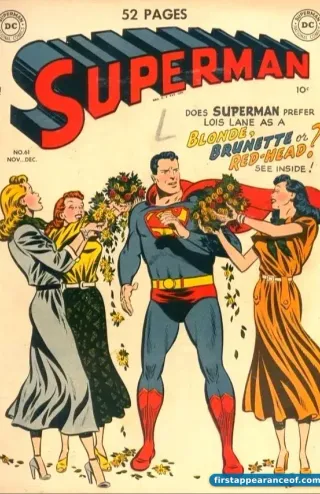
Its first comic-book appearance is Superman #61, cover-dated November 1949, in a story called “Superman Returns to Krypton!” by writer Bill Finger and artist Al Plastino. A glowing gem saps Superman’s strength, and the trail leads him, for the first time, back through the history of his own lost planet. The issue matters for more than the rock: it is an early step in turning Superman from a strongman into a character with an origin and a homeworld worth grieving.
Where it came from
The strange part of kryptonite’s history is that it did not start in the comics at all. It was invented for The Adventures of Superman radio serial, which introduced it in 1943 in a story arc about a meteor from Krypton. The reason was partly practical. A storyline that left Superman weakened, or out of action entirely, let the show give its lead voice actor a break, with another actor groaning through the kryptonite scenes. The device was useful enough that it stuck.
The comics were slower to adopt it. There is an unpublished 1940 Jerry Siegel story, “The K-Metal from Krypton,” that toyed with a similar idea, a piece of Krypton that robbed Superman of his strength, but it never ran. It took until Superman #61 in 1949 for the comics to formally bring kryptonite in, six years after radio listeners already knew what it was. For once, the comic book was following the adaptation rather than the other way around.
Red before green
The detail that surprises most people is the color. The kryptonite in Superman #61 is red, not the iconic green. The familiar green stone, the one that means lethal danger to a Kryptonian, settled in over the next couple of years in the early 1950s and gradually became the default. Later stories quietly treat green as the original, but the actual first comic kryptonite glowed red, and the book itself acknowledges the slip, with Superman later remembering the gem as green.
The colors of Kryptonite
Once the Silver Age got hold of the idea, kryptonite multiplied into a whole spectrum, each color a different plot device. Green is the standard and the deadly one. Red kryptonite causes bizarre, unpredictable, usually temporary effects, a writer’s blank check for one-issue transformations. Gold kryptonite is the frightening one, stripping a Kryptonian of powers, sometimes for good. Blue kryptonite turns the danger on Bizarro instead of Superman. The proliferation got silly enough that modern stories mostly pared it back to green, but the rainbow is part of why kryptonite became such a flexible, enduring piece of lore.
Why it endures
Kryptonite lasted because it solved a problem that never goes away: an all-powerful hero needs a credible threat, and a piece of his own dead world is a more poetic one than any villain. Lex Luthor and others weaponize it precisely because it is the honest answer to “how do you hurt Superman.” That it began on radio, arrived in the comics colored wrong, and still became the single most recognizable weakness in fiction says something about how good the core idea was. Superman #61 is where that idea entered the comics, and the green rock has been shadowing him ever since.