What Central City Is
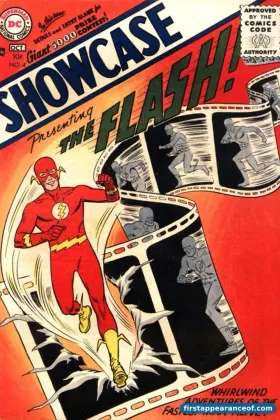
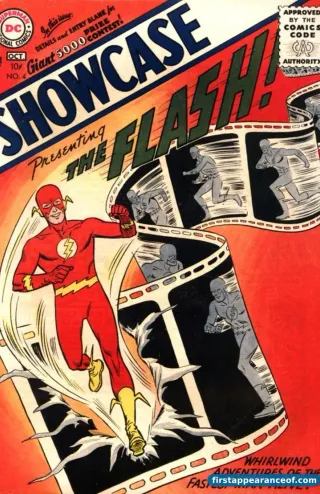
Central City is where DC’s Silver Age starts. Showcase #4, the issue that introduced it, is usually named as the official start of the Silver Age of comics, and the city came in as the working backdrop for a new Flash. Barry Allen is a police scientist in Central City, and a lab accident involving lightning and chemicals gives him his speed. Joe Kubert inked the story and Julius Schwartz edited it.
The city had a job before it had a location. Barry had a fictional hometown from his first issue; the older Flash did not. Jay Garrick, who debuted in Flash Comics #1 (January 1940 cover), was originally based in New York City and was only later retconned into the fictional Keystone City. So DC ended up with two Flash cities, one for each generation of the hero, and later stories and reference books kept revising where the pair sit.
That revising is most of Central City’s history as a place. The Silver Age book gave the city a hero and a police department to employ him. The map came afterward, in pieces, from comics, a 1977 column and a licensed game book.
Where Is Central City?
The answer has changed several times, and it has moved west. Early placements put Central City in Ohio. One fan reference cites The Flash #228 (1974) for setting it where Athens, Ohio stands, and DC’s Ask the Answer Man column said Ohio outright in 1977, in Detective Comics #470 (June 1977 cover). The same column put Star City in Connecticut and Midway City in Michigan.
The Missouri answer came after the Crisis. One fan reference says the Crisis put the twin cities in Kansas and Missouri, and a game book added the detail. The Atlas of the DC Universe, a licensed DC Heroes role-playing sourcebook written by Paul Kupperberg and published by Mayfair Games in 1990, put Central City in Missouri and Keystone City in Kansas. It was a licensed supplement, not a comic, but the comics settled in the same place. The Flash vol. 2 #188 (September 2002 cover) fixed the post-Crisis arrangement: Keystone City in Kansas, and Central City across a river on the Missouri side of the state line. A 2024 feature on DC.com restated that split.
The Missouri address is why fans compare Central City to Kansas City. The comparison is popular, and it is fan theory.
In 2026 a sitcom put the fan shorthand into dialogue. In Stuart Fails to Save the Universe, the HBO Max comedy from Chuck Lorre Productions in association with Warner Bros. Television, the gang spends Season 1, Episode 9, “Spoiler: We Couldn’t Get Green Lantern” (September 17, 2026), trapped inside a DC comic and trying to reach the Flash. Stuart tells Kripke, “He’s in Central City.” Kripke asks, “And where is that?” Stuart’s answer: “According to DC canon, roughly around Kansas City.”
The show is echoing DC’s geography, not setting it. Stuart’s line lands close to the comics because the 2002 placement puts Central City on the Missouri side of the Kansas border. The Kansas City part is the fans’ reading of that map.
Central City and Keystone City
Central City belongs to Barry Allen, the second Flash. Keystone City belongs to the first and third: Jay Garrick and Wally West. The two cities began on different worlds.
The Flash #123 (September 1961 cover), Flash of Two Worlds, written by Gardner Fox and drawn by Carmine Infantino with inks by Joe Giella under editor Julius Schwartz, is where they first meet. Barry finds himself outside an unfamiliar city and discovers it is Keystone City, home of the Golden Age Flash. The story places Keystone on the world later called Earth-Two, though the issue never uses that name. Central City stayed on Barry’s side of the divide.
Post-Crisis continuity closed the gap. The two cities became twins separated by a river, Keystone City in Kansas and Central City on the Missouri side. A trip that once took a parallel Earth now takes a river crossing.
Who Lives There
Barry Allen is the resident the city was built around: a police scientist whose job ties the Flash to the Central City police from his first story.
His enemies came next. Some of the Flash’s villains formed a loose association and called themselves the Rogues, and their first appearance as a group is The Flash #155 (September 1965 cover), by John Broome and Carmine Infantino.
Fan references place a Flash Museum in the city as well.
Central City on Screen
As of September 2026, Central City has appeared in live-action series, animation and film. CBS’s The Flash (September 20, 1990 to May 18, 1991, 22 episodes) made Barry a forensic scientist working for the Central City police, with S.T.A.R. Labs represented by Tina McGee. The CW’s The Flash (October 7, 2014 to May 24, 2023, nine seasons and 184 episodes) was set in Central City and tied Barry’s speed to the explosion of the S.T.A.R. Labs particle accelerator; the show filmed mainly in Vancouver. A 2020 map of the Arrowverse’s post-Crisis Earth-Prime put that version of Central City in Missouri, which matches the comics.
The city also turns up in the animated Justice League and Justice League Unlimited. The Flash (2023), directed by Andy Muschietti and released June 16, 2023, has Central City Police Department scenes, with London locations near St Paul’s Cathedral standing in for the city.
In the Stuart Fails to Save the Universe episode, the comic the gang is trapped in is set in Gotham City, and Stuart suggests they contact the Flash and use his cosmic treadmill to escape. The Adversary sends Mr. Freeze after them, and the speedster who saves them is Jay Garrick, the Golden Age Flash: Keystone City’s hero, not Central City’s.