Who are the New Teen Titans
For sixteen years, DC could not make the Teen Titans matter. The team had kicked around since the 1960s as a junior league of borrowed sidekicks, cancelled and revived and cancelled again, a concept nobody could turn into a book that stuck. What finally worked in 1980 was not a new idea but a new seriousness: the relaunch treated its teenagers as people with real problems worth following, and that was enough to make a perennial also-ran into one of DC’s biggest hits of the decade.
Writer Marv Wolfman and artist George Pérez did it by mixing old and new. Three original Titans came back, the ones who had grown out of being anyone’s sidekick, and Wolfman and Pérez surrounded them with four brand-new heroes carrying enough baggage to fuel years of stories. The book’s real subject was the friction between them, the arguments and the romances and the personal disasters, with the fights arranged around the drama rather than the other way round. Neither creator expected it to work; both later said they figured the series would fold inside six issues. Instead it became the book the rest of the 1980s DC line answered to.
The preview that launched a decade
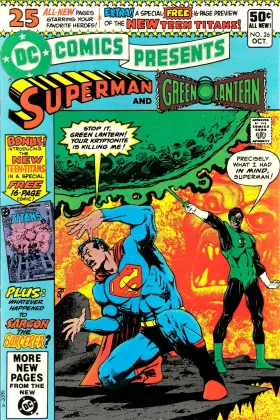
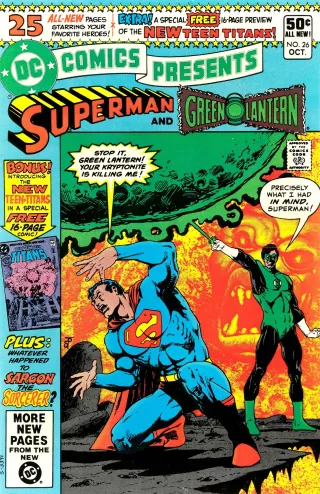
The New Teen Titans did not debut in their own #1. They debuted a month early, in a 16-page preview insert titled “Where Nightmares Begin!” bound into DC Comics Presents #26, cover-dated October 1980, behind that issue’s Superman team-up. The full ongoing, The New Teen Titans #1, followed in November 1980.
That one-month gap is the collector’s whole story, because the preview is where the new characters actually first appear. DC Comics Presents #26 carries the first Cyborg, the first Raven, and the first Starfire all at once, which makes it the key issue for the era and a book collectors chase for the trio, not for the Superman story on the cover. Anyone who buys The New Teen Titans #1 thinking it is the first appearance has the wrong issue by four weeks.
Who was in it
The founding roster ran seven deep, split between veterans and newcomers. The returning originals were Robin (Dick Grayson), Kid Flash (Wally West), and Wonder Girl (Donna Troy), Silver Age teen heroes finally written as adults-in-progress rather than junior copies of the heroes they trained under.
The four new members are the reason the book is remembered. Cyborg was a teenager rebuilt as a machine against his will; Raven was the half-demon empath fighting to keep her father out of the world; Starfire was an exiled alien princess; and Beast Boy, joining under the name Changeling, was the green shapeshifter brought over from the Doom Patrol. Three of the four, Cyborg, Raven, and Starfire, were created for this launch and debuted in the preview; Beast Boy was the veteran, imported and renamed.
DC’s answer to the X-Men
The comparison to the X-Men was not a stretch. Both books took young heroes from clashing backgrounds, locked them in a house together, and made their relationships the main event, with the soap-opera pacing where any issue might spend more time on a breakup than a battle. It was the formula reviving Marvel’s mutants in the same era, and it is why readers and critics filed the Titans next to the X-Men. For a stretch it made the New Teen Titans one of DC’s biggest hits of the decade, and it reset expectations for what a team book could be.
The Judas Contract
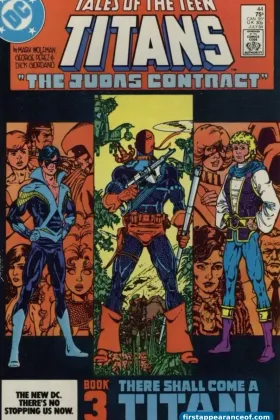
The run’s landmark is The Judas Contract, published in 1984 across Tales of the Teen Titans #42-44 and Tales of the Teen Titans Annual #3 (the series had been retitled from The New Teen Titans by then). In it, the traitor Terra infiltrates the team as a trusted member while secretly working for the mercenary Deathstroke to destroy them from the inside. It is one of the most acclaimed team-comic stories of its decade, the argument most often made for why this run belongs alongside the best superhero comics of the era, and the concluding chapters are the run’s other durable collector keys.
On screen
The 1980 team is the version the screen adapts. Teen Titans (2003-2006) built its cast, Robin, Cyborg, Beast Boy, Starfire, and Raven, straight off this run, and Teen Titans Go! (2013-present) has kept the same five in front of a younger audience ever since. The live-action Titans (2018-2023) drew its core from the same lineup, centering Dick Grayson, Starfire, Raven, and Beast Boy. None of them reach back to the 1960s Titans; they all start here.
Why it matters
Strip away the sales and the New Teen Titans are the proof that a supporting-cast concept can carry a franchise. DC had owned the Teen Titans for years without making them essential; Wolfman and Pérez managed it by taking the team seriously enough to give it real characters. The result is a run whose roster, Cyborg, Raven, and Starfire chief among them, has been feeding DC’s comics, cartoons, and films for over forty years.
Notable issues
- The Brave and the Bold #54 (1964): the original Teen Titans’ first appearance, the team this 1980 book relaunched.
- DC Comics Presents #26 (1980): the preview insert; first appearance of the New Teen Titans, and of Cyborg, Raven, and Starfire. The key.
- The New Teen Titans #1 (1980): the first ongoing issue, one month after the preview.
- Tales of the Teen Titans #44 (1984): a concluding chapter of the Judas Contract, and a run key in its own right.
- Tales of the Teen Titans Annual #3 (1984): the Judas Contract’s finale.
For collectors
The collector story concentrates in one book. DC Comics Presents #26 (1980) is the key, and it is a key three times over: the first New Teen Titans, the first Cyborg, the first Raven, and the first Starfire all sit in the same preview insert. As a Bronze Age book it was not printed scarce, so what carries it is that stacked debut plus decades of adaptations. After it, the run’s value lives in the Judas Contract chapters. For a first-appearance archive, the New Teen Titans are the rare team whose debut issue is also the debut of three of its most famous members.