Creation Story
The Punisher was Gerry Conway’s pitch at a moment when Marvel was running out of new antagonists for Spider-Man. Conway had taken over writing The Amazing Spider-Man from Stan Lee in 1972 and was looking for a character who could function as a one-off antagonist and potentially recur. His idea was a vigilante with military training, a specific grudge, and a moral logic that allowed him to kill: a character who could oppose Spider-Man without being villainous in the usual comics sense.
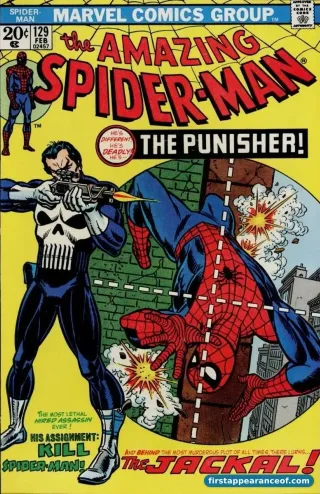
Amazing Spider-Man #129 (February 1974) introduced Frank Castle as a Vietnam-veteran Marine whose wife and children had been killed when they witnessed a mob execution in Central Park. The debut issue does not open with the origin; it opens with the Punisher already operational, hired by the Jackal to assassinate Spider-Man under the false pretense that Spider-Man is a murderer. Conway’s script treats Castle as a genuinely dangerous antagonist who happens to be wrong about his target. By the end of the issue, Spider-Man has cleared his name and the Punisher has walked away without being defeated. Marvel’s anti-hero template was set.
Ross Andru drew the interiors. John Romita Sr. drew the cover. The skull chest insignia, the black costume, and the visual language of the character were Andru’s contributions; Conway has said the name and concept were his. All three are credited as co-creators in modern Marvel attribution.
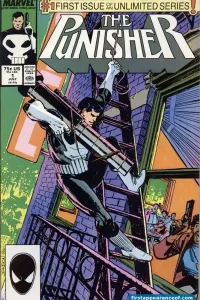
The character did not get a solo title for twelve years. Marvel ran Punisher through Spider-Man, Daredevil, Captain America, and other guest slots through the late 1970s and early 1980s. The 1975 Marvel Preview #2 gave the character his first full origin flashback in a black-and-white magazine format. The first proper solo book was the Steven Grant and Mike Zeck 1986 limited series, which led directly into Mike Baron’s 1987 ongoing. By 1992, Marvel was publishing three concurrent Punisher titles.
Collector context
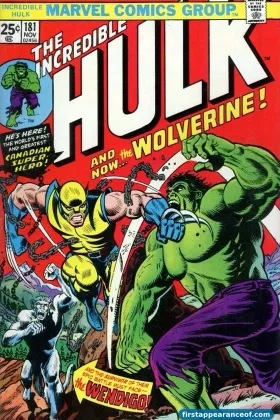
Amazing Spider-Man #129 is one of the five or six most-traded Bronze Age Marvel keys alongside Incredible Hulk #181 (Wolverine’s first full appearance), Giant-Size X-Men #1, and Marvel Spotlight #5 (Ghost Rider’s first). High-grade copies have crossed $30,000 at auction; low-grade reader copies trade in the $1,000 to $3,000 range depending on condition.
Prices on ASM #129 moved notably with three film adaptations (1989, 2004, 2008), held through the 2010s, and spiked with Jon Bernthal’s Netflix performance in Daredevil season 2 (2016) and the Punisher solo series (2017 to 2019). The performance permanently reset the character’s cultural visibility.
Secondary keys: the Steven Grant and Mike Zeck 1986 limited series #1 is the first Punisher solo book and trades as a true Copper Age key. The 1987 Mike Baron ongoing #1 is widely available in high grade. The Garth Ennis Marvel Knights Punisher #1 (2000) is a modern key with a strong reputation-driven market. The Ennis runs, particularly Punisher MAX, are the critical reference point for any serious Punisher reader.
Why the Punisher works
The Punisher is structurally a test case for how dark a mainstream-continuity Marvel hero can get and still operate in the shared universe. The character has been integrated into Spider-Man books, Avengers crossovers, and X-Men adjacent stories while simultaneously running the adult-audience MAX line where the tone is entirely different. Writers have used that split to tell two kinds of Punisher stories: the Marvel Universe Punisher who coexists with web-swinging heroes, and the grounded MAX Punisher who is a war-crime investigator operating in a world without superheroes. Both are canon; both are legitimate takes on the same character.