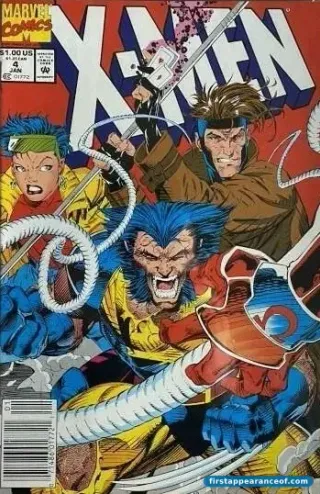
X-Men #4 (Vol. 2, 1992). Omega Red on the cover, his first appearance and first cover. Jim Lee art.

1st Appearance and 1st Cover

First Appearance of Omega Red

X-Men #4 (Vol. 2)

January 1992 · Marvel · Modern Age

Jim Lee's Soviet super-soldier answer to Wolverine. The Hulk-tier physical threat, the carbonadium tentacle weapon, and the Cold War ghost the X-Men keep dragging back into print.

Key Issue

Created by Jim Lee · John Byrne

By Atomm Updated

The first appearance (1st app) of Omega Red is X-Men #4 (Vol. 2, January 1992) — the 1991 Jim Lee relaunch, not the 1963 original series — created by Jim Lee (plots and pencils) and John Byrne (script). The issue is both his first appearance and first cover. Arkady Rossovich, a Soviet Cold War-era super-soldier project subject, is awakened by the Hand and immediately confronts the X-Men. The issue establishes his connection to Wolverine's Weapon X past and the Carbonadium-driven physiology that has remained canonical. X-Men #4 is a Modern Age key with strong adaptation-driven collector demand.

Quick Facts

Debut
X-Men #4 (January 1992)
Real name
Arkady Gregorivich Rossovich
Creators
Jim Lee (plots and pencils, co-creator), John Byrne (script, co-creator)
Publisher
Marvel Comics
First enemy
Antagonist himself.
First ally
Matsu'o Tsurayaba (his initial handler), the Hand
Team affiliations
None. Omega Red is consistently characterized as a solo operator.

First Appearance

  1. X-Men #4 (Vol. 2) cover
    First Appearance First Cover January 1992 Newsstand variant

    X-Men #4 (Vol. 2)

    By Jim Lee, John Byrne

    Jim Lee plots and pencils; John Byrne scripts. Omega Red, a Soviet super-soldier, is awakened by Matsu'o Tsurayaba and the Hand. The issue establishes his connection to Wolverine's Weapon X-era past and the Carbonadium framework that has remained canonical. The issue is both his first appearance and first cover. The book's print run was massive (X-Men #1, October 1991, sold over 8 million copies; subsequent issues maintained high circulation), so high-grade copies are abundant relative to typical Modern Age first appearances.

    Read the full breakdown

Creation Story

Omega Red is Jim Lee and John Byrne’s 1992 X-Men addition, created during Lee’s run on the relaunched X-Men flagship title. X-Men #4 (Vol. 2) (January 1992) — the second series to carry the X-Men title, launched in 1991, not the 1963 original — introduces Arkady Gregorivich Rossovich, a Soviet super-soldier project subject from the Cold War era who has been kept in cryogenic stasis since the program’s collapse. Matsu’o Tsurayaba and the Hand awaken him in service of an extortion plot against the X-Men. Lee plots and pencils; Byrne scripts; the issue cover is Lee’s iconic Omega Red front shot.

The character was deliberately positioned as a Soviet counterpart to Wolverine. Both are Cold War-era super-soldier products. Both have metal-bonded skeletons (Wolverine’s adamantium, Omega Red’s Carbonadium, an alloy explicitly designated as a less-effective Soviet analog of the Canadian original). The retroactive origin connects to Wolverine’s Weapon X timeline directly: the Carbonadium Synthesizer is an artifact Wolverine encountered during his Weapon X years, and the Synthesizer is the only known means of stabilizing Omega Red’s lethal physiology.

The book’s commercial context is important to the collector framing. X-Men #1 (October 1991) sold over 8 million copies, the highest-circulating single comic in Marvel history. Subsequent issues including #4 maintained substantial print runs. High-grade survival is abundant relative to typical Modern Age first appearances, which moderates the book’s price ceiling.

The Wolverine connection

X-Men #6 (March 1992) canonized Omega Red’s Weapon X-era connection to Wolverine. The Carbonadium Synthesizer became the recurring plot device that motivated most Omega Red stories: he hunts the Synthesizer to stabilize his death-spore physiology, and Wolverine knows where the Synthesizer is, keeping the two characters in adversarial entanglement. The framework gave Omega Red a tragic-register motivation (without the Synthesizer his own spores slowly poison him) that distinguished him from generic strongman antagonists.

X-Men #18 (March 1993) by Fabian Nicieza developed the carbonadium-coil tentacle weaponry that became Omega Red’s signature visual element. The tentacles, which retract into his forearms when not deployed, are the kind of high-concept Image-influenced design that defines the early-1990s X-Men aesthetic.

Adaptations

X-Men: The Animated Series (1992 to 1997) preserved the Cold War origin and Wolverine connection. The “Red Dawn” two-parter is the show’s most ambitious Omega Red treatment. The animated portrayal is the version that introduced the character to most non-comics audiences.

Deadpool & Wolverine (2024, Shawn Levy) is Omega Red’s most prominent live-action portrayal to date, appearing in the void-realm sequences as part of the film’s antagonist roster.

Collector context

X-Men #4 is the Omega Red Modern Age key. The book’s massive print run keeps high-grade survival abundant; CGC 9.8 copies trade in the $80 to $200 range depending on cover variant and adaptation-driven demand timing.

Secondary keys: X-Men #6 (1992, Wolverine past reveal, Carbonadium Synthesizer setup). X-Men #18 (1993, Carbonadium tentacle weaponry developed).
Key subsequent appearances

After the debut, these are the issues collectors and historians reach for next.

  1. 1992

    X-Men #4

    First appearance and first cover.

    Newsstand variant
  2. 1992

    X-Men #6

    Wolverine Past Reveal

    Jim Lee. Omega Red's connection to Wolverine's Weapon X past is canonized. The Carbonadium Synthesizer plot framework is established.

    Newsstand variant
  3. 1993

    X-Men #18

    Soul Daggers

    Fabian Nicieza. Omega Red's death-spore-emitting ability and Carbonadium-coil tentacle weaponry are fully developed in continuity.

In adaptations

Film, TV, animation, and game appearances.

  1. 1992

    X-Men: The Animated Series

    Animated

    Fox Kids series. Omega Red appears in the 'Red Dawn' two-parter and supporting capacity. The animated portrayal preserves the comics character framework and Cold War backstory.

  2. 2024

    Deadpool & Wolverine

    Film

    Shawn Levy directs. Omega Red appears in a brief antagonist capacity in the void-realm sequences. The most prominent live-action portrayal to date.

Frequently asked questions

The questions readers and collectors ask most.

What is Omega Red's first appearance?

Omega Red's first appearance is X-Men #4 (January 1992), created by Jim Lee (plots and pencils) with John Byrne on script. The issue is both his first appearance and first cover. Arkady Rossovich, a Soviet super-soldier project subject, is awakened by the Hand.

Is X-Men #4 valuable?

Yes, but with a caveat. X-Men #4 is a Modern Age key, but the early X-Men (1991) print runs were massive. X-Men #1 sold over 8 million copies; X-Men #4 maintained substantial circulation. High-grade copies survived in large numbers. CGC 9.8 copies trade in the $80 to $200 range depending on cover variant and timing of sale. Demand has tracked with adaptation visibility (the X-Men: The Animated Series 'Red Dawn' two-parter, the 2024 Deadpool & Wolverine appearance).

Is Omega Red connected to Wolverine?

Yes. The Omega Red origin retroactively connects to Wolverine's Weapon X past. Both characters are products of Cold War-era super-soldier programs (Wolverine through Canada's Department K, Omega Red through the Soviet equivalent). The connecting plot device is the Carbonadium Synthesizer, an artifact that controls Omega Red's death-spore physiology. Wolverine encountered the Synthesizer during his Weapon X years and is one of the few Marvel characters with personal knowledge of how Omega Red can be contained.

What is Carbonadium?

A fictional Marvel metal alloy that Soviet scientists developed as a low-grade analog of adamantium. Carbonadium is more flexible than adamantium and bonded to Omega Red's bones; the alloy is also the substrate of his retractable tentacle-coils. Without the Carbonadium Synthesizer (the artifact that regulates the alloy's interaction with his physiology), Omega Red's death-spores are slowly toxic to himself. The Synthesizer is the recurring plot device that motivates most Omega Red stories.

Why does Omega Red emit 'death spores'?

His mutant ability generates lethal pheromones that drain life force from anyone in proximity. The death-spore emission was originally portrayed as uncontrolled, requiring the Carbonadium Synthesizer to keep him alive (without the alloy stabilization, his own spores would slowly kill him). The framework gives his existence a low-grade tragic register: he is dependent on the Soviet super-soldier program's residual technology for his own survival, which keeps him politically and operationally entangled even when he wants to operate alone.