Creation Story
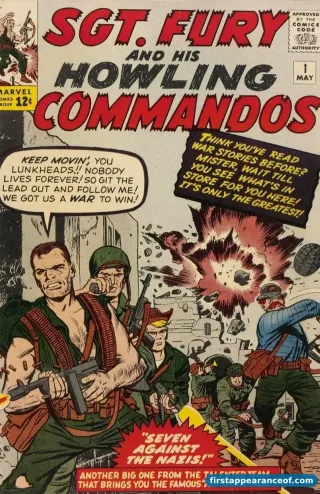
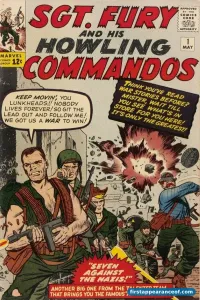
Nick Fury is one of the few Marvel characters with two distinct first-appearance keys representing two different genres. Stan Lee and Jack Kirby launched Sgt. Fury and His Howling Commandos #1 in May 1963 as a Marvel war comic, not a superhero book. Fury is a World War II Army sergeant leading the First Attack Squad, a unit of Howling Commandos serving in the European theater. The book ran for over twenty years and was one of Marvel’s most durable non-superhero titles. Dick Ayers was the primary penciller for much of the run.
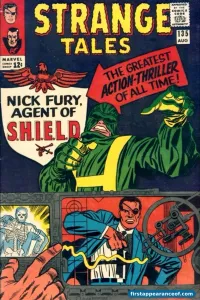
Two years later, Lee and Kirby reintroduced the character in Strange Tales #135 (August 1965) as director of S.H.I.E.L.D., a Cold War-era intelligence agency. The same character, aged up from WWII service, now operating as a spy in a modern superhero setting. The framing was novel: Marvel had no shared-universe spy hero, and the genre fit neatly alongside the publisher’s superhero books. Fury’s S.H.I.E.L.D. stories ran as a back-up feature in Strange Tales from #135 through the series’ end, then took over the title with Nick Fury, Agent of S.H.I.E.L.D. #1 in June 1968.
The Jim Steranko run on Strange Tales and the early issues of Nick Fury, Agent of S.H.I.E.L.D. is the single most influential Silver Age spy-comics work Marvel published. Steranko’s psychedelic page layouts, photomontage techniques, and avant-garde design vocabulary defined the visual language of Marvel’s spy genre and influenced every subsequent S.H.I.E.L.D. artist.
The Ultimate Fury pivot
The Ultimates #1 (March 2002) by Mark Millar and Bryan Hitch introduced the Ultimate Nick Fury: a Black man explicitly designed to resemble Samuel L. Jackson. Bryan Hitch has said the design was a love letter to Jackson’s on-screen persona. Jackson himself saw the comics character, contacted Marvel, and was cast in the 2008 Iron Man mid-credits scene as a setup for the MCU.
Jackson’s MCU performance across thirteen-plus films and television series has become the default Nick Fury for most modern audiences. Marvel’s main-continuity Nick Fury was gradually shifted to a character who looks like Jackson (Nick Fury Jr., the 616-continuity’s son of the original Fury, introduced in 2012). The Jackson-designed Fury is now more familiar than the Lee-Kirby original for readers who came to Marvel through the films.
Collector context
Sgt. Fury and His Howling Commandos #1 is a Silver Age Marvel key. High-grade CGC copies have crossed $25,000 at auction. Low-grade reader copies are accessible for a few thousand dollars. The book’s value held through Jackson’s MCU tenure.
Strange Tales #135 (first S.H.I.E.L.D. Fury) is a parallel key and often the one that matters more to collectors focused on the modern spy-era character. High-grade copies in the low-four-figure range. Nick Fury, Agent of S.H.I.E.L.D. #1 (1968) is the first self-titled series and the Steranko-run starting point.
The Ultimates #1 (2002) is the Ultimate Nick Fury key and the book that set up the Jackson MCU casting. Modern-era key; accessible in high grade.