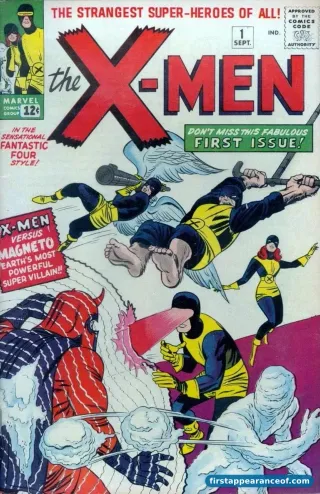
Jean Grey as Marvel Girl on the cover of X-Men #1 (1963), flying alongside the original team.

1st Appearance as Marvel Girl

First Appearance of Jean Grey

X-Men #1

September 1963 · Marvel · Silver Age

The X-Man whose biggest moments were her transformations. Marvel Girl, Phoenix, Dark Phoenix, each a distinct character and a distinct collector key.

Key Issue

Created by Stan Lee · Jack Kirby

By Atomm Updated

Jean Grey has three distinct first-appearance keys that collectors treat as separate books. Her first appearance as Marvel Girl is X-Men #1 (September 1963), created by Stan Lee and Jack Kirby. Her first appearance as Phoenix is X-Men #101 (October 1976), by Chris Claremont and Dave Cockrum. Her first appearance as Dark Phoenix is X-Men #135 (July 1980), by Claremont and John Byrne. The character is unique in having a three-stage publishing identity, each with its own collectible key.

Quick Facts

Debut
X-Men #1 (September 1963) as Marvel Girl
Real name
Jean Elaine Grey
Creators
Stan Lee (script), Jack Kirby (art). Phoenix identity by Chris Claremont and Dave Cockrum (X-Men #101, 1976). Dark Phoenix by Claremont and John Byrne (X-Men #135, 1980).
Publisher
Marvel Comics
First enemy
Magneto (shared X-Men #1 antagonist)
First ally
Cyclops (her lifelong romantic partner, founding X-Men together)
Team affiliations
X-Men (founding member), X-Factor, Red X-Men

Firsts Timeline

  1. X-Men #1 cover
    First Appearance as Marvel Girl September 1963

    X-Men #1

    By Stan Lee, Jack Kirby

    Jean Grey debuts as Marvel Girl, the sole female founding member of the X-Men. Stan Lee writes; Jack Kirby designs. Her telekinesis is the initial power; telepathy is added later in the Lee and Kirby run.

    Read the full breakdown
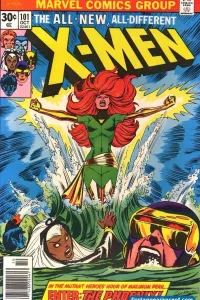
  2. X-Men #101 cover
    First Appearance as Phoenix October 1976

    X-Men #101

    By Chris Claremont, Dave Cockrum

    Chris Claremont and Dave Cockrum transform Marvel Girl into Phoenix at the end of a story arc. The visual transformation, the new costume, and the Phoenix Force entity all debut in this issue. The defining Jean Grey key for modern collectors.

    Read the full breakdown
  3. First Appearance as Dark Phoenix July 1980

    X-Men #135

    By Chris Claremont, John Byrne

    Claremont and Byrne's Dark Phoenix Saga reaches its transformation point. Phoenix becomes Dark Phoenix, devours a star, and kills billions. The arc concludes in X-Men #137 with Jean's death.

    Read the full breakdown

Creation Story

Jean Grey is one of the few Marvel characters whose collectible first-appearance spans three distinct keys corresponding to three identity transformations. The Marvel Girl debut in X-Men #1 (September 1963) is her original introduction alongside the rest of the founding team. Phoenix in X-Men #101 (October 1976) and Dark Phoenix in X-Men #135 (July 1980) are the transformations that define the character’s modern-era cultural weight.

Stan Lee and Jack Kirby created Marvel Girl. Jean’s original powers were telekinesis; telepathy was added in later Lee and Kirby issues. Kirby designed the original costume (green and yellow with a mask), which has been re-adopted by Marvel Girl-era flashback sequences.

Chris Claremont and Dave Cockrum transformed Jean into Phoenix in X-Men #101. The story: Jean pilots a space shuttle through a solar-radiation storm to save the team, her death is implied, and she emerges in a pool of water on Earth transformed into a cosmic-powered being calling herself Phoenix. Cockrum’s redesign of the costume (green and gold with a phoenix-emblem chest insignia) is one of the most-imitated X-Men visuals. The Phoenix Force mythology expanded from this single issue into a Marvel cosmic entity still active across events.

Claremont and John Byrne built the Dark Phoenix Saga across Uncanny X-Men #129 to #138 (1980). The arc tracks Jean’s corruption by the Phoenix Force, her transformation into Dark Phoenix in X-Men #135, her consumption of a star in a distant galaxy (killing billions of alien inhabitants), and her eventual sacrifice on the moon in X-Men #137 to stop herself from killing again. The arc is widely considered one of the greatest superhero stories ever published.

The retcon problem

Jean Grey’s death in X-Men #137 was meant to be permanent. Editor-in-chief Jim Shooter had personally signed off on it; the stakes were explicit. Six years later, X-Factor #1 (1986) retconned the entire Dark Phoenix story: the Jean who had become Dark Phoenix was not Jean at all, but the Phoenix Force impersonating her. The original Jean Grey had been preserved in a healing cocoon at the bottom of Jamaica Bay the entire time. The retcon was controversial and remains one of the most-discussed editorial decisions in X-Men history.

The retcon created a long-standing continuity problem: if the Phoenix Force was a separate entity and Jean was not responsible for the Dark Phoenix killings, what was the emotional weight of the original arc? Subsequent writers have worked around the retcon in different ways. Grant Morrison’s New X-Men (2001 to 2004) treated Phoenix as a real piece of Jean’s identity rather than a separate entity, then killed her again in New X-Men #150 (2004). The Phoenix Force continued to appear across events (Avengers vs X-Men, Phoenix Resurrection) as a distinct character.

Collector context

X-Men #1 is the Marvel Girl key. X-Men #101 is the Phoenix key. X-Men #135 is the Dark Phoenix key. X-Men #137 is the Phoenix-death issue. All four are Bronze Age or Silver Age keys that collectors track separately.

The defining single-book key for most collectors is X-Men #101 because it is the Phoenix transformation and the starting point of the modern-era Jean Grey. It also triggers the Dark Phoenix Saga directly. High-grade copies have crossed $5,000 at auction. The Claremont and Byrne run from Uncanny X-Men #108 to #143 is one of the most collected Marvel runs of the Bronze Age.
Key subsequent appearances

After the debut, these are the issues collectors and historians reach for next.

  1. 1963

    X-Men #1

    First appearance as Marvel Girl. Shared debut with the other founding X-Men.

  2. 1976

    X-Men #101

    First Phoenix

    Phoenix transformation. Claremont and Cockrum. Modern-era collector key.

  3. 1980

    X-Men #135

    Dark Phoenix

    Dark Phoenix transformation. Claremont and Byrne.

  4. 1980

    X-Men #137

    Dark Phoenix Death

    Conclusion of the Dark Phoenix Saga. Jean Grey dies. One of the most consequential character deaths in Marvel history.

  5. 1986

    X-Factor #1

    Jean Grey returns to life. Retcon reveals the Dark Phoenix was the Phoenix Force impersonating Jean; the original Jean was preserved. Bob Layton and Jackson Guice launch the reunion book.

  6. 2004

    New X-Men #150

    Morrison's Death

    Jean dies again at the end of Grant Morrison's New X-Men run. Kept dead for over a decade.

  7. 2017

    Phoenix Resurrection #1

    Matthew Rosenberg-written limited series that brings Jean Grey back to life. The modern-era return.

In adaptations

Film, TV, animation, and game appearances.

  1. 1992

    X-Men: The Animated Series

    Animated

    Starring:Catherine Disher

    Five-season Fox Kids series. Disher's voice performance includes the Dark Phoenix Saga, widely regarded as one of the best animated adaptations of a Marvel arc.

  2. 2000

    X-Men

    Film

    Starring:Famke Janssen

    Bryan Singer directs. Janssen plays Jean across the original X-Men film trilogy.

  3. 2006

    X-Men: The Last Stand

    Film

    Starring:Famke Janssen

    Brett Ratner. Adapts the Dark Phoenix Saga loosely; widely panned for the simplification.

  4. 2011

    X-Men: First Class

    Film

    Starring:Not featured as lead

    The prequel era begins without Jean Grey.

  5. 2016

    X-Men: Apocalypse

    Film

    Starring:Sophie Turner

    Bryan Singer. Turner's Jean Grey in the 1980s-set prequel.

  6. 2019

    Dark Phoenix

    Film

    Starring:Sophie Turner

    Simon Kinberg directs. Second film adaptation of the Dark Phoenix Saga. Failed commercially and critically.

Frequently asked questions

The questions readers and collectors ask most.

What is Jean Grey's first appearance?

Jean Grey's first appearance as Marvel Girl is X-Men #1 (September 1963). Her first appearance as Phoenix is X-Men #101 (October 1976). Her first appearance as Dark Phoenix is X-Men #135 (July 1980). Collectors treat all three as distinct keys. Her single first-appearance key (as a character) is X-Men #1.

Is X-Men #101 valuable?

Yes. X-Men #101 is the defining Phoenix key and one of the most important Bronze Age Marvel books. High-grade copies (CGC 9.0 and above) have crossed $5,000 at auction. The issue's collector weight is entirely tied to the Phoenix transformation and the subsequent Dark Phoenix Saga. The book trades below X-Men #1 (where Jean first appears as Marvel Girl) but above most other Claremont-era X-Men keys.

What is the Dark Phoenix Saga?

The Dark Phoenix Saga is the X-Men arc running across Uncanny X-Men #129 to #138 (January to October 1980) by Chris Claremont and John Byrne. Jean Grey, already transformed into Phoenix, becomes Dark Phoenix, devours a star (killing billions of alien inhabitants), and is eventually stopped when she sacrifices herself on the moon in X-Men #137. The arc is widely considered one of the greatest superhero stories ever published and anchors Claremont and Byrne's collaborative run.

Did Jean Grey really die?

Yes, twice. She died at the end of the Dark Phoenix Saga in X-Men #137 (1980) and stayed dead until X-Factor #1 (1986) retconned the death. She died again at the end of Grant Morrison's New X-Men run in 2004 and stayed dead until Phoenix Resurrection #1 (2017). Both deaths were consequential and both resurrections were editorially significant. The second resurrection set up the Matthew Rosenberg Jean Grey solo title and her return to the modern X-Men books.

Who created Phoenix?

Chris Claremont and Dave Cockrum introduced the Phoenix identity and visual in X-Men #101 (October 1976). Claremont plotted and scripted; Cockrum pencilled. John Byrne, who took over as penciller for the later X-Men run, co-wrote and drew the Dark Phoenix Saga with Claremont and is often credited as a primary architect of the Dark Phoenix arc specifically.