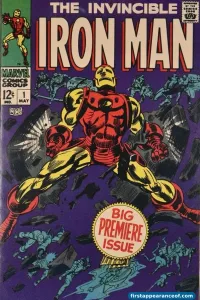
Creation Story
Iron Man was Stan Lee’s experiment in getting readers to root for a character they should have hated. In 1962 Marvel’s readership was teenagers, and the Cold War was the subtext of every superhero book on the stands. Lee made the bet that a Cold-War-era industrialist arms dealer, the exact profile of the establishment the same readers were mistrusting, could become the hero of a book if the arms dealer himself was forced to confront what his weapons did. “It was the reader’s chance to root for someone they would ordinarily have been against,” Lee wrote later. The pitch worked on the readership the way he predicted.
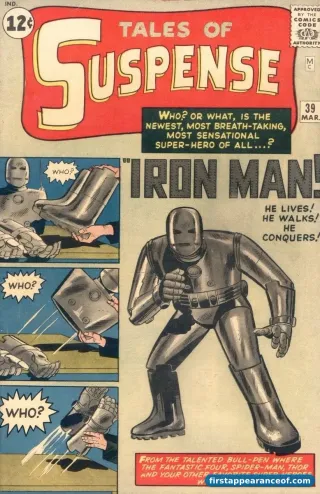
The writing was a three-way split. Lee plotted Tales of Suspense #39 and handed the script off to his younger brother Larry Lieber, who did the scripting for several of Marvel’s early 1960s book launches (Thor, Ant-Man, Iron Man) while Lee focused on the flagship Fantastic Four and Spider-Man titles. Don Heck pencilled the interiors. Jack Kirby designed the cover and the original gray armor silhouette. The issue was a thirteen-page story in an anthology title (Tales of Suspense was a monster-and-suspense book at the time); Iron Man did not headline his own solo series until 1968.
The first Iron Man story is structurally the cleanest superhero origin of the decade. Stark is captured by Vietnamese forces, wounded by a shrapnel booby-trap in his own weapons, held captive with a fellow prisoner (the scientist Yinsen), and forced to build weapons. Instead he builds an armored suit with a battery-powered magnet to keep the shrapnel out of his heart and breaks out. Yinsen is killed covering Stark’s escape. Stark returns to the United States as Iron Man and carries the reminder of Yinsen’s death for the rest of the character’s publishing history.
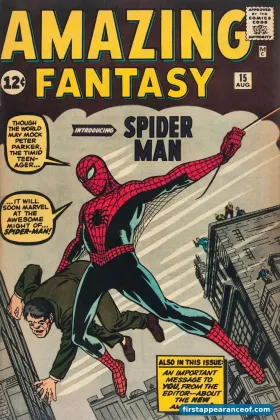
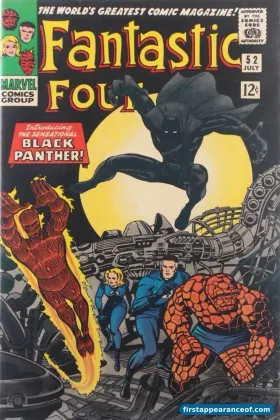
For collectors, Tales of Suspense #39 is one of the most-traded Silver Age Marvel keys alongside Amazing Fantasy #15 and Fantastic Four #1. The book was reprinted immediately and repeatedly through the 1960s and 1970s, but first prints are identifiable by indicia and by cover-price variations. High-grade copies crossed $300,000 at auction after the 2008 film and the character’s MCU-era cultural weight has kept demand elevated.
Why the armor keeps changing
The Iron Man armor has been redesigned more times than any other single piece of costume iconography in Marvel. Tales of Suspense #39 is the gray armor. Tales of Suspense #40 is the gold version. Tales of Suspense #48 (December 1963) is the red-and-gold, redesigned by Steve Ditko, which is the version that became the character’s permanent identity. From there the armor has been upgraded, miniaturized, weaponized, and nanotech-integrated across more than sixty years of continuity, with major redesigns landing in Iron Man #200 (Silver Centurion), Iron Man: Extremis (nano-armor), the 2008 film (practical-effect plate armor by Stan Winston Studios), and the Bleeding Edge armor (Matt Fraction era).
For new readers trying to find an entry point: Extremis #1 to #6 (2005) by Warren Ellis and Adi Granov is the starting point that works best. The six-issue arc is self-contained, it was the primary reference for the 2008 film, and it establishes the modern Tony Stark voice that Robert Downey Jr. channelled.
Collector context
Tales of Suspense #39 is a book most serious Silver Age Marvel collectors work toward rather than start with. It trades below Amazing Fantasy #15 and Fantastic Four #1 but above Journey into Mystery #83 (Thor’s first) and Strange Tales #110 (Doctor Strange’s first). The 2008 film permanently reset the character’s cultural visibility and pulled Iron Man collectibles into the same tier as Spider-Man, Fantastic Four, and X-Men rather than the tier below where they had traded through the 1990s.
First printings of the Iron Man #1 (1968) self-titled series remain accessible in mid-grade, and the Jim Starlin-era issues (Iron Man #55 with the first appearance of Thanos and Drax) are the Bronze Age Iron Man keys that collectors chase hardest after the 2018 Avengers films made Thanos the most-searched Marvel villain in census data.