Creation Story
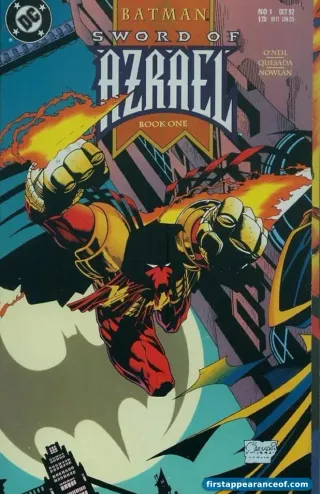
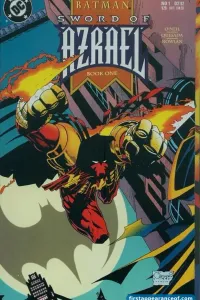
Azrael is Dennis O’Neil and Joe Quesada’s Knightfall lead-in. Batman: Sword of Azrael #1 (October 1992) launches a four-issue limited series that introduces Jean-Paul Valley, a Gotham University computer-science student whose late father Ludovic was secretly the latest avatar of the Azrael identity, the enforcer of the Order of Saint Dumas. Jean-Paul inherits the role under stress when his father is murdered.
O’Neil writes; Quesada pencils; Kevin Nowlan inks. The series is a deliberate setup for the Knightfall crossover that would launch six months later. DC editorial wanted a candidate to take the Batman role during Bruce Wayne’s back-broken recovery, and the Sword of Azrael limited series introduces Jean-Paul as a credible alternate-Batman: trained from infancy via psychological conditioning, possessed of esoteric combat skills, and unstable enough to make his eventual tenure narratively interesting.
The Quesada art is widely cited as a high point in his pre-Marvel work. Quesada later became Marvel’s Editor-in-Chief from 2000 to 2011, but the Sword of Azrael run remains his most-discussed early-career project.
Becoming Batman
Batman #497 (July 1993) is the back-break issue: Bane breaks Bruce Wayne’s spine. Batman #500 (October 1993) is the formal transition: Jean-Paul Valley assumes the Batman identity. Doug Moench writes; Jim Aparo and Mike Manley provide art. Bruce specifically chose Jean-Paul over Dick Grayson and Tim Drake; the choice was deliberately costly, signaling Bruce’s belief that protecting his protégés mattered more than ensuring continuity.
Jean-Paul’s deep psychological conditioning by the Order of Saint Dumas resurfaced under the stress of the Batman role. The “AzBat” era (Batman #500 to #514, late 1993 through 1994) is widely regarded as one of the most divisive Bat-runs in history. Jean-Paul’s armored gold-and-black Batman, his willingness to kill antagonists, and his isolation from the Bat-family allies are deliberate dramatic departures from Batman convention. The arc was structurally a study in how the Batman role corrupts an unprepared inheritor; readers’ reactions ranged from “overwrought 1990s excess” to “deliberate counterargument to grimdark Batman.”
The AzBat era ended in Batman #509 to #514 (Doug Moench and Mike Manley) when Bruce Wayne returned, defeated Jean-Paul in the redesigned Batcave, and reclaimed the cowl. Jean-Paul retreated, broken, and would re-emerge later as Azrael in his solo title.
The solo era
Azrael #1 (February 1995) launched the character’s first ongoing. Dennis O’Neil continued writing his co-creation. Barry Kitson pencilled. The book ran 100 issues through 2003 and was re-titled Azrael: Agent of the Bat with issue #47 to formalize Jean-Paul’s reintegration into the Bat-family network. The solo run is widely regarded as O’Neil’s strongest extended Bat-mythos work outside Detective Comics.
Adaptations
James Frain’s Theo Galavan / Azrael in Gotham (Fox, 2014) is the most prominent live-action portrayal, though the comics framework is loosely adapted. Sean Maher’s Azrael in Batman: Hush (2018, animated) is the most comics-faithful screen treatment.
Collector context
Batman: Sword of Azrael #1 is the Azrael Modern Age key. High-grade CGC 9.8 copies have crossed $300 at auction.
Secondary keys: Batman #500 (1993, Jean-Paul becomes Batman). Azrael #1 (1995, first solo). Batman #514 (Bruce reclaims cowl, AzBat era ends).