First Appearance

First Appearance of Zatanna

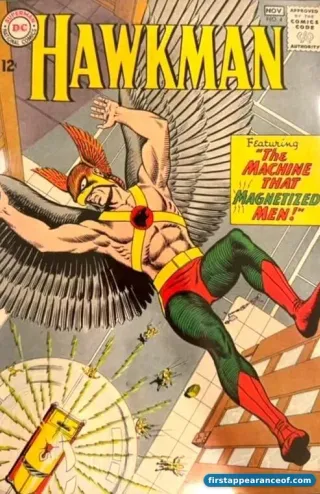
Hawkman #4 (1964). DC's backwards-speaking Mistress of Magic, daughter of the Golden Age magician Zatara, who debuted in 1964 on a quest to find her vanished father.

By Atomm Updated

Hawkman #4 (1964), the issue that introduces Zatanna as she begins the search for her missing father, Zatara.

First Appearance

  1. First Appearance November 1964

    Hawkman #4

    By Gardner Fox, Murphy Anderson

    Zatanna debuts in 'The Girl Who Split in Two!', written by Gardner Fox and drawn by Murphy Anderson. She arrives looking for her vanished father, the Golden Age magician Zatara, the hook that launched a multi-title crossover across the DC line.

    Read the full breakdown

Quick Facts

Debut
Hawkman #4 (November 1964)
Real name
Zatanna Zatara
Creators
Gardner Fox (writer), Murphy Anderson (artist)
Publisher
DC Comics
First ally
The DC heroes she recruits across the 'Search for Zatara' crossover, including Hawkman, the Atom, and Green Lantern
Team affiliations
Justice League of America, Justice League Dark, the Sentinels of Magic

The first appearance (1st app) of Zatanna is Hawkman #4 (November 1964), created by writer Gardner Fox and artist Murphy Anderson. She is Zatanna Zatara, a stage magician who casts spells by speaking incantations backwards, the daughter of the Golden Age magician Zatara. Her debut opened a multi-issue "Search for Zatara" crossover that ran through several DC titles before resolving in Justice League of America #51 (1967). She later joined the Justice League and became DC's signature sorceress.

Creation Story

Zatanna arrived as a question before she was a character. Writer Gardner Fox and artist Murphy Anderson introduced her in Hawkman #4 (November 1964), and rather than open with an origin, they dropped her into the middle of a mystery: a young magician hunting for her vanished father. Readers met her already in motion, with a goal and a gimmick and almost no backstory, which was the point. The missing father was the Golden Age magician Zatara, and the search for him was built to spill out of Hawkman and into other heroes’ books.

That gimmick is the spellcasting. Zatanna works magic by speaking her commands backwards, the same device Fox had given Zatara in his Golden Age stories. Fox had written those early Zatara strips himself, so Zatanna was less a new invention than a second generation of an idea he already owned. Editor Julius Schwartz coordinated the rollout across the line, and the result was one of DC’s earliest attempts at a continuity that ran through several titles at once, with a new heroine as the connective tissue.

First Appearance: Hawkman #4

Hawkman #4, cover-dated November 1964, carries Zatanna’s debut in the story “The Girl Who Split in Two!” She comes to Hawkman and Hawkgirl for help finding her father, and the issue establishes the pieces that would define her: the backwards incantations, the stage-magician costume, and the family legacy she is trying to recover. Fox writes and Anderson draws, the same team steering the Hawkman title at the time.

As a collector book, #4 is a Silver Age DC key on the strength of that first appearance rather than the issue’s wider fame. It is the start of a character still headlining stories sixty years later, the kind of long-lived debut a first-appearance archive exists to track.

The Search for Zatara

The debut was the opening chapter of a deliberate crossover. Zatanna’s hunt for her father continued through The Atom #19 (1965), Green Lantern #42 (1966), and a chapter in Detective Comics #355 (1966), before the quest resolved in Justice League of America #51 (1967), where she finally reunites with Zatara. Spreading a single storyline across four unrelated titles was unusual for the mid-1960s, and it gave Zatanna a reach few new characters got: by the time the search ended, she had guest-starred alongside a big slice of the DC roster.

That visibility paid off. A 1978 reader poll led editor Julius Schwartz to induct her as a full member of the Justice League in Justice League of America #161, and from there she settled in as DC’s go-to sorceress. Later stories sharpened her: Brad Meltzer’s Identity Crisis (2004) put her at the center of the League’s memory-wiping scandal, and Grant Morrison’s Seven Soldiers: Zatanna (2005) rebuilt her as a working magician haunted by her father’s shadow. A 2010 solo series by Paul Dini carried that version forward.

For collectors

The collector story is clean: Hawkman #4 is the one issue that matters, the single first appearance of a character with a long shelf life. The books that follow are story keys rather than scarcity plays. Justice League of America #161 marks her League induction, Identity Crisis reframed her for a generation of readers, and the Morrison and Dini runs are where the modern Zatanna was assembled. None of them carries the weight of the 1964 debut. If you are tracing the Mistress of Magic, the path starts and stays at Hawkman #4.
Key subsequent appearances

After the debut, these are the issues collectors and historians reach for next.

  1. 1967

    Justice League of America #51

    Crossover Finale

    The end of the 'Search for Zatara' run that began with her debut. Zatanna finally reunites with her father after a quest that had threaded through four other heroes' titles, closing one of DC's earliest multi-book continuity events.

  2. 1978

    Justice League of America #161

    Joins the League

    After a reader poll run by editor Julius Schwartz, Zatanna is inducted as a full member of the Justice League of America in 'The Reverse-Spells of Zatanna's Magic' by Gerry Conway and Dick Dillin. It moved her from recurring guest to A-list DC hero.

  3. 2004

    Identity Crisis

    The Mind-Wipe

    Brad Meltzer's event makes Zatanna central to its most divisive reveal: that the League had used her magic to wipe the memories of villains, and of Batman when he objected. It recolored the character and the League's history for years of stories afterward.

  4. 2005

    Seven Soldiers: Zatanna

    Morrison Solo

    Grant Morrison's four-issue limited series, part of the larger Seven Soldiers project, rebuilds Zatanna as a working magician wrestling with her father's legacy and her own confidence. The take most modern writers draw from.

In adaptations

Film, TV, animation, and game appearances.

  1. 1993

    Batman: The Animated Series

    Animated

    Starring:Julie Brown

    Zatanna's animated debut, in a 1993 episode written by Paul Dini, who would go on to write her 2010 solo comic.

  2. 2010

    Young Justice

    Animated

    Starring:Lacey Chabert

    Chabert voices Zatanna as a member of the young team, with the show drawing heavily on her relationship with her father, Zatara.

  3. 2010

    Smallville

    TV

    Starring:Serinda Swan

    Swan plays Zatanna across the show's final three seasons as a fellow magic-user who crosses paths with Clark Kent, her first live-action appearance.

  4. 2017

    Justice League Dark

    Animated

    Starring:Camilla Luddington

    In the DC animated film, Luddington voices Zatanna as part of its supernatural team, the version that pairs her with DC's occult corner rather than the mainline League.

Frequently asked questions

The questions readers and collectors ask most.

What is Zatanna's first appearance?

Zatanna's first appearance is Hawkman #4 (November 1964), in the story 'The Girl Who Split in Two!' by writer Gardner Fox and artist Murphy Anderson. She debuts mid-mystery, already searching for her missing father, the magician Zatara.

How does Zatanna's magic work?

She casts spells by speaking her commands backwards. To make something rise she might say 'esir,' and the spell does the rest. It is the same trademark device her father Zatara used, and it lets writers show exactly what she is doing while keeping the magic readable.

Is Zatanna related to Zatara?

Yes. Zatanna is the daughter of Giovanni Zatara, a Golden Age magician who first appeared in Action Comics #1 (June 1938), the same issue that introduced Superman. Gardner Fox, who had written Zatara's early stories, created Zatanna decades later and built her debut around the search for him.

What was the 'Search for Zatara'?

It was an early DC crossover that used Zatanna's hunt for her father as a thread through other heroes' books. Beginning in Hawkman #4 (1964), it continued through The Atom, Green Lantern, and Detective Comics before resolving in Justice League of America #51 (1967), an unusual piece of multi-title continuity for the period.

Related characters