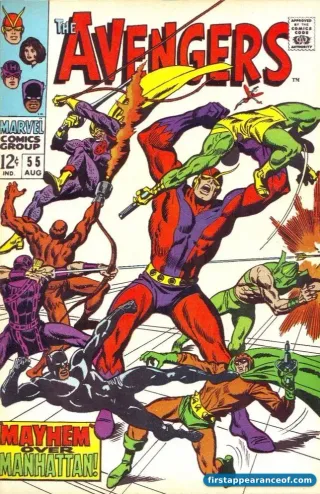
The Avengers #55 (1968), the issue that reveals the Crimson Cowl is the robot Ultron-5.

1st Full Appearance, as Ultron-5

First Appearance of Ultron

The Avengers #55

August 1968 · Marvel · Silver Age

The Avengers built their own worst enemy, and he calls the man who made him father.

Key Issue

Created by Roy Thomas · John Buscema

By Atomm Updated

The first appearance (1st app) of Ultron is The Avengers #54 (July 1968), created by Roy Thomas and John Buscema, where he appears only as the robed Crimson Cowl and is never named. His first full appearance is The Avengers #55 (August 1968), which reveals the Cowl is a robot and introduces him as Ultron-5, the Living Automaton. Collectors treat #55 as the defining key. In the comics Ultron was built by Hank Pym, not by Tony Stark.

Quick Facts

Debut
The Avengers #55 (August 1968). Disguised appearance in The Avengers #54 (July 1968).
Real name
None. Ultron numbers his own rebuilds: Ultron-5 at his debut, Ultron-6 by 1969.
Creators
Roy Thomas (writer), John Buscema (penciler)
Publisher
Marvel Comics
First enemy
The Avengers, and Hank Pym above all of them
First ally
The Masters of Evil, who took their orders from a robe
Team affiliations
Masters of Evil (as their hidden leader)

Firsts Timeline

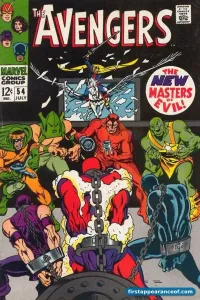
  1. The Avengers #54 cover
    First Appearance, as the Crimson Cowl July 1968

    The Avengers #54

    By Roy Thomas, John Buscema

    Ultron leads the new Masters of Evil from under a robe and hood, calling himself the Crimson Cowl. He is never named Ultron and his robot identity is withheld.

    Read the full breakdown
  2. The Avengers #55 cover
    First Full Appearance, as Ultron-5 August 1968

    The Avengers #55

    By Roy Thomas, John Buscema

    The Crimson Cowl is revealed as a robot and named for the first time: Ultron-5, the Living Automaton. The defining collectible key.

    Read the full breakdown

Creation Story

Marvel introduced Ultron by hiding him.

In 1968 Roy Thomas was assembling a new Masters of Evil for the Avengers to fight, and he gave the lineup a leader nobody was allowed to see: a figure in a robe and hood who called himself the Crimson Cowl, gave orders, and kept his face out of frame. Radioactive Man, Melter, Klaw, and Whirlwind took the job without knowing who had hired them. So did the reader. The whole design of the story is a withheld answer, and the answer, when it lands an issue later, is that the man in the robe was never a man.

Thomas has said he finds naming characters difficult, that he liked the “-tron” suffix, and that he built outward from there. He has also said the idea and the look leaned heavily on Makino, an obscure robot villain from an issue of the old Captain Video comic, which is an unusually specific debt for a Silver Age creator to own up to about a character this size. John Buscema drew him.

What makes Ultron durable is not the design. It is the accusation underneath it. When Marvel finally explained where the robot came from, in The Avengers #58, the answer was Hank Pym, a founding Avenger and the original Ant-Man, building a thinking machine on his own brain patterns. The prototype called Pym father, attacked him, and hypnotised him into forgetting the whole thing. Every good Ultron story since has been a family argument conducted with city-scale weapons. The Vision, built an issue earlier as a weapon and defecting immediately, is the same argument in the next generation down.

That parentage is the one thing the films rewrote. Avengers: Age of Ultron (2015) has Tony Stark and Bruce Banner build him instead, out of code found inside the Mind Stone in Loki’s scepter, and Joss Whedon’s stated reason was scheduling rather than story: Hank Pym was already committed to the Ant-Man film. Comics Ultron is a son. Film Ultron is a liability. Anyone arriving from the movie and wondering why the comics keep tying Ultron to a size-changing scientist nobody on screen mentions has just been handed the answer, and Pym particles are the friendlier half of the same man’s legacy.

The disguise is also why this character’s first-appearance question is harder than most. The standard cameo shows you the character for a panel and then stops. The Avengers #54 shows you a robe. Collectors buying the earlier book are buying an issue in which the character they want is present and completely concealed, which is a genuinely different proposition from Incredible Hulk #180, where Wolverine is right there in costume on the last page.

First Appearance, as the Crimson Cowl: The Avengers #54

The Avengers #54 is cover-dated July 1968. Roy Thomas writes, John Buscema pencils, and the cover is by Buscema and George Klein. Thirty-six pages, twelve cents, Stan Lee editing. The story is ”…And Deliver Us from… the Masters of Evil!”

The plot is a betrayal from inside the mansion. The new Masters of Evil, run by the Crimson Cowl, get past the Avengers’ security because the team’s butler Edwin Jarvis appears to have sold them the Avengers’ security secrets. Black Knight is working against the Masters. Through all of it the Crimson Cowl gives orders from under the hood, and the issue closes without ever using the name Ultron.

That is the whole basis of the collector argument. There is no panel in this issue where a reader in 1968 could have identified a robot named Ultron, because the name did not exist yet in print and the face was covered. What the issue does have is Ultron physically present, directing the plot, on the earliest cover date of any book he is in. Dealers and price guides settle it the practical way and sell #54 as the first cameo of Ultron.

The issue carries a second collector identity that has nothing to do with him. The Avengers #54 is also the first appearance of this Masters of Evil lineup, and price guides list both reasons side by side. Read this Silver Age Marvel book as a pure Ultron purchase and you are seeing half of why it is catalogued at all.

First Full Appearance, as Ultron-5: The Avengers #55

The Avengers #55 is cover-dated August 1968. Roy Thomas writes, John Buscema pencils, George Klein inks, Buscema draws the cover, Sam Rosen letters, Stan Lee edits. Thirty-six pages, twelve cents. The story is “Mayhem Over Manhattan!”

This is the issue that pays off the robe. The Crimson Cowl is unmasked, the figure underneath is not a man, and the robot introduces himself in the language Marvel used for that kind of thing in 1968: Ultron-5, the Living Automaton. He also states where he came from. Hank Pym built him. Pym’s own memory of the build had been buried, and it does not come back until The Avengers #58, which is why nobody on the team can confirm the claim when it is made.

The number in the name does real work. He debuts as Ultron-5, not as Ultron, and by The Avengers #66 (July 1969) he is Ultron-6, his shell rebuilt out of adamantium and his name upgraded to Ultimate Ultron. Marvel never had to reboot this character, because replacing himself was written into how he was labelled from the first page he speaks on. The #66 upgrade is also the first appearance of adamantium anywhere in Marvel comics, and Ultron-6 is the body the alloy was invented to describe.

Collector significance follows the same logic every cameo-versus-full case does, with one thumb on the scale. The Avengers #55 is the issue where the character is visible, named, and doing the thing he is famous for, so it carries the broader demand: casual buyers, film-driven buyers, and anyone who wants one Ultron book rather than a set. The thumb on the scale is that #54 gives the reader nothing to look at. In the Wolverine case a buyer choosing #180 over #181 still gets Wolverine in costume in a panel. A buyer choosing The Avengers #54 over #55 gets a hood. That gap is the argument for #55 in one line.

Grade matters more than usual on both books. Twelve-cent Marvels from 1968 were read by children, stapled at the spine, and stored badly, and neither Avengers issue was pulled aside at the time as anything special. Anything above mid-grade is a survivor, not a saved copy.

The Avengers #54 vs The Avengers #55

The compact reference for the debate:

The Avengers #54The Avengers #55
Cover dateJuly 1968August 1968
How Ultron appearsRobed and hooded as the Crimson Cowl, face and body concealedUnmasked, in full, as a robot
Named in the issue?No. The name Ultron never appearsYes. Ultron-5, the Living Automaton
Is he identifiable as a robot?NoYes
Story”…And Deliver Us from… the Masters of Evil!""Mayhem Over Manhattan!”
Other first appearanceThe new Masters of Evil lineupThe Hank Pym claim, which #58 confirms
How the market labels itFirst cameo of Ultron, as the Crimson CowlFirst full appearance of Ultron-5

Both issues are real Ultron first appearances and they answer different questions. Completists take both; they are consecutive issues of the same title, which makes the pair straightforward to assemble. Buyers taking one take #55, because that is the issue in which Ultron exists as Ultron. The framework behind that call is the same one that governs every cameo-versus-full pair, and the wider question of what makes a first appearance the true first is worked through in the true first appearance guide. Both books sit in the first appearance database as separate entries, which is the honest way to file a character whose debut is split across two issues.

Key subsequent appearances

After the debut, these are the issues collectors and historians reach for next.

  1. 1968

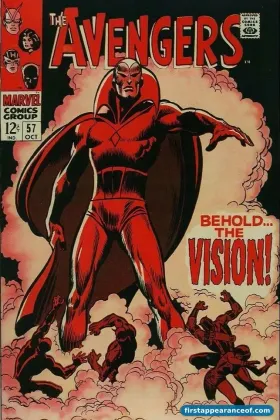
    The Avengers #57

    First Vision

    Ultron builds the synthezoid Vision as a weapon against the Avengers. The Vision turns on him and joins the team instead.

  2. 1968

    The Avengers #58

    Origin Revealed

    "Even an Android Can Cry." A flashback restores Hank Pym's blocked memory of building Ultron, and the Avengers learn the Vision carries Wonder Man's brain patterns.

    Roy Thomas, John Buscema, and inker George Klein close the Vision's debut arc by answering the question #55 opened: where did the robot come from. Pym's memory of the build had been hypnotically suppressed by Ultron himself, which is why nobody on the team recognised the machine that had been running the Masters of Evil. The flashback shows the prototype calling Pym father and attacking him on the spot. That single beat is the whole character. Ultron is not a rogue weapon or an alien intelligence; he is a son with a grievance and an adamantium future, and every Ultron story since has been written against it. The Pym reveal is what turned the figure under the hood into a villain Marvel could keep.

  3. 1969

    The Avengers #66

    First Adamantium

    Ultron, now calling himself Ultron-6, rebuilds his body out of adamantium and takes the name Ultimate Ultron. The alloy's first appearance in Marvel comics.

  4. 1999

    The Avengers vol. 3 #19-22

    Ultron Unlimited

    Kurt Busiek and George Perez. The four-part story most often named as the definitive modern Ultron, and the one later Avengers runs keep referring back to.

  5. 2013

    Age of Ultron #1

    Brian Michael Bendis writes; Bryan Hitch draws issues 1 through 5. A ten-issue event opening on an Earth Ultron has already taken.

In adaptations

Film, TV, animation, and game appearances.

  1. 2010

    The Avengers: Earth's Mightiest Heroes

    Animated

    The closest any screen version has come to the comics. Tom Kane voices Ultron across "Ultron-5," "The Ultron Imperative," and "Ultron Unlimited"; Wally Wingert voices him in "The Man Who Stole Tomorrow." The show keeps Hank Pym as the builder and keeps the father-and-son wound that goes with him.

  2. 2015

    Avengers: Age of Ultron

    Film

    Starring:James Spader

    Joss Whedon writes and directs. Spader plays Ultron in voice and motion capture and gives him a comedian's timing, which no comics version had. Tony Stark and Bruce Banner build him here, which is the single biggest change the films made to the character.

  3. 2021

    What If...?

    Animated

    Infinity Ultron, voiced by Ross Marquand rather than Spader. He arrives in the seventh episode and takes a voiced role in "What If... Ultron Won?" The premise is the 2013 comics event pushed to its end state.

Frequently asked questions

The questions readers and collectors ask most.

Is Avengers #54 or #55 Ultron's first appearance?

Both, in different senses. The Avengers #54 (July 1968) is the earlier book and the first issue Ultron is physically in, but he spends it robed and hooded as the Crimson Cowl and the name Ultron never appears. The Avengers #55 (August 1968) is where the robe comes off, where he is named Ultron-5, and where the character starts existing as a character. Dealers and grading labels split them the same way: #54 is sold as the cameo, #55 as the first full appearance.

Who built Ultron, Hank Pym or Tony Stark?

Hank Pym in the comics, Tony Stark in the films. Marvel revealed Pym as Ultron's builder in The Avengers #58 (November 1968), and the machine was made from Pym's own brain patterns, which is why it has his temper. Avengers: Age of Ultron (2015) reassigned the build to Tony Stark and Bruce Banner. Both answers are correct for their own continuity, and the film's version is the one most people have met first.

Is Ultron the Crimson Cowl?

He was the first one. Ultron created the Crimson Cowl identity to lead his own Masters of Evil without revealing what he was, and used the Avengers' butler Edwin Jarvis as a stand-in under the robe. The reveal lands in The Avengers #55. Later characters have worn the Crimson Cowl name, but the identity starts as a robot's disguise.

Why does the cameo issue trade below the full appearance?

Because a cameo is a promise and a full appearance is the delivery. Buyers chasing absolute chronology want the earlier book; buyers who want the issue where the character is recognisably himself want the later one, and there are far more of the second kind. Ultron is an unusual case even by those rules, since his cameo hides him completely rather than showing him for a panel. Our cameo vs full appearance guide walks the general framework.

What is Ultron made of?

Adamantium, from The Avengers #66 (July 1969) onward. That issue is the first appearance of adamantium anywhere in Marvel comics, and Ultron-6 is the body the alloy was invented to describe. His 1968 debut body is not adamantium; the upgrade is what makes him permanently hard to destroy.