Creation Story
Talia al Ghul was written to be thrown away. Dennis O’Neil said as much to Mike W. Barr in a 1984 Amazing Heroes interview: she “was a lady who was invented” to “serve the needs of that plot and that story, with no thought that she would ever appear again.” The plot was a Detective Comics serial about the League of Assassins, a group DC had introduced in Strange Adventures #215 (December 1968) and named in Detective Comics #405 (November 1970). Dr. Darrk, the League’s first head, was the serial’s running villain. Talia walked in as his hostage.
Her father was an afterthought too. Asked years later about the Ra’s mention in Detective #411, O’Neil could only offer a guess: “If I had to guess, I would say that we plotted the story, and then before it got edited we probably invented Ra’s.” In Batman: Tales of the Demon (1991) he wrote that the Ra’s and Talia design “was never imposed on the material; rather, it emerged gradually as we produced the individual episodes.” The woman who names herself the daughter of Ra’s al Ghul did so before her writer had a Ra’s to show. O’Neil and Neal Adams built him next, for Batman #232, and by O’Neil’s later account they “set out consciously and deliberately to create a villain in the grand manner.” Grant Morrison, writing in Supergods (2011), credited the pair with “two classic and abiding Batman antagonists, in the forms of international crime lord Ra’s al Ghul and his sexy daughter Talia.”
Adams got to her before anyone else did. Bob Brown drew her interior debut, but Adams drew the Detective #411 cover, and, as 13th Dimension frames the sequence, he put her on that cover first and then defined her in Batman #232, so the first Talia readers saw was his. In a 2022 column for the site he described the assignment: “I was given the task of drawing the most beautiful woman in the world. To wit: Talia al Ghul.” His reference points were Sophia Loren, Marilyn Monroe, Raquel Welch, and Senta Berger, and his method was blunter than the brief. “Draw a beautiful woman. Tell people it’s the most beautiful woman in the world and let their imaginations guide them.” The Bronze Age Batman that O’Neil and Adams were building wanted, in Adams’s words, more than “clowns like the Joker.” Talia was the accident that gave it a love interest with a gun.
First Appearance and First Cover: Detective Comics #411
Detective Comics #411 carries a May 1971 cover date and a 15-cent price. The lead story is “Into the Den of the Death-Dealers!”, scripted by Dennis O’Neil, pencilled by Bob Brown, inked by Dick Giordano, and edited by Julius Schwartz. The backup is a Batgirl story, “Cut… and Run!”, by Frank Robbins, Don Heck, and Giordano again on inks. The cover logo is the shared bat-emblem carrying both the Batman and Batgirl names.
The cover is Neal Adams. A sword is the central element, and the DC production department cut a path for the blade through the logo. Talia is a tiny figure in the composition. That is enough to make Detective #411 her first cover as well as her first appearance.
The story opens with Batman climbing the Statue of Freedom, Gotham’s stand-in for the Statue of Liberty, to meet an informant who is offering evidence on Doctor Darrk and the League of Assassins. The trail leads out of the country. Batman, in disguise, follows Darrk across an unnamed Asian country aboard the Soom Express, and once he drops the disguise both he and a mystery woman on the train are taken prisoner. The woman gives her name as Talia, “daughter of he who is called Ra’s-al-Ghul.” Darrk has fallen out with her father and kidnapped her. While the two are held together she learns who Batman is under the cowl.
The finish is hers. Batman and Talia get out of an arena death trap, Darrk tries one last trick, and Talia shoots him; he falls back onto the tracks as the Soom Express comes through. The League’s first head, Doctor Darrk (Ebeneezer Darcel), dies in the issue that introduces her. She is called only “Talia” throughout. No surname.
That is what makes the debut a full first appearance rather than a walk-on. She is named, she speaks, and she decides the plot. Her first ally is Batman and her first enemies are Darrk and the League, which sets the pattern for what follows: Talia on the hero’s side of the frame for reasons of her own.
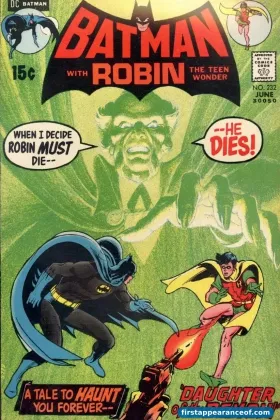
The ordering question is the one collectors ask most. Ra’s al Ghul is mentioned in Detective #411 and never shown; his own first appearance is Batman #232, “Daughter of the Demon,” cover-dated June 1971, one cover month after his daughter. Per DC’s on-sale records as reported by 13th Dimension, Detective #411 went on sale March 30, 1971 and Batman #232 on April 22, 1971, a gap of 23 days. Talia is absent from the #232 cover, which is a giant green Ra’s looming over Batman and Robin, so #411 stays her only cover in the sequence. Among Batman-family first appearances, the daughter beating the father into print by a single cover month is why collectors keep this book on want lists.
Batman #232 is the book that makes her matter, since it introduces Ra’s, sends Batman to Calcutta and the Himalayas on a hunt that turns out to be a test her father staged, and ends with Talia admitting her feelings for Batman. Detective #411 is the book that got her into the story at all. DC issued a Detective Comics #411 Facsimile Edition in 2024 with the Adams cover, so the debut is back on shelves for readers who want the issue without hunting a fifty-year-old copy.