Creation Story
The Red Hood is a name, not a person. DC has handed it to two characters more than half a century apart, and the gap between them is why the search query has three plausible answers instead of one. Get the question right and the issue follows: the name, the man, or the man wearing the name.
The name came first, in 1951, as a throwaway disguise in a Batman mystery. It sat unused for decades. What made it worth reviving was a corpse.
Jason Todd was the second Robin, introduced in 1983 to fill a suit Dick Grayson had outgrown. He was written first as a near-copy of Dick, another circus acrobat cut to the same pattern, and then rewritten after Crisis on Infinite Earths into a street kid Batman caught stealing the Batmobile’s tires. Readers did not warm to either version. In 1988 editor Dennis O’Neil turned that coldness into an event: a 900-number telephone poll, running alongside A Death in the Family, that let the audience vote on whether Jason survived the Joker. They voted to kill him by 72 votes.
That result is the character. Judd Winick’s 2005 return story works because the audience is implicated in it: the readers who dialled the number in 1988 are the reason there was a body to bring back. Winick gave him the Joker’s discarded alias to wear, which turns the helmet into an accusation rather than a costume.
The result is a Bat-family member who argues with the premise of the Bat-family. That is a difficult thing to keep in print for two decades, and DC has managed it by never quite resolving the argument.
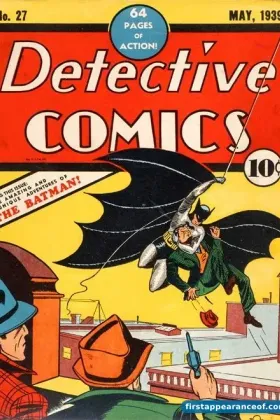
First Red Hood (the Joker's Alias): Detective Comics #168
Detective Comics #168 is cover-dated February 1951 and carries the story “The Man Behind the Red Hood!”. Bill Finger wrote it. Lew Sayre Schwartz and Win Mortimer pencilled, George Roussos inked, Jack Schiff edited.
The story is a cold case. Batman and a group of university students work a decade-old robbery back to its unidentified culprit: a man who wore a red hood over his head to rob the Monarch Playing Card Company, and who escaped Batman by going into a chemical waste basin rather than be caught. He came out of it with green hair, chalk-white skin, and red lips.
That first Joker origin keeps the 1951 issue in collector demand. Alan Moore, Brian Bolland, and John Higgins built Batman: The Killing Joke on it in 1988, loosely adapting the sequence. Finger and Schwartz put the red hood, the card company, and the chemical waste in print thirty-seven years earlier.
Detective Comics #168 introduces a disguise, not an ongoing Red Hood identity. The hood belongs to one Joker-origin story and would not become Jason Todd’s name until 2005. Calling the 1951 issue Jason’s first appearance collapses fifty-four years and two different characters into one row.
First Appearance of Jason Todd: Batman #357
Batman #357 is cover-dated March 1983, written by Gerry Conway with art by Don Newton. Jason Todd debuts here as a circus acrobat, twenty-two years before he becomes Red Hood and before he takes the Robin identity.
The version of Jason introduced here is deliberately familiar: another circus acrobat, built to the Dick Grayson template. Conway was writing a replacement for Dick Grayson, who had aged out of the sidekick role and was on his way to becoming Nightwing. Building the new Robin from the old Robin’s template was the safe choice, and it is the choice that made Jason forgettable.
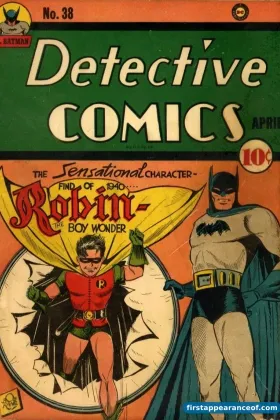
Two issues track the transition after that. Batman #366, cover-dated December 1983, is where Jason puts on the Robin suit for the first time, before Batman has agreed to any of it; collector listings sell that issue as the first Jason Todd in costume. Batman #368, cover-dated February 1984, is where Dick Grayson formally hands the mantle over.
Then Crisis on Infinite Earths reset DC’s continuity and Jason was rewritten from scratch. Batman #408, cover-dated June 1987, by Max Allan Collins and Chris Warner, throws out the circus entirely: Batman finds a kid stripping the tires off the Batmobile and takes him in. The title was branded “Batman: The New Adventures” from that issue forward to flag how much had changed. The street-kid Jason is the version that dies a year later, and the version the Red Hood is built on.
For a collector, Batman #357 is the anchor book of that whole sequence. Every later Jason Todd key, the death and the resurrection both, points back to it.
First Appearance of Jason Todd as the Red Hood: Batman #635
Batman #635 is cover-dated February 2005 and opens “Under the Red Hood, Part One.” Judd Winick wrote it, Doug Mahnke pencilled it. This is the issue almost every search for the first appearance of the Red Hood is actually looking for.
Winick’s structure withholds the reveal. A masked figure in a red helmet moves on Gotham’s criminal underworld and takes it over rather than shutting it down, working from a knowledge of Batman’s methods that nobody outside the family should have. Readers were meant to spend three issues guessing. The answer arrives in Batman #638, cover-dated May 2005, when the helmet comes off and it is the dead Robin.
The full arc runs Batman #635 to #641 and #645 to #650, plus Batman Annual #25, from February 2005 to April 2006, with a hiatus between August and November 2005. Mahnke drew most of it; Eric Battle and Shane Davis pencilled the rest.
What makes #635 the key rather than #638 is what the market has decided the book is. #638 is the reveal; #635 is the first appearance, and first appearance is the category collectors and grading services index on. It is also the better issue to own on the merits, because the premise, a man in the Joker’s old hood running Gotham’s crime rather than fighting it, is present from the first pages.
The 2010 animated adaptation, which Winick scripted himself, is why the story has a readership well outside comics. If someone knows the Red Hood from anything, they know him from the film, and the film is this arc.
Detective Comics #168 vs Batman #357 vs Batman #635
Three books, three different questions, and the reason this page exists:
| Detective Comics #168 | Batman #357 | Batman #635 | |
|---|---|---|---|
| Cover date | February 1951 | March 1983 | February 2005 |
| Creators | Bill Finger, Lew Sayre Schwartz | Gerry Conway, Don Newton | Judd Winick, Doug Mahnke |
| What is first here | The Red Hood name | Jason Todd the character | Jason Todd as the Red Hood |
| Who wears the hood | The pre-chemical-bath Joker | Nobody | Jason Todd |
| Appearance type | The name as a one-story disguise | Full appearance, out of costume | Full appearance, in the helmet |
| Collector shorthand | Golden Age Joker origin key | First Jason Todd | First Jason Todd as Red Hood |
| The query it answers | ”Who was the first Red Hood?" | "What is Jason Todd’s first appearance?" | "What is the Red Hood’s first appearance?” |
Batman #357 is Jason Todd’s debut. The Red Hood identity begins twenty-two years later in Batman #635. Listings that call #357 the first Red Hood have substituted the character’s debut for the identity’s debut.
Collectors after Jason Todd’s own debut chase Batman #357. Those after the Red Hood chase Batman #635, usually with #638 for the reveal. Detective Comics #168 sits at the front of the whole thread as a Golden Age Joker key that happens to carry the name.
First Title Headlining the Red Hood: Red Hood and the Outlaws #1
Red Hood and the Outlaws #1 is cover-dated November 2011, written by Scott Lobdell with art by Kenneth Rocafort and colors by Blond. It launched as part of DC’s New 52 relaunch and ran to 2015.
The book put Jason with Roy Harper, better known as Arsenal, and Starfire.
What the title did for the character is more useful than what it did for the stories. Before 2011 the Red Hood was an antagonist who visited the Batman books. After 2011 he had a monthly, a supporting cast, and a place in the line, which is the difference between a storyline and a franchise. By the time Gotham Knights made him one of four playable leads in 2022, he was as load-bearing as Nightwing.
For collectors the 2011 first issue is an accessible modern key: the first ongoing series with the Red Hood name on the cover. It sits well behind Batman #635 in demand but is far easier to find than Detective Comics #168.
Jason Todd’s thread runs through most of the first-appearance archive here: Batman took him in, the Joker killed him, Robin is the suit he wore, and Nightwing is the man he replaced. The cameo-versus-full logic that sorts issues like these is covered in the true first appearance guide.