Creation Story
Every other Marvel hero of the era works for free. That is the quiet argument Hero for Hire #1 makes, and it is the one original thing in a book assembled from borrowed parts. Stan Lee wanted a character built on the blaxploitation films that were making money in 1971 and 1972, with Shaft and Super Fly named as the direct models. Lee and Roy Thomas worked up the premise together, and the structural idea came out of it: a hero who asks to be paid. Thomas also went back to Philip Wylie’s 1930 novel Gladiator to work out what unbreakable skin should do.
Archie Goodwin wrote the first four issues. George Tuska pencilled and became the series’ main artist. John Romita Sr. designed the costume and pulled Cage away from the movie-poster shorthand of the original pitch.
The credit that deserves more attention than it usually gets belongs to Billy Graham. He was the only Black artist working at Marvel at the time, and he was brought onto the book, in the plain wording of the record, to make sure that Tuska’s African-American characters looked African-American. A company launching a comic about a Black hero had exactly one Black artist to call, and his job on the book included fixing what his colleagues could not draw. Graham inked the debut issue and stayed with the title.
What the creative team produced is stranger than the genre it copied. The blaxploitation surface is loud and dated. Underneath it is a premise no other superhero comic had tried: a man the justice system stole years and a life from decides that saving people is labor, and labor has a price. Cage does not fight crime because a butler told him to. He does it because it is the only marketable skill he came out of prison with. Five decades of writers have tried to talk him out of it, and the character keeps handing them the bill.
First Appearance and First Cover: Hero for Hire #1
Hero for Hire #1 is cover-dated June 1972 and cost 20 cents. The story is “Out of Hell—a Hero!”, written by Archie Goodwin, pencilled by George Tuska, inked by Billy Graham, with a cover by John Romita Sr. The indexes file the series as Hero for Hire; the logo on the cover reads Luke Cage, Hero for Hire. Listings use both forms.
For collectors this is the simplest possible shape. First appearance, first cover, and complete origin, all in issue one, with no earlier cameo to argue about. If you arrived here from the true first appearance guide, there is nothing to disambiguate.
The origin runs on betrayal rather than accident. Carl Lucas and Willis Stryker grew up together in Harlem and both wanted the same woman, Reva Connors. When she chose Lucas, Stryker planted drugs in his home. The drugs belonged to the Maggia, Reva was killed in the fallout, and Lucas went to Seagate Prison for a crime committed against him. Inside, Shades and Comanche tried to pull him into their gang and he fought both of them off. He volunteered for an experiment meant to accelerate healing; a racist guard tampered with the equipment mid-procedure; and the sabotage gave him unbreakable skin and superhuman strength instead. He broke out, walked into New York under the name Luke Cage, and put up a shingle.
Three characters debut alongside him. Willis Stryker, who returns as Diamondback, is the first and most personal antagonist a Marvel hero had been given in a while: not a scientist with a ray, but the friend who did this to him. Shades and Comanche both start here too, and both outlive the run.
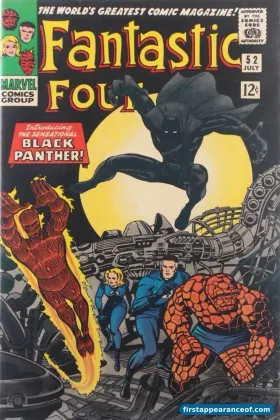
Most summaries of this book get the record wrong. Cage is not the first Black superhero. Black Panther beat him to print by six years in Fantastic Four #52, July 1966, and the Falcon in Captain America #117, September 1969. Cage is not even the first Black character to headline a comic book; Dell published Lobo #1 in December 1965, by Don Arneson and Tony Tallarico, starring a Black gunslinger in the Old West, and distributors in parts of the country refused to carry it. It was cancelled after two issues. What Cage holds is the record that sits between those two: the first Black superhero to lead his own ongoing Marvel series.
The distinction matters because leading a book is a different commercial decision from joining a team, and the dates show how much later Marvel was willing to make it. Black Panther debuted in 1966 and did not headline a feature of his own until Jungle Action in 1973, more than a year after Hero for Hire #1. He did not get a series carrying his own name until Black Panther #1 in January 1977, almost five years after Cage’s book launched. Cage got the lead slot first. Whether that says more about the character or about which genre Marvel thought would sell in 1972 is a fair question, and the answer is probably the genre. It is still the record.
First Issue Titled Power Man: Power Man #17
Power Man #17 is cover-dated February 1974 and cost 20 cents. Len Wein wrote it, Tuska and Graham handled the art, and Gil Kane drew the cover. The story is “Rich Man: Iron Man, Power Man: Thief!”, in which someone posing as Tony Stark’s representative hires Cage to test security at Stark International, which goes exactly as badly as that sounds until the two heroes work out they have been played.
The logo makes this issue a collector first. Same series, same numbering, new name: this is the first issue published as Power Man. The rename came from the Black power movement and was, reportedly, an attempt to move more copies. The Hero for Hire title never came back, though the phrase stayed welded to the character and is still the first thing most readers can tell you about him.
The swap traded a name describing what Cage does for a name describing what he is. Every writer since has pulled him back toward the job anyway, which suggests the original title was the better read on the character.
First Issue Titled Power Man and Iron Fist: Power Man and Iron Fist #50
Power Man and Iron Fist #50 is cover-dated April 1978 and cost 35 cents. Chris Claremont wrote it, with art by John Byrne and Dan Green. Cage has finally cleared his name and is a free man for the first time in the series. He and Danny Rand take on the assassins Stiletto and Discus, with the Daughters of the Dragon guest starring, and the book carries both their names from here.
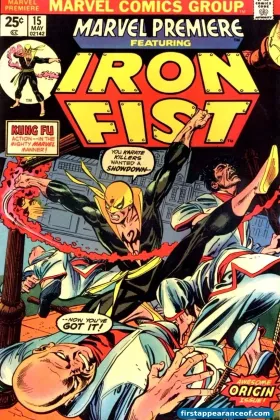
Marvel folded two solo books into one, and the result outlived whatever the accounting reason was. Iron Fist had debuted four years earlier in Marvel Premiere #15 as a kung-fu import, and pairing a martial artist with a man who cannot be cut produced one of the cleanest buddy setups Marvel ever built. Neither character has escaped it since, and neither has wanted to.
The merge also fixed a structural problem with Cage. A hero for hire needs a new client every issue, and clients wear out fast as a plot engine. A permanent partner replaced the client with a relationship. Everything modern readers know about Cage, the marriage, the Avengers membership, the Netflix run, runs through the book that merge created.
The rest of the era’s Marvel keys sit on the Bronze Age hub and the Marvel publisher hub, and the wider first appearance database tracks how many other characters share this pattern of surviving on someone else’s book.