Creation Story
Lion-O was built around a contradiction: he looks like the strongest adult in the room, but he begins the story as a child who has not learned how to lead. During the ThunderCats’ voyage from the dying planet Thundera, he physically grows into an adult while his judgment is still catching up.
That idea gives the series its engine. Tobin Wolf created ThunderCats, and head writer Leonard Starr turned the premise into the animated world introduced by “Exodus.” Larry Kenney supplied the voice that made Lion-O sound commanding even when the character was unsure. The Sword of Omens and Eye of Thundera provide the iconography, but the gap between Lion-O’s appearance and experience gives him a story.
The comics did not invent him. Marvel’s Star Comics line translated an already-screened character to print later in 1985. That order matters whenever a collector asks for Lion-O’s first appearance: the earliest answer is an episode, while the collectible comic answer is ThunderCats #1.
Animated Debut: ThunderCats, “Exodus”
“Exodus” first aired January 23, 1985. Some listings use September 9, because that date marks the start of the regular weekday syndicated run, but the January pilot broadcast is the earlier public appearance and the one that puts Lion-O on screen first.
Tobin Wolf created ThunderCats, and head writer Leonard Starr wrote “Exodus” and shaped its world. Larry Kenney gave Lion-O a commanding voice before the character had the judgment to match it. The audience meets a leader who looks ready years before he feels ready.
The episode introduces Lion-O before the familiar adult version is fully formed. He is the young heir among the Thunderians fleeing their doomed planet Thundera. During the voyage to Third Earth, he grows to adult size inside his suspension capsule while the younger ThunderKittens do not, and he arrives as the new Lord of the ThunderCats with adult strength and a child’s incomplete preparation for command. Starr’s script establishes the pieces the franchise would reuse for decades: the Sword of Omens, the Eye of Thundera set into its hilt, the team that looks to Lion-O, and the burden of leadership he inherits before he is ready for it.
“Exodus” supplies a complete origin. The Sword of Omens is already Lion-O’s defining weapon, with the Eye of Thundera set in its hilt as the source of the team’s power. Jaga, Panthro and Mumm-Ra arrive fully formed. The first broadcast also establishes the tension every later version reworks: a young lord growing into a title his body says he already deserves.
ThunderCats began as animation. Lion-O entered the culture through a television screen, and every later version works from the character “Exodus” created. His earliest appearance is an episode; the comic followed.
First Comics Appearance: ThunderCats #1
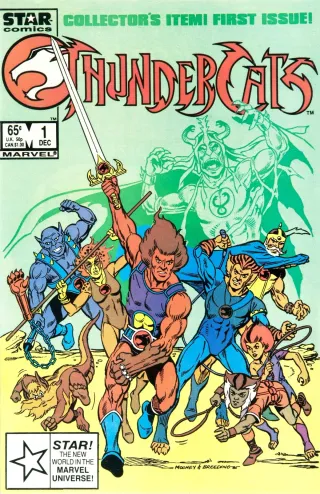
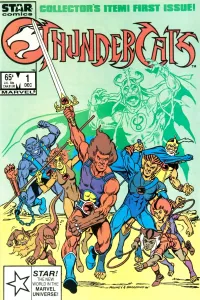
ThunderCats #1 carries a December 1985 cover date and was published by Marvel’s Star Comics imprint. David Michelinie adapted Leonard Starr’s original screenplay, Jim Mooney pencilled the story, and Brett Breeding inked it. The issue retells “Exodus,” so the story beats arrive after the animated version even though the medium changes.
This is the issue comic collectors mean when they call a book Lion-O’s first appearance. It puts him in an American comic for the first time and begins Marvel’s licensed ThunderCats series. Star Comics continued the run into ThunderCats #2 later in 1985 and #3 in 1986, but #1 is the one that opens the character’s comics history. It is also the anchor for everything that followed on the page: WildStorm relaunched the license with its own ThunderCats #1 in 2002, and Dynamite began a new ongoing in 2024. Each of those is a fresh #1, which is exactly why collectors are careful to name the Marvel/Star Comics issue as the first.
Medium settles the distinction. “Exodus” created Lion-O, while ThunderCats #1 brought him into American comics later that year.
Animated Debut vs Comics Debut: Which Is Lion-O's First?
“Exodus” is Lion-O’s first appearance because audiences saw it in January 1985. ThunderCats #1 is his first comics appearance and the physical issue comic collectors track. Neither label needs to erase the other: the episode answers when the character debuted, while the comic answers when he first reached the printed page.
| Animated debut | Comics debut | |
|---|---|---|
| Date | January 23, 1985 | December 1985 cover date |
| Appearance type | Full television debut in “Exodus” | Full American comics debut |
| On a collectible cover? | No episode-specific cover; the season DVD is the packaged artifact | Yes, on ThunderCats #1 |
| Character exposure | Lead character throughout the pilot | Lead character in the comic adaptation |
| Collector significance | Earliest packaged artifact containing the true debut | First printed American comic appearance |
The two dates also resolve the cartoon confusion. September 9, 1985 marks the regular weekday launch, but the pilot aired in January. The comic’s December cover date leaves Lion-O firmly animation-first, with a later licensed-comic key.
The Lord of the ThunderCats
The Sword of Omens can summon the ThunderCats. It cannot make Lion-O mature. Again and again, he has to turn raw certainty into earned leadership.
The 2011 series and ThunderCats Roar each reworked that setup for a new audience, but the core stays fixed: a young lord who carries the Sword of Omens and has to grow into command while leading his team to a new home on Third Earth. That consistency is why a character created for a syndicated cartoon can still anchor a new comics line and a feature-film announcement four decades later.