Creation Story
Kraven the Hunter wants nothing Spider-Man can hand over. He hunts him as sport, and that motive is the entire character. The setup reads as the old “Most Dangerous Game” premise relocated into a superhero book: a hunter whose next quarry has to be a man.
Stan Lee and Steve Ditko created him for a Marvel book that had been minting new villains since its first issue, and Kraven stood out in that crowd by wanting less than any of them. The man doing the hunting is Sergei Kravinoff, a Russian immigrant, the son of an aristocrat whose family fled the country after the Revolution.
His edge comes out of a bottle: a potion brewed from jungle herbs that grants superhuman strength, speed, and senses. The potion supplies the power; the signature is the method. Kraven prefers to take his prey with his bare hands.
The concept aged into the character’s best material. Twenty-three years after the debut, J.M. DeMatteis, Mike Zeck, and Bob McLeod took the motive seriously enough to finish it: Kraven’s Last Hunt, the 1987 six-parter, ends with the hunter convinced he has finally won, and refusing to outlive the victory.
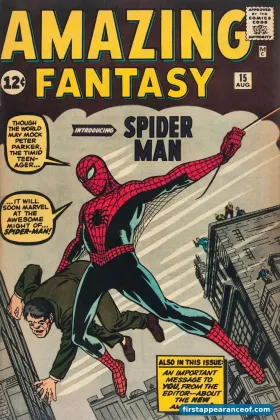
First Appearance: The Amazing Spider-Man #15
The Amazing Spider-Man #15 carries an August 1964 cover date and a 12-cent cover price. The debut story runs under the new villain’s own name, “Kraven the Hunter”: Stan Lee scripted it, Steve Ditko pencilled and inked it and drew the cover, Art Simek lettered, and Stan Goldberg colored. Kraven is the title, the antagonist, and the engine of the plot. There is no cameo to argue over, no earlier mention, no competing issue: as Silver Age keys go, the claim is unusually clean.
Collectors file the book as a top-tier Silver Age Spider-Man key, and three things carry that status. It is the first appearance of Kraven the Hunter. The Chameleon, who debuted in The Amazing Spider-Man #1 (March 1963), returns. And Aunt May’s blind-date subplot slips in the first mention of Mary Jane Watson: Peter’s prospective date is “the niece of their neighbor, Mrs. Watson,” unnamed and unseen on the page. A mention, not an appearance, and collectors are precise about that difference. The issue also caps the villain-debut run of The Amazing Spider-Man #1 through #15, a spine of Silver Age first appearances.
The story gives the hunt a sponsor. The Chameleon summons his old friend Kraven to destroy Spider-Man, and Kraven opens the way a hunter opens: he studies his prey, watches Spider-Man work, and takes his measure before committing to the kill. Then the trap: a paralyzing potion that leaves Spider-Man with shaking hands, backed by a set of magnetic bracelets. The strength behind the bare hands gets its own origin in the issue: a potion Kraven stole from the witch doctor of a hidden African tribe. None of it is enough. Spider-Man outmaneuvers him, both villains are captured, and the story closes on Kraven and the Chameleon deported. For a villain debut, the portrait is complete: the pride, the preparation, the bare-hands code, and a loss that leaves the hunter alive for a rematch.
The rematch came fast. The Amazing Spider-Man Annual #1, dated 1964, already has Kraven answering Doctor Octopus’s recruitment call as a founding member of the Sinister Six, within months of his debut by cover date. Kraven lost his first hunt and got promoted anyway.
One relationship in the 1964 story reads differently now than it did on the stands. The story presents the Chameleon as Kraven’s old friend, and that is as far as it goes. Current canon makes the Chameleon, Dmitri Smerdyakov, Kraven’s half-brother; the kinship was written in during the 1990s, three decades after the two debuted. SpiderFan’s issue-cited history places the half-brother reveal in Sensational Spider-Man Annual ‘96, with The Amazing Spider-Man #389 and Spectacular Spider-Man #241 and #244 carrying the surrounding family backstory.