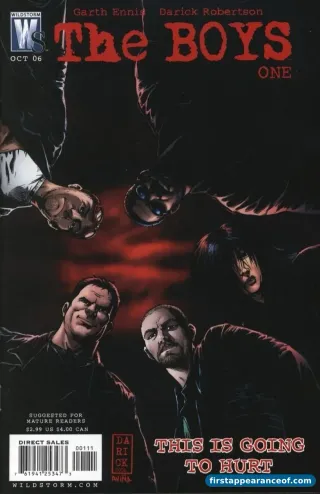
The Boys #1 (2006). Homelander on the cover, the film-genre-satirical superhero antagonist.

1st Appearance and 1st Cover

First Appearance of Homelander

The Boys #1

October 2006 · Independent · Modern Age

Garth Ennis's satirical Superman. Corporate-engineered propaganda product, The Boys's recurring antagonist, and the Amazon Prime TV character who made 'evil Superman' a mainstream genre.

Key Issue

Created by Garth Ennis · Darick Robertson

By Atomm Updated

The first appearance (1st app) of Homelander is The Boys #1 (October 2006), created by Garth Ennis and Darick Robertson. The character is a genetically-engineered superpowered corporate asset positioned as the leader of The Seven, Vought-American's corporate-Justice-League analog. The 72-issue The Boys ran from 2006 to 2012. The Amazon Prime Video adaptation (2019 forward) with Antony Starr as Homelander reset the character's cultural visibility at scale and established him as one of the most recognizable superhero-satirical figures of the 2020s.

Quick Facts

Debut
The Boys #1 (October 2006)
Real name
John (no surname canonically; Homelander was produced by Vought-American corporate genetic engineering)
Creators
Garth Ennis (writer, co-creator), Darick Robertson (artist, co-creator)
Publisher
Dynamite Entertainment (original DC WildStorm imprint launch; moved to Dynamite with issue #7)
First enemy
Billy Butcher (his primary antagonist across the run)
First ally
Queen Maeve (member of The Seven, Homelander's teammate and former lover), Vought-American (his corporate sponsors)
Team affiliations
The Seven (Vought-American's Justice-League analog, as team leader)

First Appearance

  1. The Boys #1 cover
    First Appearance First Cover October 2006

    The Boys #1

    By Garth Ennis, Darick Robertson

    Garth Ennis writes; Darick Robertson pencils. The Boys #1 was originally a WildStorm imprint title under DC but moved to Dynamite Entertainment with issue #7 after DC dropped the book over its political content. Homelander is the book's primary antagonist from the debut through the series' conclusion.

    Read the full breakdown

Creation Story

Homelander is the primary antagonist of Garth Ennis and Darick Robertson’s The Boys, a satirical critique of corporate superhero franchises that ran 72 issues from October 2006 through November 2012. Ennis had been developing the concept for years; the character and the book were positioned as his most direct broadside against mainstream superhero publishing, which he had been openly critical of during his Hellblazer, Punisher, and Preacher work.

The Boys #1 (October 2006) launched at DC under the WildStorm imprint. Homelander appears on the cover and is introduced as the team leader of The Seven, a Vought-American-corporation-sponsored superhero team that structurally parallels DC’s Justice League: Starlight as a Wonder Woman analog, A-Train as a Flash analog, Black Noir as a Batman analog, Queen Maeve as a Wonder Woman-adjacent figure, and Homelander as a Superman analog. The parallel is deliberate and explicit.

DC published six issues under WildStorm and then dropped the book in early 2007 over concerns about its political framework and its critique of the Justice League analog. Dynamite Entertainment picked up the book with issue #7 and published the remainder of the run. The publishing transition is unusual in modern mainstream comics; The Boys is one of very few titles that has shifted between major publishers mid-run.

The satirical framework

Ennis’s Homelander is deliberately designed as the worst version of Superman. Corporate-engineered rather than naturally born. Emotionally hollow rather than morally grounded. Propaganda-branded rather than genuinely heroic. Abusive toward his teammates, sexually predatory toward the public, and psychologically unstable under his public image. The character is the book’s structural argument: that if actual superhumans existed under corporate management, they would be catastrophically bad for everyone.

The satirical framing has been preserved across the entire run and the Amazon adaptation. The book does not redeem Homelander; his trajectory is downward, and his eventual fate is the payoff for the reader’s 72-issue commitment.

The Amazon era

The Boys on Amazon Prime Video, developed by Eric Kripke starting in 2019, has run four seasons through 2025 with a fifth and final season scheduled for 2026. Antony Starr’s performance as Homelander is widely regarded as one of the defining television villain performances of the 2020s; the character’s cultural visibility at scale is entirely a function of the show rather than of the comics.

The Amazon adaptation drove substantial collector interest in The Boys #1. Prices on the first print have risen steadily with each subsequent season.

Collector context

The Boys #1 is the Homelander key. High-grade CGC 9.8 copies have crossed $1,500 at auction. First-print copies of the WildStorm imprint version (issues #1 to #6) and the Dynamite-imprint continuation (#7 onward) are distinct collector targets; the WildStorm variant has greater scarcity because of the shorter run before DC dropped the book.

Secondary keys: The Boys #7 (first Dynamite-imprint issue). The Boys Presents: Herogasm #1 (2009) is a spin-off mini-series first. The Boys #66 and #72 are arc-conclusion keys for collectors targeting the book’s structural climax.
Key subsequent appearances

After the debut, these are the issues collectors and historians reach for next.

  1. 2006

    The Boys #1

    First appearance.

  2. 2009

    The Boys #30

    Herogasm

    Herogasm six-issue arc. Homelander as central figure. Widely reproduced as the book's peak moment of superhero-satire.

  3. 2011

    The Boys #66

    Over the Hill with the Swords of a Thousand Men

    Homelander's Washington D.C. attack arc, the book's climax.

  4. 2012

    The Boys #72

    Final Issue

    The Boys concludes. Homelander's fate is resolved.

In adaptations

Film, TV, animation, and game appearances.

  1. 2019

    The Boys

    TV

    Starring:Antony Starr

    Amazon Prime Video series. Eric Kripke showruns. Starr's performance as Homelander is widely regarded as one of the defining television villains of the 2020s. Four seasons through 2025, fifth and final season scheduled for 2026.

  2. 2022

    The Boys Presents: Diabolical

    Animated

    Animated anthology series. Homelander appears in several shorts.

Frequently asked questions

The questions readers and collectors ask most.

What is Homelander's first appearance?

Homelander's first appearance is The Boys #1 (October 2006), created by Garth Ennis and Darick Robertson. The issue is his first appearance and first cover. The Boys was originally a DC WildStorm imprint title but moved to Dynamite Entertainment with issue #7 after DC dropped the book over its political content.

Is The Boys #1 valuable?

Yes, substantially. The Boys #1 is one of the most traded modern-era Dynamite keys. High-grade copies (CGC 9.8) have crossed $1,500 at auction. The book's value accelerated sharply with the 2019 Amazon Prime Video adaptation and has continued to rise through multiple seasons of the show. The WildStorm/DC-cover first-print variant and the Dynamite re-release from issue #7 onward are distinct collector targets.

Why did DC drop The Boys?

The Boys is explicitly a critique of corporate superhero franchises. DC published the first six issues under the WildStorm imprint in 2006 but dropped the book in 2007 over concerns that its political framework and its explicit satirizing of DC's own Justice League framework were commercially awkward for the publisher. Dynamite Entertainment picked up the book with issue #7 and published the remainder of the 72-issue run. The DC-to-Dynamite transition is a unique editorial event in modern mainstream comics.

Is Homelander a Superman parody?

Explicitly. Garth Ennis designed Homelander as a satirical inversion of Superman: the corporate-engineered, flag-draped, all-American superhero who is hollow, abusive, and genuinely dangerous. The Seven (Homelander's team) maps directly to the Justice League: Starlight is Wonder Woman, A-Train is Flash, Black Noir is Batman, Queen Maeve is Wonder Woman-adjacent. The parallel is not subtle; Ennis has discussed the framing openly in interviews. The satirical framework is the book's primary thesis: that corporate superheroes would be the worst people alive if they existed.

Is the Amazon show faithful to the comics?

The Amazon adaptation is substantially more faithful than most comics-to-TV translations. Eric Kripke has preserved the core Ennis-Robertson satirical thesis, kept the Homelander-as-unhinged-propaganda-asset framing, and escalated the corporate-critique elements that work well in live-action. The show diverges on specific plot details and introduces characters and arcs not in the comics, but the core character positioning is faithful. Antony Starr's performance is widely regarded as one of the most acclaimed television villain performances of the 2020s.