Creation Story
The Falcon exists because Gene Colan asked for him. “I approached Stan, as I remember, with the idea of introducing an African-American hero and he took to it right away,” Colan recalled years later. Stan Lee scripted the result as writer-editor, Colan drew it, and Joe Sinnott inked it.
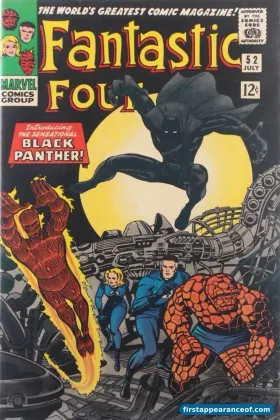
Colan was pitching into a specific gap. Black Panther had debuted in Fantastic Four #52 (1966) as the first Black superhero in mainstream American comics, but T’Challa is African, the king of Wakanda. The rest of Marvel’s Black characters were supporting cast. Sam Wilson became the first African-American superhero in mainstream comics: the second Black superhero to debut in a mainstream monthly publication, following Marvel’s Black Panther, and the first who was American.
Marvel itself has drawn the line the same way. “The Falcon was the very first African-American super hero, as opposed to The Black Panther, who preceded him, but wasn’t American,” as Tom Brevoort, then Marvel’s Senior Vice President of Publishing, put it in a 2011 Marvel.com piece.
The Sam Wilson of those early years is a social worker from Harlem, a clean-cut professional whose one companion is a trained bird. The wings, the Avengers membership, and the shield were all still years out.
First Appearance: Captain America #117
Captain America #117 carries a cover date of September 1969, a 15-cent price, and the story title “The Coming of… the Falcon!” Lee is the writer-editor, with Colan on pencils, Sinnott on inks, and Sam Rosen on letters. The cover is credited to Colan and Sinnott on the Heritage Auctions listing for the original art. That date puts #117 in the closing months of the Silver Age, which makes it one of the last major first appearances of the era.
The story opens with Captain America already beaten. The Red Skull, holding the Cosmic Cube, has swapped bodies with him and banished him to the Isle of Exiles, home base of the Exiles, the Skull’s betrayed ex-henchmen. Marooned there and wearing his enemy’s face, Cap meets a man who came to the island with a trained falcon named Redwing; he had answered an ad for a hunting falcon. Cap suggests a costumed identity, and the Falcon is born.
The newcomer is introduced in #117 and named Sam Wilson by #118. The debut opens a three-issue arc that runs through #119 with the same Lee, Colan, Sinnott, and Rosen credits. In #118, Cap, still disguised, trains Sam and puts him in the costume, and the two rally the islanders against the Exiles. In #119, Sam learns the man who trained him is Captain America, and the Cosmic Cube fails the Skull at the decisive moment.
The Falcon on these pages is easy to misremember through fifty years of hindsight. He wears his original green costume; the red-and-white suit arrives in Captain America #144 (December 1971). And he cannot fly. The wings, jet-powered gliders designed by Black Panther with Wakandan tech, come in 1974’s Captain America #170. For his first five years, the Falcon is a superhero who fights on foot.
The partnership the arc sets up becomes the book itself. Cap and the Falcon formally become partners in Captain America #133 (cover date January 1971), and from #134 the series is cover-billed Captain America and the Falcon, a billing it holds through most of #134-222 (1971-1978). That kept Sam’s name on a flagship Marvel title for most of a decade. He joined the Avengers in 1979.
As a collectible, #117 is the defining Falcon key, the 1st app everything else about the character points back to, and a top-tier late-Silver-Age Marvel key. High-grade copies are scarce. Marvel issued a facsimile edition in 2021.
First as Captain America: All-New Captain America #1
Sam Wilson had been the Falcon for 45 years when the shield changed hands. The setup came in 2014, when Steve Rogers lost the super-soldier serum and aged rapidly. Marvel announced the succession in July 2014 on The Colbert Report, and on the page Steve named Sam the new Captain America in Captain America vol. 7 #25 (cover date December 2014).
Sam’s own series followed. All-New Captain America #1, by Rick Remender and Stuart Immonen, launched in November 2014 under a January 2015 cover date as part of Marvel’s Avengers NOW! relaunch. The issue gets filed under both years for that reason; the timeline uses the cover date, as it does for #117.
Three issues into the run, Remender closed out a forty-year-old story problem. Captain America #186 (cover date June 1975), written by Steve Englehart, had asserted that Sam’s social-worker past was fabricated: that he had really been “Snap” Wilson, a mob-connected criminal from Los Angeles, and that the Red Skull had used the Cosmic Cube to implant the clean identity as a trap to spring on Cap. Those were the story’s claims. All-New Captain America #3 (2015) inverted them: the criminal past was the false implant, a racist smear the Skull manufactured, and the social-worker life is Sam’s true history.
The mantle era ran on from there. The ongoing starring Sam Wilson as Captain America launched in October 2015, written by Nick Spencer with Daniel Acuña. Steve Rogers eventually resumed the role and Sam returned to the Falcon identity, then took up the shield again in 2021’s The United States of Captain America.
Marvel staged the same handoff on screen. Anthony Mackie’s Sam Wilson debuted in Captain America: The Winter Soldier (2014), received the shield from an aged Steve Rogers at the end of Avengers: Endgame (2019), accepted the mantle in the 2021 finale of The Falcon and the Winter Soldier, the Disney+ series he co-headlines with Bucky Barnes, and passed the Falcon identity to Joaquin Torres. Captain America: Brave New World (2025) gave Mackie his first film billing as Captain America. As of September 2026, he is set to reprise the role in Avengers: Doomsday, scheduled for December 18, 2026, with Avengers: Secret Wars to follow in 2027.