Creation Story
Clayface is not one character. It is a name, passed down a line of villains for more than eighty years, which is exactly why the “first appearance of Clayface” question has two right answers. The name starts with Batman himself, in the Golden Age, and it belongs to a deranged actor. The shapeshifting mud-monster that the name now conjures came two decades later and was a completely different man.
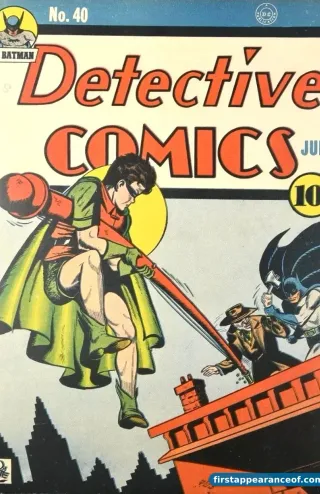
The first Clayface, Basil Karlo, was created by Bill Finger and Bob Kane in Detective Comics #40 (June 1940), barely a year into Batman’s own run. Karlo is a horror-film actor who snaps when he learns his old movie is being remade without him, and starts murdering the new production’s cast and crew while dressed as his most famous role, a villain called Clayface. He has no powers at all. He is a man in a costume with a grudge, which makes him a very early example of Batman’s “broken performer” rogues, the same well that later produced the theatrical side of the Joker and Two-Face.
The Clayface people actually picture, the one made of living clay who can become anyone, arrived in 1961 and is the reason this page is built the way it is. The 2026 DC Studios film uses that version, Matt Hagen, so the page has to answer both the name’s true first appearance and the film character’s first appearance, because they are not the same book.
First Appearance (Basil Karlo): Detective Comics #40
Detective Comics #40 is a genuine Golden Age Batman key. It is the first appearance of Clayface as a name and as a concept, even though the Basil Karlo of 1940 looks almost nothing like the modern character. This is the book that matters if the question is strictly “when did Clayface first appear,” and the answer is unambiguous: June 1940, in an early Bill Finger and Bob Kane story.
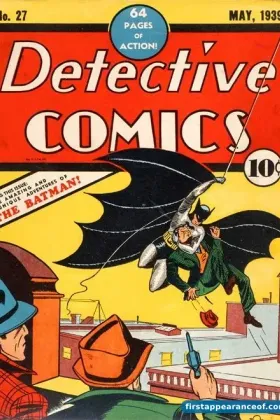
As a collectible it sits in the most desirable stretch of Detective Comics, the run of early issues close to Batman’s own 1939 debut in #27. High-grade copies of any Detective Comics issue from 1940 are scarce and expensive, and #40 carries the added significance of a first villain appearance in a line of comics where first villain appearances drive enormous demand. Karlo’s long second life, returning across the decades and eventually being rewritten as an actual clay shapeshifter, keeps interest in his debut alive in a way that a one-off Golden Age villain would never sustain.
First Appearance (Matt Hagen): Detective Comics #298
Detective Comics #298 (December 1961) introduces Matt Hagen, and this is the Clayface the rest of the culture remembers. Bill Finger, returning to the name he created, worked with artist Sheldon Moldoff to invent a new origin built for the Silver Age: Hagen is a treasure hunter who falls into a hidden pool of radioactive protoplasm and emerges able to reshape his own body into any form. The clay-monster powers, the melting features, the becoming-anyone trick, all of it starts here.
For collectors, #298 is the key that has tracked the character’s screen popularity most closely, because it is the first appearance of the version every adaptation uses. The 1992 animated series, the games, and the 2026 film all build on Hagen rather than Karlo. That makes Detective Comics #298 the “movie first appearance” in the same way that a modern adaptation can turn a mid-run Silver Age issue into a sought-after book. It is a far more affordable entry point than the 1940 Karlo debut, and for many buyers it is the more meaningful one, because it is the first appearance of the Clayface they actually know.
Basil Karlo vs Matt Hagen
The two debuts answer two different questions, which is why both are real keys.
| Detective Comics #40 | Detective Comics #298 | |
|---|---|---|
| Year | June 1940 | December 1961 |
| Character | Basil Karlo | Matt Hagen |
| Creators | Bill Finger, Bob Kane | Bill Finger, Sheldon Moldoff |
| Powers | None; a costumed killer | Shapeshifting clay body |
| Why it matters | The true first Clayface | The version adapted on screen, including the 2026 film |
If the question is “what is the first appearance of Clayface,” the answer is Detective Comics #40. If the question is “what is the first appearance of the Clayface in the movie,” the answer is Detective Comics #298. A collector buying around the 2026 film should know which one they actually want, because the price gap between a 1940 Golden Age Batman key and a 1961 Silver Age issue is large.
The other Clayfaces
The name kept moving after Hagen. Preston Payne, the third Clayface, debuts in Detective Comics #478 (1978) as a scientist whose touch melts living flesh, a genuinely grim body-horror twist that the 2026 film’s tone seems to echo. Sondra Fuller followed in the 1980s, and a story called the Mud Pack eventually gathered the various Clayfaces into a single group, cementing the idea that Clayface is a lineage rather than a person.
The most interesting modern turn belongs to the original. In Detective Comics #934 (2016), writer James Tynion IV pulled Basil Karlo onto Batman’s own team during the Rebirth relaunch, training the would-be-reformed villain alongside Batwoman, Red Robin, Spoiler, and Orphan. It recast the first Clayface as a tragic figure fighting his own nature, and that sympathetic, body-horror framing is the thread the DC Studios film picks up. If you are tracing the character through this first-appearance archive, the line runs from Karlo’s 1940 debut to Hagen’s 1961 powers to the modern, sympathetic Clayface the movie is built to sell.